

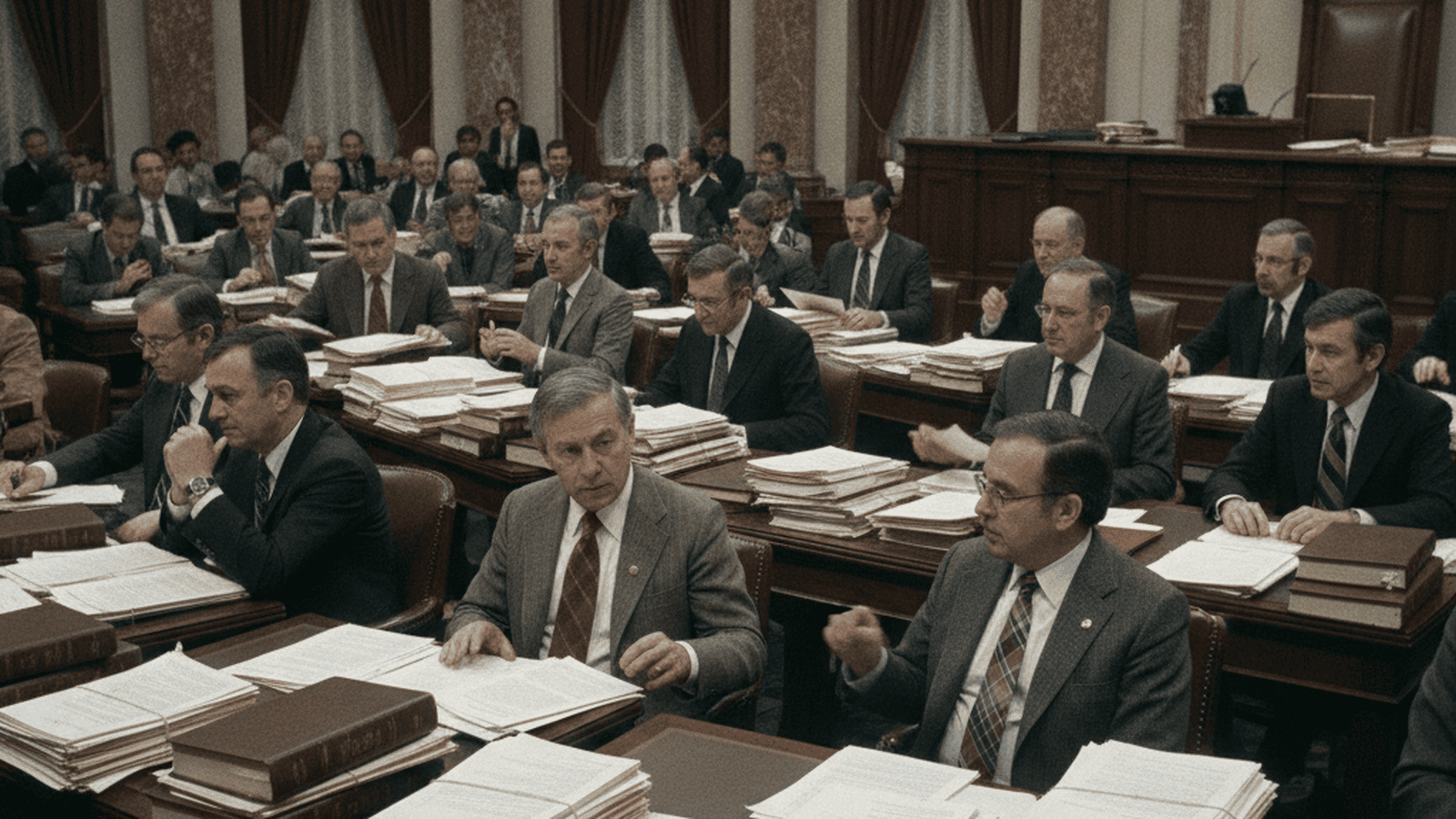
In 1975, the United States Senate lowered the threshold for invoking cloture from two-thirds of those present to three-fifths of the total membership. This parliamentary realignment was intended to reduce obstructionism but ultimately institutionalized the 60-vote requirement for most major legislation.
TLDR: The 1975 Senate Cloture Reform lowered the vote threshold to end filibusters from 67 to 60. Led by a bipartisan coalition, this procedural shift aimed to modernize the United States Senate. While easing some gridlock, it established the 60-vote supermajority as a permanent fixture of the American legislative process.
In March 1975, the United States Senate underwent a fundamental parliamentary realignment that permanently altered the legislative landscape of the American government. For over half a century, the chamber had operated under a version of Rule XXII that required a two-thirds majority of senators present and voting to invoke cloture and end a filibuster. This high bar, which often necessitated 67 votes if the chamber was full, had historically allowed a determined minority to paralyze the Senate, most notably during the long battles over civil rights legislation in the mid-20th century. By the mid-1970s, however, a new generation of lawmakers, emboldened by the post-Watergate desire for government transparency and efficiency, sought to break this tradition of obstruction.
The push for reform was spearheaded by a bipartisan coalition led by Senators Walter Mondale, a Democrat from Minnesota, and James Pearson, a Republican from Kansas. These reformers argued that the existing rules were anachronistic and prevented the majority from governing effectively in an era that demanded swift legislative action. The reformers initially proposed a “leaking” cloture rule, a mechanism that would have gradually lowered the required vote threshold the longer a debate continued. This proposal was met with fierce resistance from Senate traditionalists and the “Old Guard,” who feared that any easing of the filibuster would destroy the Senate’s unique character as the world’s greatest deliberative body and a necessary check on the “tyranny of the majority.”
Senate Majority Leader Mike Mansfield supported the modernization effort, recognizing that public patience with legislative paralysis was reaching a breaking point. The ensuing debate over the rule change itself became a legendary procedural battleground. Opponents of the reform used the very filibuster the reformers were trying to weaken to block the resolution, leading to a “filibuster against the filibuster.” This forced the Senate into a series of complex and exhausting parliamentary maneuvers that lasted for weeks in early 1975.
The turning point of the crisis came when Vice President Nelson Rockefeller, acting in his role as the Senate’s presiding officer, made a series of controversial rulings that favored the reformers. Rockefeller suggested that at the beginning of a new Congress, the Senate could change its rules by a simple majority vote, rather than being bound by the rules of the previous session. This “constitutional option”—which critics later dubbed the “nuclear option”—terrified the Senate’s institutionalists, including future Majority Leader Robert Byrd. They feared a precedent that would allow a simple majority to change any rule at any time, effectively turning the Senate into a majoritarian body like the House of Representatives. To avoid this outcome, a compromise was struck to preserve the Senate’s status as a “continuing body” while still lowering the threshold.
The final agreement lowered the cloture threshold to three-fifths of the total Senate membership, which translates to 60 votes. This “constitutional” majority replaced the “two-thirds of those present” rule, providing a more predictable, albeit still difficult, path to ending debate. The change was formally adopted on March 7, 1975, by a vote of 56 to 27. While it was a victory for the reformers, it was also a significant concession to those who wanted to maintain the filibuster as a core feature of the institution.
This realignment shifted the power dynamics within the Senate in ways the reformers did not entirely foresee. While it made it slightly easier to overcome obstruction, it also institutionalized the 60-vote threshold as the de facto requirement for passing any controversial legislation. The “talking filibuster,” where senators held the floor for hours in a physical test of endurance, began to fade. It was replaced by the “virtual filibuster,” where the mere threat of failing to reach 60 votes could stall a bill before it even reached the floor. The 1975 reform thus set the stage for the modern era of hyper-partisanship, ensuring that the 60-vote supermajority remains a cornerstone of the American legislative process.

Miles Harrington serves as the Senior Correspondent for Federal Systems & Executive Power at Just Right News, where he brings a disciplined, constitutionalist lens to the inner workings of the American government. With a focus on the mechanics of the federal bureaucracy and the limits of executive authority, Harrington has established himself as a vital voice for readers who value transparency, accountability, and the preservation of the separation of powers.
A native of Richmond, Virginia, Harrington’s perspective is deeply rooted in the traditions of the Old Dominion. Growing up in a city defined by its historical significance and its role as a center of American jurisprudence, he developed an early appreciation for the foundational principles of the Republic. His upbringing in Richmond—a place where the legacy of the Founding Fathers is woven into the landscape—instilled in him a belief that the federal government should remain within its constitutional bounds. This background informs his skepticism of centralized overreach and his commitment to reporting on the ways in which the administrative state impacts the lives of everyday citizens.
In his current role, Harrington specializes in the complexities of federal systems. He doesn’t just report on the headlines of the day; he digs into the structural shifts within the executive branch that often go unnoticed by the mainstream press. Whether he is analyzing the implications of a new federal regulation or investigating the expansion of agency jurisdiction, his work is characterized by a rigorous adherence to the facts and a dedication to the rule of law.
Harrington is perhaps best known for his signature feature series, “How Washington Works.” Through this ongoing project, he demystifies the often-opaque processes of the nation’s capital, pulling back the curtain on the “Deep State” and the unelected officials who wield significant influence over national policy. By breaking down complex legislative maneuvers and executive orders, he empowers Just Right News readers to understand the true levers of power in Washington. His reporting serves as a necessary check on the federal government, ensuring that the actions of those in power are held up to the light of public scrutiny.
Now based in Washington, D.C., Harrington operates at the epicenter of the political world, yet he remains intentionally distanced from the “Beltway bubble.” His proximity to the halls of power allows him to maintain a robust network of sources across the federal landscape, but his heart remains in the principled conservatism of his Virginia roots. He views his role not merely as a reporter, but as a steward of the public trust, dedicated to providing the clarity and context that conservative voters need to navigate an increasingly complex political environment.
Through his sharp analysis and unwavering commitment to the truth, Miles Harrington continues to be a cornerstone of the Just Right News team. His work ensures that the principles of limited government and executive restraint remain at the forefront of the national conversation, providing a crucial service to those who believe in a government that is truly of, by, and for the people.