

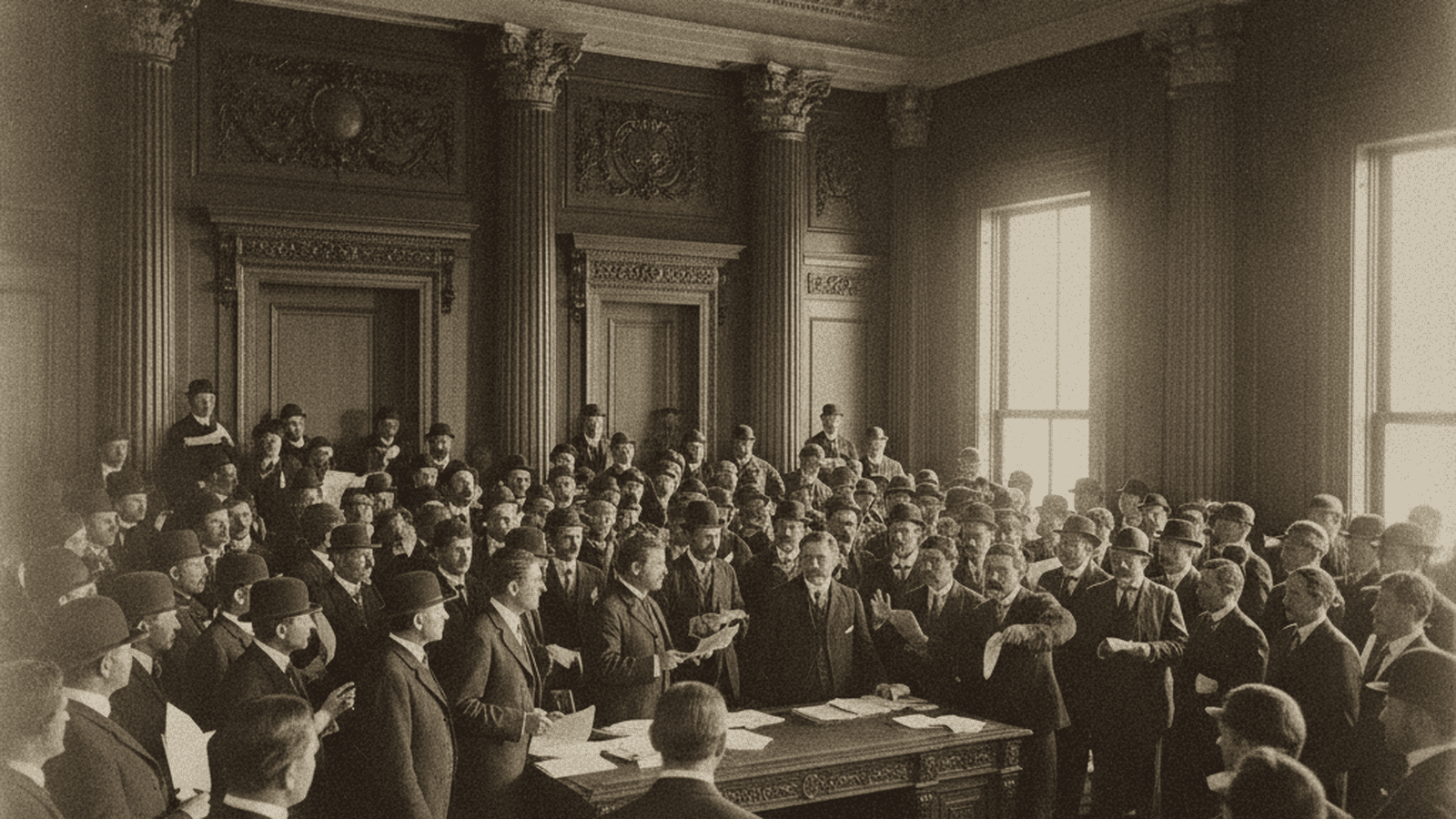
In 1905, Colorado experienced a unique constitutional crisis where three different men held the office of governor in a single day. Following a disputed election between Alva Adams and James Peabody, the state legislature brokered a compromise that saw Adams unseated, Peabody sworn in and then immediately resigned, and Jesse McDonald taking the oath. This event highlighted the intense political and corporate tensions within the United States during the Progressive Era.
TLDR: In March 1905, Colorado saw three governors in 24 hours following a fraudulent election. The Republican legislature unseated Democrat Alva Adams, briefly installed James Peabody, and then elevated Jesse McDonald via a pre-arranged resignation. The crisis led to major electoral reforms and the adoption of direct democracy measures in the state.
The 1904 gubernatorial election in Colorado was not merely a political contest; it was a flashpoint in a period of intense industrial strife known as the Colorado Labor Wars. The incumbent, Republican James Peabody, had become a polarizing figure due to his aggressive suppression of labor strikes. By declaring martial law in mining districts like Cripple Creek and Telluride, Peabody had effectively used the state militia to break the power of the Western Federation of Miners. His Democratic challenger, Alva Adams, a former governor himself, campaigned on a platform of “industrial peace” and the restoration of civil liberties, promising to end the military occupation of strike zones. When the ballots were initially tallied, Adams appeared to have won by a margin of approximately 10,000 votes, a substantial lead that suggested a clear mandate for change.
However, the victory was short-lived as the state descended into a constitutional quagmire. Republicans immediately challenged the results, alleging that the Democratic machine in Denver had engaged in massive voter fraud. They claimed that “repeaters”—men hired to vote multiple times—had flooded the polls and that ballot boxes had been stuffed with fraudulent papers. In retaliation, Democrats accused the Republicans of using the state’s military apparatus to intimidate miners and suppress the opposition vote in rural, corporate-controlled counties. The dispute was eventually brought before the Republican-controlled state legislature, which held the constitutional authority to adjudicate contested elections.
Throughout the winter of 1905, a legislative committee investigated the claims. The evidence revealed a sordid picture of corruption on both sides, but the Republican majority focused their scrutiny on Democratic strongholds. Despite the findings, a significant faction of moderate Republicans feared that simply installing the unpopular Peabody would incite a general strike or even an armed insurrection. The Colorado Supreme Court further complicated matters by asserting its jurisdiction, leading to a legal deadlock that threatened the stability of the state government.
The crisis reached its surreal climax on March 16 and 17, 1905, through a series of carefully orchestrated political maneuvers. To resolve the impasse, party leaders and corporate mining interests brokered a secret deal. First, the legislature voted to unseat Alva Adams, declaring his election void due to fraud. James Peabody was then sworn in as governor for the second time. However, his return to power was a mere formality. Under the terms of the pact, Peabody had been required to sign a letter of resignation before he was even allowed to take the oath of office. This ensured that he would not actually exercise the powers of the governorship.
True to the agreement, Peabody resigned within twenty-four hours of his inauguration. This allowed Lieutenant Governor Jesse F. McDonald to be sworn in as the state’s third governor in a single day. This unprecedented sequence of events—Adams to Peabody to McDonald—became a national scandal, illustrating the extreme lengths to which political machines and corporate interests would go to maintain control. While the “Three Governors” compromise successfully averted immediate violence, it left the Colorado electorate deeply disillusioned.
The legacy of the 1905 crisis was a fundamental shift in Colorado’s political landscape. The spectacle of the legislature bartering away the governorship fueled the rising Progressive movement. In the years that followed, citizens demanded reforms to curb the influence of “The Beast,” a term used by reformers to describe the alliance between corrupt politicians and corporate monopolies. By 1910, Colorado voters overwhelmingly approved constitutional amendments establishing the right to initiative and referendum. These direct democracy measures were designed to ensure that the will of the people could never again be so easily subverted by legislative maneuvering or backroom deals.

Lila Hayes serves as a Staff Writer for Just Right News, where she anchors the “Courts, Law, and Constitutional Order” beat. Her work is defined by a steadfast commitment to the foundational principles of the American republic and a rigorous defense of the legal frameworks that ensure national stability. As a primary voice for the outlet, she provides readers with a clear-eyed analysis of the judiciary, focusing on the importance of originalism and the preservation of the separation of powers.
Lila’s perspective was forged in the American heartland. Raised in St. Louis, Missouri, she grew up in a Hispanic household where the values of hard work, faith, and respect for the law were paramount. Her upbringing instilled in her a deep appreciation for the American Dream and the legal protections that make it possible. This Missouri background remains a cornerstone of her reporting, providing a grounded, common-sense counter-narrative to the often-insular legal circles of the coastal elite. She understands that the decisions made in high-court chambers have real-world consequences for families and small business owners across the country.
At Just Right News, Lila has become widely recognized for her signature feature series, “The Rulebook of Power.” In this ongoing project, she delves into the mechanics of the federal government, examining how administrative overreach and judicial activism can threaten the delicate balance of the Constitution. She approaches her beat with the tenacity of a veteran journalist and the precision of a legal scholar, consistently advocating for a judiciary that interprets the law as written rather than legislating from the bench. For Lila, the Constitution is not a “living” document subject to the whims of modern social trends; it is a fixed standard that ensures the government remains the servant of the people, not their master.
Now based in Philadelphia, Pennsylvania, Lila finds herself at the very epicenter of American constitutional history. Living and working in the city where the Founders drafted the documents she defends daily provides a constant source of inspiration. The historic halls and landmarks of Philadelphia serve as a daily reminder of the high stakes involved in her reporting. Her presence in the city allows her to bridge the gap between the historical intent of the law and its contemporary application, ensuring that the legacy of the Founding Fathers remains central to the national conversation.
Throughout her career, Lila has remained dedicated to the idea that a free society requires an informed citizenry and a transparent legal system. Her reporting is more than just a collection of headlines; it is a defense of the constitutional order that has sustained the nation for over two centuries. By focusing on the “Rulebook of Power,” she ensures that her readers understand not just what is happening in the courtrooms, but why those decisions matter for the future of American liberty. Lila Hayes continues to be a vital voice for those who believe that the law should be a shield for the citizen and a constraint on the state.