

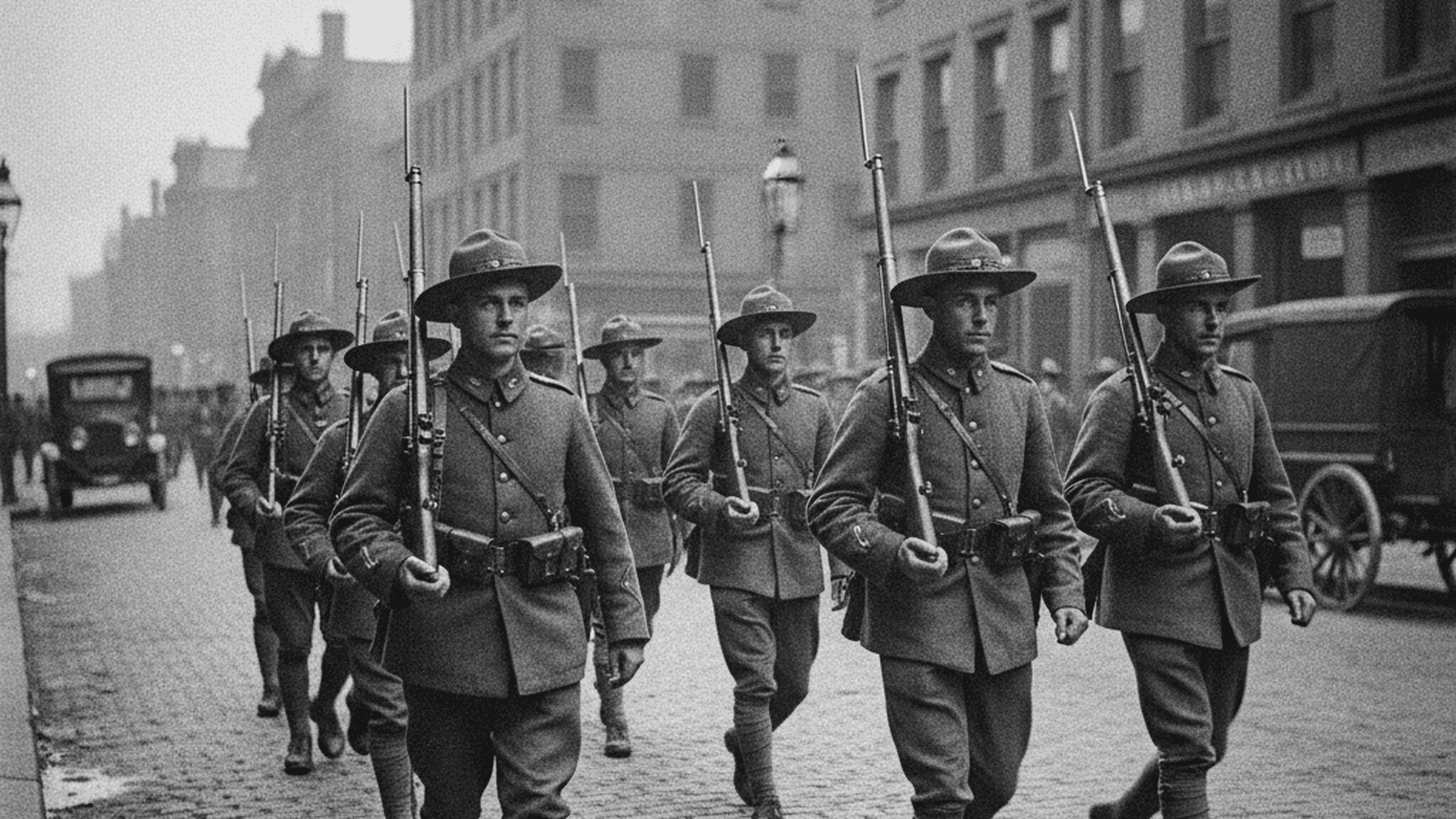
In 1919, Massachusetts Governor Calvin Coolidge intervened in the Boston Police Strike, asserting that public employees had no right to strike against public safety. This event in the United States redefined the limits of executive power regarding labor disputes and propelled Coolidge to the national stage.
TLDR: Following a massive police walkout in Boston in 1919, Governor Calvin Coolidge utilized his executive authority to mobilize the State Guard and permanently replace the striking officers. His firm stance against public sector strikes transformed national labor policy and established a precedent for executive intervention in essential service disruptions.
In the immediate aftermath of World War I, the United States entered a period of profound social and economic instability. High inflation eroded the purchasing power of workers, while the “Red Scare” fueled public anxiety over radicalism and labor militancy. In Boston, Massachusetts, these national tensions converged in the 1919 Boston Police Strike, a landmark event that redefined the boundaries of public sector labor relations and the scope of executive authority. The conflict originated from the deteriorating conditions faced by the city’s police force. Officers worked long hours in dilapidated station houses, often infested with vermin, and their wages had remained stagnant despite a 75% increase in the cost of living. Seeking a mechanism for collective bargaining, the officers sought to affiliate with the American Federation of Labor (AFL).
Police Commissioner Edwin Upton Curtis, a staunch conservative appointed by the governor, viewed the unionization effort as a threat to civil authority. He issued a departmental order explicitly forbidding officers from joining any “outside” organization. When the officers defied this directive and formed the Boston Police Union, Curtis brought charges against 19 union leaders and suspended them. This provocation led to a strike vote, and on the evening of September 9, 1919, approximately 1,100 of the city’s 1,500 officers walked off their beats. The city was left with a skeleton crew of volunteers and older officers who had not joined the walkout.
The first night of the strike saw Boston descend into chaos. With no police presence, crowds gathered in the streets, leading to widespread looting, property damage, and public disturbances. While Mayor Andrew Peters initially attempted to restore order by calling out local units of the State Guard, the violence continued into the second night, resulting in several deaths. Governor Calvin Coolidge, who had initially remained in the background to observe the political fallout, eventually determined that the situation required a decisive exercise of gubernatorial power. On September 11, Coolidge took full command of the State Guard and the police department, effectively asserting state control over municipal affairs.
The defining moment of the crisis occurred during an exchange between Coolidge and AFL President Samuel Gompers. Gompers had appealed to the governor, arguing that the officers were being punished for exercising their rights as workers. Coolidge’s response was swift and uncompromising: “There is no right to strike against the public safety by anybody, anywhere, any time.” This statement resonated powerfully across a nation weary of labor unrest and fearful of bolshevism. Coolidge’s firm stance transformed the strike from a local labor dispute into a national referendum on the rule of law. He supported Commissioner Curtis’s refusal to reinstate any of the striking officers, leading to the recruitment of an entirely new police force.
The political ramifications for Coolidge were transformative. His handling of the strike propelled him from the governorship of Massachusetts to the national stage, earning him a reputation as a champion of “law and order.” This newfound fame secured his nomination as the Republican vice-presidential candidate in 1920, eventually leading to his presidency following the death of Warren G. Harding. Legally, the strike established a precedent that severely restricted the collective bargaining rights of public employees for decades. It reinforced the doctrine that government service, particularly in public safety, carries a unique obligation that supersedes traditional labor rights. The 1919 Boston Police Strike remains a pivotal case study in the use of executive power to maintain social order and the enduring tension between labor advocacy and the perceived requirements of public safety.

Miles Harrington serves as the Senior Correspondent for Federal Systems & Executive Power at Just Right News, where he brings a disciplined, constitutionalist lens to the inner workings of the American government. With a focus on the mechanics of the federal bureaucracy and the limits of executive authority, Harrington has established himself as a vital voice for readers who value transparency, accountability, and the preservation of the separation of powers.
A native of Richmond, Virginia, Harrington’s perspective is deeply rooted in the traditions of the Old Dominion. Growing up in a city defined by its historical significance and its role as a center of American jurisprudence, he developed an early appreciation for the foundational principles of the Republic. His upbringing in Richmond—a place where the legacy of the Founding Fathers is woven into the landscape—instilled in him a belief that the federal government should remain within its constitutional bounds. This background informs his skepticism of centralized overreach and his commitment to reporting on the ways in which the administrative state impacts the lives of everyday citizens.
In his current role, Harrington specializes in the complexities of federal systems. He doesn’t just report on the headlines of the day; he digs into the structural shifts within the executive branch that often go unnoticed by the mainstream press. Whether he is analyzing the implications of a new federal regulation or investigating the expansion of agency jurisdiction, his work is characterized by a rigorous adherence to the facts and a dedication to the rule of law.
Harrington is perhaps best known for his signature feature series, “How Washington Works.” Through this ongoing project, he demystifies the often-opaque processes of the nation’s capital, pulling back the curtain on the “Deep State” and the unelected officials who wield significant influence over national policy. By breaking down complex legislative maneuvers and executive orders, he empowers Just Right News readers to understand the true levers of power in Washington. His reporting serves as a necessary check on the federal government, ensuring that the actions of those in power are held up to the light of public scrutiny.
Now based in Washington, D.C., Harrington operates at the epicenter of the political world, yet he remains intentionally distanced from the “Beltway bubble.” His proximity to the halls of power allows him to maintain a robust network of sources across the federal landscape, but his heart remains in the principled conservatism of his Virginia roots. He views his role not merely as a reporter, but as a steward of the public trust, dedicated to providing the clarity and context that conservative voters need to navigate an increasingly complex political environment.
Through his sharp analysis and unwavering commitment to the truth, Miles Harrington continues to be a cornerstone of the Just Right News team. His work ensures that the principles of limited government and executive restraint remain at the forefront of the national conversation, providing a crucial service to those who believe in a government that is truly of, by, and for the people.