

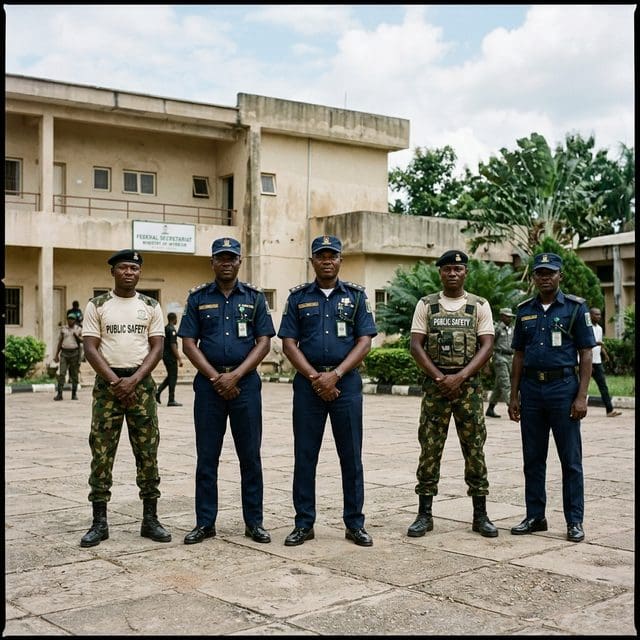
The promotions include the Nigeria Immigration Service, but reports do not provide immigration-specific staffing figures or border-enforcement measures.
The Federal Government of Nigeria has approved promotions for 27,624 officers across four services, including the Nigeria Immigration Service, PUNCH reported October 22. The announcement comes alongside a broader recruitment effort, but available reports do not specify how many promoted officers serve in immigration or whether the decision will affect staffing at border posts.
The promotions cover the Nigeria Security and Civil Defence Corps (NSCDC), the Federal Fire Service, the Nigerian Correctional Service and the Nigeria Immigration Service. The reported figure is a combined total. Reports do not provide service-by-service allocations, promotion grades or an implementation timeline, making it impossible to determine the scale of advancement in any one agency.
The immigration service is among the agencies responsible for Nigeria’s migration and border functions. However, the promotion announcement includes no enforcement measures, such as border interceptions, removals, visa decisions or asylum claims. It describes a personnel decision, not changes in migration flows or enforcement results. Nor does it say whether promoted officers will be assigned to field posts, headquarters or other duties.
The Civil Defence, Correctional, Fire and Immigration Services Board also approved 228 pending disciplinary cases on October 22, according to PUNCH. Sanctions differed across the four services, but reports do not give a service-by-service breakdown or identify how many cases involved immigration personnel. The figure refers to cases approved by the board, not cases in each agency.
The board also approved a healthcare policy framework intended to improve personnel fitness and wellbeing across the NSCDC, correctional, immigration and fire services. The reports describe its purpose but provide no details on funding, coverage, rollout dates or measures of impact.
A separate recruitment process offers context for the government’s staffing plans. The CDCFIB portal is due to reopen from October 28 to November 13, but only for candidates who reached the oral-interview stage. The Nation and Blueprint reported that candidates may check their status and obtain drug-screening instructions during this period; it is not a new application window.
Eligible candidates must obtain a portal code and take a free drug test administered by the National Drug Law Enforcement Agency in their state. The Whistler and Blueprint report that results are expected immediately and candidates who test drug-free will receive certificates. Those who clear screening are expected to travel to Abuja to collect appointment letters. Testing does not guarantee appointment; final clearance is still required.
The Whistler and Blueprint reported that a first-phase intake of 30,000 recruits is part of a government target of 120,000 personnel during President Bola Tinubu’s first term. The reports do not say how many recruits are intended for the immigration service, how personnel will be distributed among agencies, or how the target compares with existing staffing. The total should not be treated as an immigration-service hiring figure.
A Federal Civil Service Commission listing for a 2026 Directorate Promotion Examination Center Update, dated September 17, is not linked in the available report to the CDCFIB promotion exercise. It provides no additional detail about the four services or their recruitment process.
The announcements document promotions, disciplinary decisions, a welfare framework and a recruitment process across Nigeria’s public-safety services. They do not show whether immigration capacity is increasing at border crossings or provide data on migrant populations, visa programs or asylum processing. Service-specific staffing and deployment figures, alongside migration statistics, would be needed to assess how the personnel decisions affect migration management.

Julie Harris serves as a Staff Writer for Just Right News, where she tackles some of the most pressing and complex issues facing the nation today. As the lead reporter for the Migration, Demographics & Cultural Shifts beat, Julie provides a grounded, principled perspective on how the movement of people and the changing makeup of communities are reshaping the American landscape. Her work is defined by a commitment to exploring the long-term consequences of social change, prioritizing the stability of local institutions and the preservation of national identity.
Her deep understanding of these issues is rooted in her upbringing in Tucson, Arizona. Growing up in a prominent border state, Julie witnessed firsthand the intricate realities of migration and the profound impact it has on local infrastructure, law enforcement, and the social fabric. This early exposure instilled in her a respect for the rule of law and a keen awareness of the challenges that arise when federal policies fail to align with the needs of border communities. Her reporting often reflects this lived experience, bringing a necessary level of nuance to topics that are often treated with abstraction in coastal newsrooms.
Now based in Santa Fe, New Mexico, Julie continues to report from the heart of the American Southwest. Her location provides a unique vantage point to observe the intersection of traditional regional cultures and the modern shifts brought about by both internal and external migration. In Santa Fe, a city defined by its rich history and distinct cultural heritage, she finds a perfect environment to explore how communities strive to maintain their character while navigating the pressures of a rapidly changing world. This perspective allows her to bridge the gap between policy debates in Washington and the reality of life in the high desert.
At Just Right News, Julie’s work is characterized by a dedication to examining the data and the human stories that define the “New Mosaic” of America. Her signature feature series, “The New Mosaic,” has become a cornerstone of her reporting. Through this series, Julie explores the evolving social architecture of the United States, documenting how shifts in population affect everything from local economies to the political landscape. She brings a critical eye to the narrative of demographic inevitability, instead asking how these shifts impact the average citizen’s sense of belonging and the integrity of the American social contract.
Julie’s background and her dedication to conservative principles make her a vital voice in contemporary journalism. She understands that demographics are more than just numbers on a spreadsheet; they represent the future of the American family and the nation’s enduring legacy. Through her diligent reporting and insightful analysis, Julie Harris ensures that her readers are informed about the forces shaping their world, providing a perspective that is as thoughtful as it is necessary for the modern era.