

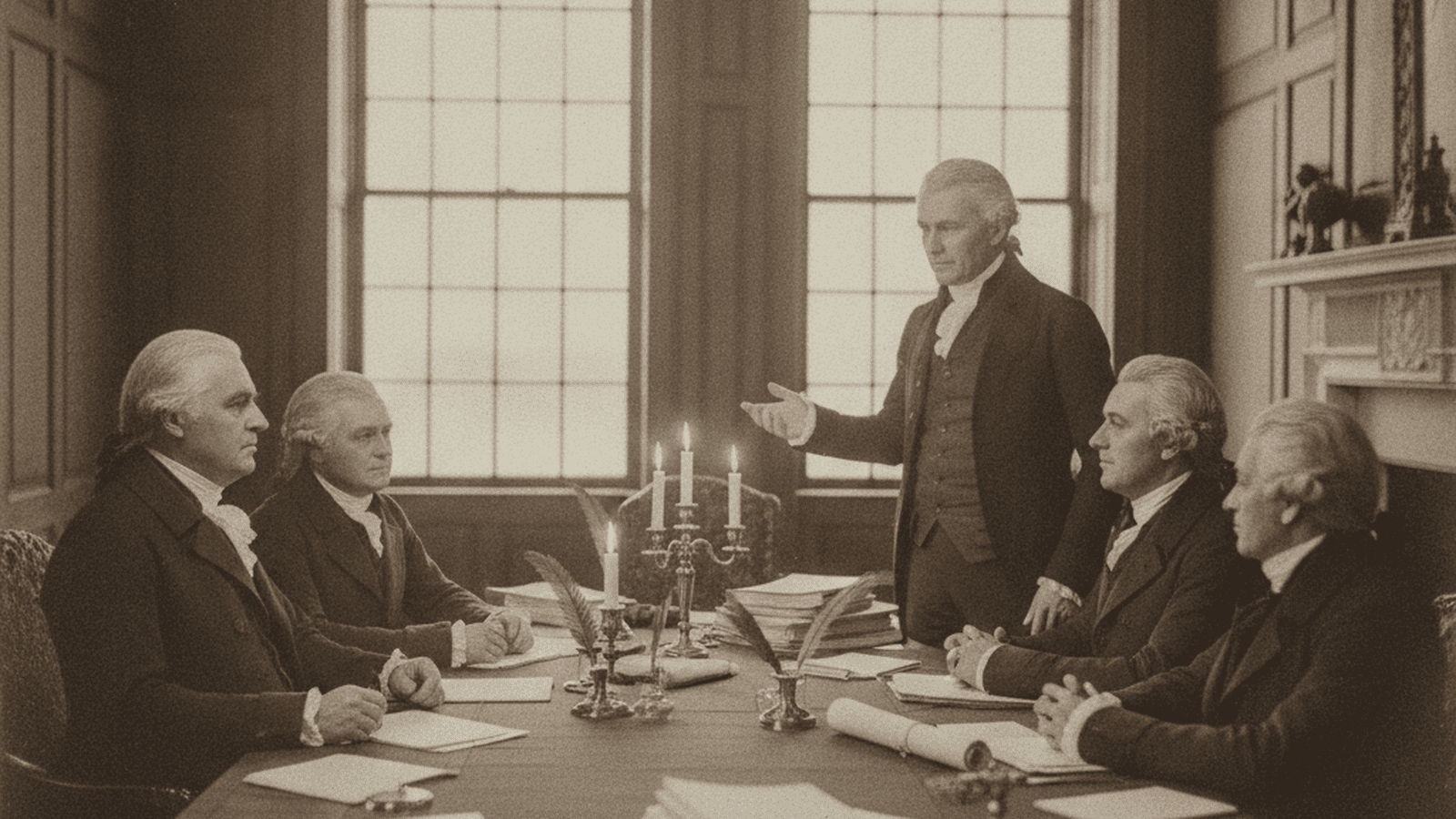
In 1801, a constitutional standoff in New York between Governor John Jay and the Council of Appointment over the power to nominate public officials led to a significant shift in state governance. The resulting constitutional convention in the United States redefined executive authority, granting legislative members equal nominating power and fueling the rise of the spoils system.
TLDR: The 1801 New York Council of Appointment crisis saw Governor John Jay clash with DeWitt Clinton over patronage rights. A subsequent constitutional convention stripped the governor of exclusive nominating power, empowering legislative factions. This realignment transformed New York politics into a partisan machine, eventually leading to the Council’s total abolition in 1821.
The New York Council of Appointment, established by the state’s 1777 constitution, served as one of the most powerful and controversial bodies in the early history of the United States. Composed of the governor and four senators chosen by the assembly, the council held the authority to appoint nearly every civil and military officer in the state, from the mayor of New York City to local sheriffs and justices of the peace. By 1801, this system reached a breaking point as partisan tensions between Federalists and Democratic-Republicans intensified. Governor John Jay, a staunch Federalist and former Chief Justice, found himself presiding over a council that had fallen under the control of his political opponents following the election of 1800.
The crisis began when the Democratic-Republican members, led by the ambitious and strategically minded DeWitt Clinton, challenged the governor’s traditional prerogative. Historically, the governor held the exclusive right to nominate candidates, while the council members merely provided or withheld their consent. Clinton and his allies argued that the constitution granted every member of the council an equal right to nominate. This interpretation threatened to strip the governor of his primary tool for maintaining executive influence and rewarding political loyalists across the state.
Governor Jay refused to entertain nominations from the council members, insisting that such a move would violate the executive’s constitutional role and create a “hydra-headed” executive. The council members, in turn, refused to vote on Jay’s nominees, effectively halting the machinery of government. This deadlock paralyzed the state’s administrative functions, leaving hundreds of essential positions vacant as the two sides engaged in a war of pamphlets and public declarations. Unable to reach a compromise, Jay eventually adjourned the council in February 1801 and appealed to the state legislature for a definitive ruling on the constitutional language.
The legislature, also controlled by Democratic-Republicans, declined to intervene directly and instead called for a state constitutional convention to settle the matter. Meeting in Albany in October 1801, the convention was tasked with resolving the ambiguity of Article XXIII of the 1777 constitution. Vice President Aaron Burr presided over the gathering, which quickly became a forum for parliamentary realignment. The delegates, many of whom were beneficiaries of the new Republican ascendancy, ultimately voted to uphold the council’s claim. They formally declared that the right to nominate was vested in each individual member of the council, not just the governor.
This decision marked a significant defeat for executive authority and a victory for legislative factions. By decentralizing the appointment power, the convention inadvertently laid the groundwork for the “spoils system” that would dominate New York politics for the next twenty years. The Council of Appointment became a vehicle for wholesale partisan purges, as whichever party controlled the assembly could now dictate every minor office in the state, regardless of the governor’s wishes. This shift empowered the “Albany Regency” and other political machines that prioritized party loyalty over administrative competence.
The fallout from the 1801 crisis eventually led to a complete overhaul of the state’s governance. The council’s reputation for corruption and blatant partisanship grew so great that it was entirely abolished during the Constitutional Convention of 1821. This later reform returned the nominating power to the governor, subject to senate confirmation, creating the appointment model that remains common in many U.S. states today. The 1801 conflict remains a primary example of how early American political actors struggled to balance executive independence with legislative oversight during the nation’s first major party transition.

Miles Harrington serves as the Senior Correspondent for Federal Systems & Executive Power at Just Right News, where he brings a disciplined, constitutionalist lens to the inner workings of the American government. With a focus on the mechanics of the federal bureaucracy and the limits of executive authority, Harrington has established himself as a vital voice for readers who value transparency, accountability, and the preservation of the separation of powers.
A native of Richmond, Virginia, Harrington’s perspective is deeply rooted in the traditions of the Old Dominion. Growing up in a city defined by its historical significance and its role as a center of American jurisprudence, he developed an early appreciation for the foundational principles of the Republic. His upbringing in Richmond—a place where the legacy of the Founding Fathers is woven into the landscape—instilled in him a belief that the federal government should remain within its constitutional bounds. This background informs his skepticism of centralized overreach and his commitment to reporting on the ways in which the administrative state impacts the lives of everyday citizens.
In his current role, Harrington specializes in the complexities of federal systems. He doesn’t just report on the headlines of the day; he digs into the structural shifts within the executive branch that often go unnoticed by the mainstream press. Whether he is analyzing the implications of a new federal regulation or investigating the expansion of agency jurisdiction, his work is characterized by a rigorous adherence to the facts and a dedication to the rule of law.
Harrington is perhaps best known for his signature feature series, “How Washington Works.” Through this ongoing project, he demystifies the often-opaque processes of the nation’s capital, pulling back the curtain on the “Deep State” and the unelected officials who wield significant influence over national policy. By breaking down complex legislative maneuvers and executive orders, he empowers Just Right News readers to understand the true levers of power in Washington. His reporting serves as a necessary check on the federal government, ensuring that the actions of those in power are held up to the light of public scrutiny.
Now based in Washington, D.C., Harrington operates at the epicenter of the political world, yet he remains intentionally distanced from the “Beltway bubble.” His proximity to the halls of power allows him to maintain a robust network of sources across the federal landscape, but his heart remains in the principled conservatism of his Virginia roots. He views his role not merely as a reporter, but as a steward of the public trust, dedicated to providing the clarity and context that conservative voters need to navigate an increasingly complex political environment.
Through his sharp analysis and unwavering commitment to the truth, Miles Harrington continues to be a cornerstone of the Just Right News team. His work ensures that the principles of limited government and executive restraint remain at the forefront of the national conversation, providing a crucial service to those who believe in a government that is truly of, by, and for the people.