

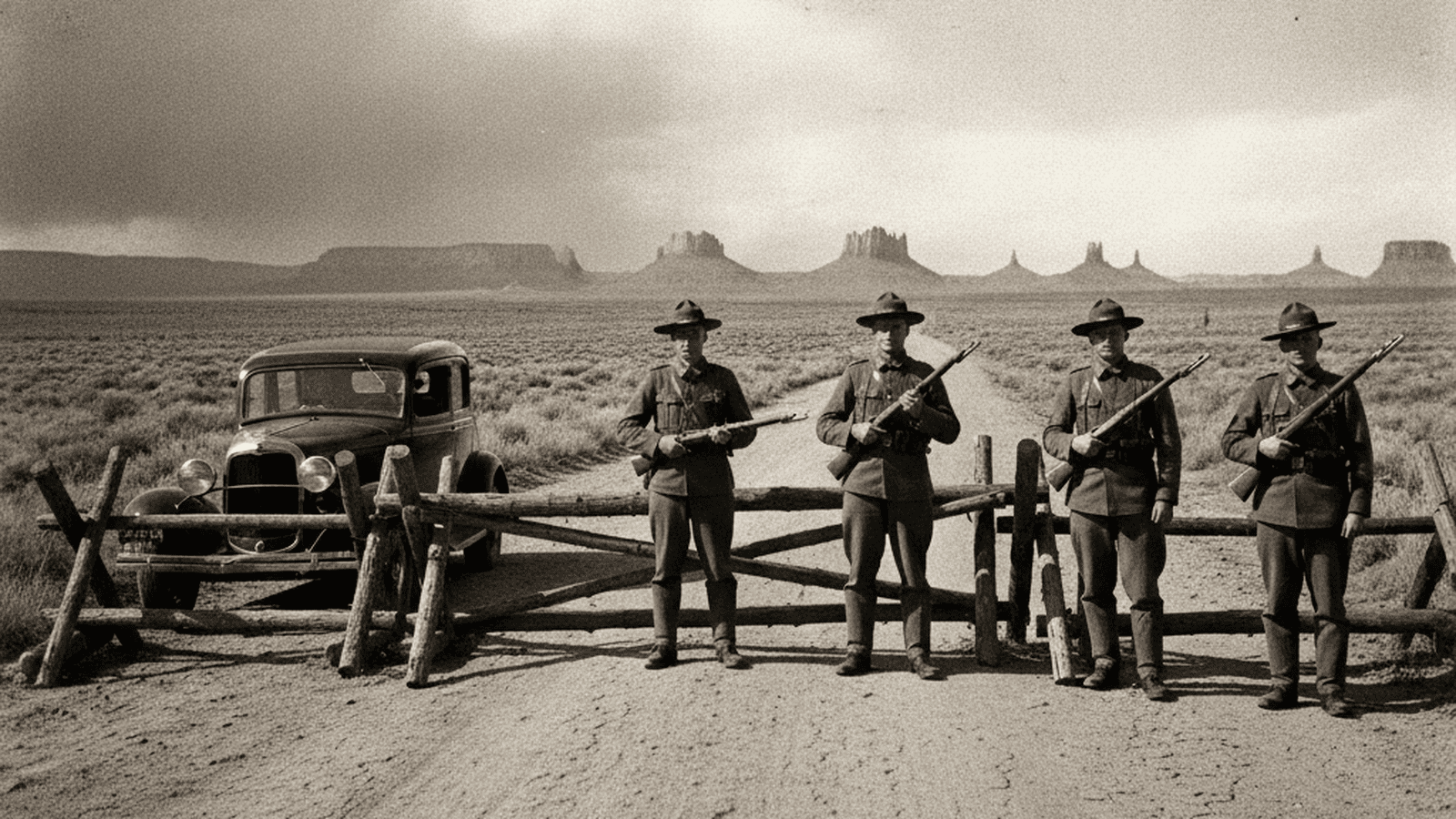
In 1936, Colorado Governor Edwin C. Johnson declared martial law to prevent impoverished migrants from entering the state during the Great Depression. This executive action in the United States highlighted the tensions between state sovereignty and federal constitutional rights.
TLDR: Governor Edwin C. Johnson deployed the National Guard in 1936 to seal Colorado’s southern borders against indigent migrants. This controversial use of executive power during the New Deal era sparked a constitutional crisis over the right to interstate travel, eventually forcing a retreat under federal pressure.
In the spring of 1936, the United States remained mired in the economic wreckage of the Great Depression. As the Dust Bowl environmental catastrophe displaced thousands across the Great Plains, a steady stream of migrants moved westward in search of survival. In Colorado, Governor Edwin C. Johnson viewed this migration with mounting hostility. He feared that the arrival of impoverished families would deplete the state’s limited relief resources and exacerbate local unemployment. On April 18, 1936, Johnson invoked his authority as commander-in-chief of the state militia to declare martial law along Colorado’s southern border.
The executive proclamation established a military zone extending ten miles north of the border with New Mexico and Oklahoma. Johnson dispatched approximately 100 members of the Colorado National Guard to man checkpoints at key entry points, including the strategic Raton Pass near Trinidad. These soldiers were given explicit orders to prevent indigents, tramps, and paupers from entering the state. The Governor’s rationale rested on the claim that Colorado had a sovereign right to protect its treasury from being overwhelmed by residents of neighboring jurisdictions.
This blockade immediately disrupted interstate commerce and travel. National Guardsmen, dressed in their standard-issue wool uniforms and campaign hats, stopped automobiles and searched freight trains. Travelers who could not produce a certain amount of cash or proof of employment were summarily turned back. The sight of armed troops patrolling the highways created a spectacle that drew national attention and sharp criticism from civil rights advocates.
The political fallout was swift and severe. New Mexico Governor Clyde Tingley denounced the blockade as an un-American act and a violation of the United States Constitution. Tingley threatened to launch a reciprocal blockade or a total boycott of Colorado products, which would have devastated the regional economy. The New Mexico legislature even considered a formal protest to the federal government. Meanwhile, the American Civil Liberties Union and various labor organizations condemned Johnson’s use of executive power as a dangerous precedent that undermined the basic rights of citizenship.
Inside Colorado, the blockade was met with a mixture of support and revulsion. Some local newspapers praised Johnson for his stance in prioritizing Colorado residents. However, many citizens were disturbed by the logistical chaos and the ethical implications of denying entry to the poor. The blockade also proved difficult to enforce effectively across the rugged, porous terrain of the high desert. Despite the military presence, many migrants simply bypassed the main roads, slipping into the state through mountain trails and unguarded backroads.
The federal government’s reaction was one of cautious disapproval. While the Roosevelt administration was wary of infringing on state sovereignty, the Department of Justice began investigating whether the blockade violated federal statutes. Under mounting pressure from the federal government, neighboring states, and the national press, Johnson realized the blockade was unsustainable. On April 28, 1936, just ten days after it began, the Governor rescinded the martial law order. He claimed the operation had successfully deterred a horde of migrants, though critics argued it had only succeeded in tarnishing the state’s reputation.
The 1936 Colorado border crisis remains a significant episode in the history of executive power and the right to travel in the United States. It highlighted the fragility of constitutional protections during times of national emergency. The controversy contributed to the eventual legal consensus that states cannot restrict the movement of citizens based on their economic status. This principle was later solidified by the U.S. Supreme Court in the 1941 case Edwards v. California, which ensured that the right to interstate travel remains a fundamental pillar of American liberty.

Miles Harrington serves as the Senior Correspondent for Federal Systems & Executive Power at Just Right News, where he brings a disciplined, constitutionalist lens to the inner workings of the American government. With a focus on the mechanics of the federal bureaucracy and the limits of executive authority, Harrington has established himself as a vital voice for readers who value transparency, accountability, and the preservation of the separation of powers.
A native of Richmond, Virginia, Harrington’s perspective is deeply rooted in the traditions of the Old Dominion. Growing up in a city defined by its historical significance and its role as a center of American jurisprudence, he developed an early appreciation for the foundational principles of the Republic. His upbringing in Richmond—a place where the legacy of the Founding Fathers is woven into the landscape—instilled in him a belief that the federal government should remain within its constitutional bounds. This background informs his skepticism of centralized overreach and his commitment to reporting on the ways in which the administrative state impacts the lives of everyday citizens.
In his current role, Harrington specializes in the complexities of federal systems. He doesn’t just report on the headlines of the day; he digs into the structural shifts within the executive branch that often go unnoticed by the mainstream press. Whether he is analyzing the implications of a new federal regulation or investigating the expansion of agency jurisdiction, his work is characterized by a rigorous adherence to the facts and a dedication to the rule of law.
Harrington is perhaps best known for his signature feature series, “How Washington Works.” Through this ongoing project, he demystifies the often-opaque processes of the nation’s capital, pulling back the curtain on the “Deep State” and the unelected officials who wield significant influence over national policy. By breaking down complex legislative maneuvers and executive orders, he empowers Just Right News readers to understand the true levers of power in Washington. His reporting serves as a necessary check on the federal government, ensuring that the actions of those in power are held up to the light of public scrutiny.
Now based in Washington, D.C., Harrington operates at the epicenter of the political world, yet he remains intentionally distanced from the “Beltway bubble.” His proximity to the halls of power allows him to maintain a robust network of sources across the federal landscape, but his heart remains in the principled conservatism of his Virginia roots. He views his role not merely as a reporter, but as a steward of the public trust, dedicated to providing the clarity and context that conservative voters need to navigate an increasingly complex political environment.
Through his sharp analysis and unwavering commitment to the truth, Miles Harrington continues to be a cornerstone of the Just Right News team. His work ensures that the principles of limited government and executive restraint remain at the forefront of the national conversation, providing a crucial service to those who believe in a government that is truly of, by, and for the people.