

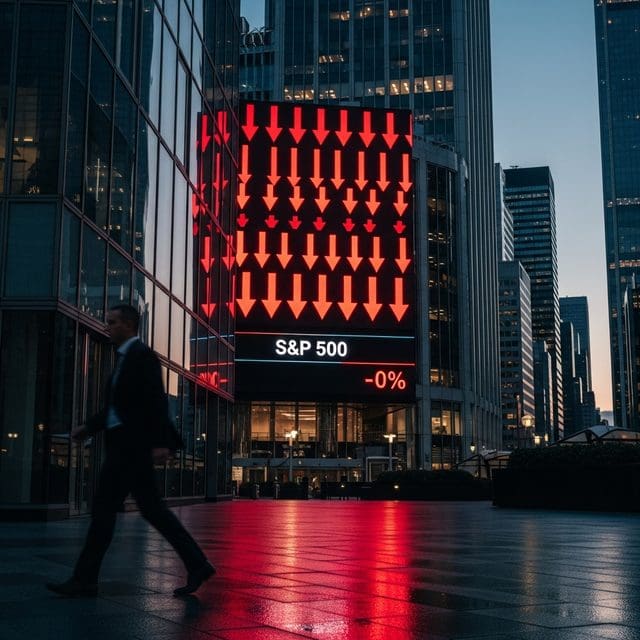
U.S. equities retreated from record highs as investors weighed cooling producer price data against rising Treasury yields and persistent geopolitical risks in the Middle East.
Financial markets saw a measured pullback during Friday’s session, with the SPY benchmark trading down 0.20% as investors paused following a string of record-breaking sessions. The slight retreat in U.S. equities comes despite cooling inflation data, as the market grapples with a complex mix of rising Treasury yields, energy supply risks, and a persistent wealth gap. While the S&P 500 recently touched new highs fueled by AI optimism, today’s action reflects a consolidation phase. The Dow Jones fell approximately 0.17%, while the tech-heavy Nasdaq dropped 0.30%.
This downward pressure coincided with a move in the bond market, where the 10-year Treasury yield rose to nearly 4.70%. The resulting positively sloped yield curve, with a spread of roughly 55 basis points over the 2-year note, suggests that while immediate rate hike wagers are fading, the market remains wary of long-term inflationary pressures. For the American taxpayer, the macro-economic narrative remains a study in contradictions. July’s producer prices remained unchanged, reinforcing a cooling trend that has supported global markets, particularly in Asia where stocks are on track for their strongest week in two months.
However, the cost of living remains a central concern as Brent crude prices climbed to $87.82 per barrel. This rise in energy costs, driven by a risk premium related to Middle East supply concerns, acts as a regressive tax on working families navigating a K-shaped economy. Gold also saw firmer bidding, benefiting from a softer dollar and a renewed interest in defensive assets as the VIX edged higher to 14.68. Recent data highlights this economic divide: while high-income earners drive discretionary spending, lower-income consumers show signs of constrained demand.
This disparity is further complicated by shifting trade policies. A federal trade court recently ruled that the administration can block cheap imports from platforms like Temu and Shein from entering the country tariff-free, a move intended to protect domestic interests that may impact the short-term purchasing power of budget-conscious households. Meanwhile, JPMorgan strategists have warned that tech stocks may underperform in the second half of 2026, even as the broader S&P 500 maintains investor confidence in AI-driven growth.
In the corporate sector, the ‘Invisible Economy’ of institutional consolidation continues. PrimeSource Brands, a portfolio company of Clearlake Capital Group, finalized its acquisition of Starborn Industries on August 12. Simultaneously, Industrial Control Solutions expanded its aerospace footprint by acquiring Modern Instrument Company. These moves toward centralization occur as major tech players face internal instability; OpenAI has seen a string of executive departures, including its chief operating officer and chief revenue officer, ahead of a planned IPO.
Other sectors are seeing significant capital shifts toward international development. The Sports Boulevard Development Company announced a $186 million real estate investment fund for a five-star hotel in Riyadh, signaling a continued flow of capital toward Middle Eastern urban projects. In the digital asset space, Forgd launched the Market Maker Performance Index on Tokenomist to increase transparency in a volatile market. Ultimately, today’s market movement suggests a defensive posture. While headline indices remain near historic levels, the underlying reality for Main Street is one of cautious navigation through a landscape of high yields, rising energy costs, and centralized financial control.

Jordan Lee serves as the Senior Correspondent for Wall Street, Finance, and Monetary Systems at Just Right News. Based in the heart of the world’s financial capital, New York City, Lee brings a sharp, principled eye to the complex mechanisms that drive the global economy. His reporting is defined by a commitment to fiscal responsibility, the defense of the free market, and a deep-seated belief that a transparent monetary system is the bedrock of a free society.
Raised in Portland, Oregon, Lee’s perspective was forged in a city that has undergone significant cultural and economic shifts. His upbringing in the Pacific Northwest instilled in him a profound appreciation for the industriousness of small business owners and the importance of local economic stability. Watching the evolution of his hometown’s landscape sparked an early interest in how federal fiscal policy and large-scale financial trends eventually trickle down to the average citizen. This background provides him with a unique vantage point; he understands the growing disconnect between the policy-making elite and the reality of Main Street, a theme that frequently resonates throughout his work.
Now operating from his base in New York City, Lee bridges the gap between the high-stakes trading floors of Manhattan and the households of everyday Americans. He views the financial sector not merely as a collection of numbers and tickers, but as a vital engine of American prosperity that requires constant vigilance and accountability. His reporting often highlights the dangers of centralized financial control and the necessity of maintaining a system that rewards merit, risk-taking, and innovation.
As the creator and lead of the featured series, “The Invisible Economy,” Lee pulls back the curtain on the often-opaque world of monetary systems. He specializes in translating the dense jargon of central banking and international finance into actionable insights for the Just Right News audience. His work explores the “invisible” forces—such as inflationary pressures, regulatory creep, and the expansion of the administrative state—that erode the purchasing power of American families. By focusing on these systemic issues, Lee empowers readers to understand the hidden forces shaping their financial independence.
Lee’s journalistic philosophy is rooted in a steadfast commitment to traditional American values. As an Asian American professional who has navigated the competitive corridors of the financial world, he is a vocal advocate for meritocracy and the preservation of the American Dream. He believes that a stable currency and a predictable regulatory environment are essential for national sovereignty and individual liberty. His reporting frequently warns against the risks of government overreach in the private sector, arguing that the most effective solutions to economic challenges arise from competition and individual enterprise rather than bureaucratic mandates.
At Just Right News, Jordan Lee remains dedicated to providing a clear-eyed defense of the taxpayer. Whether he is analyzing market volatility or investigating the long-term implications of national debt, his mission is to provide the truth about where the money is going and what it means for the future of the country. Through his rigorous analysis and principled stance, Lee has become a trusted voice for those who value a strong, sovereign, and fiscally sound America.