

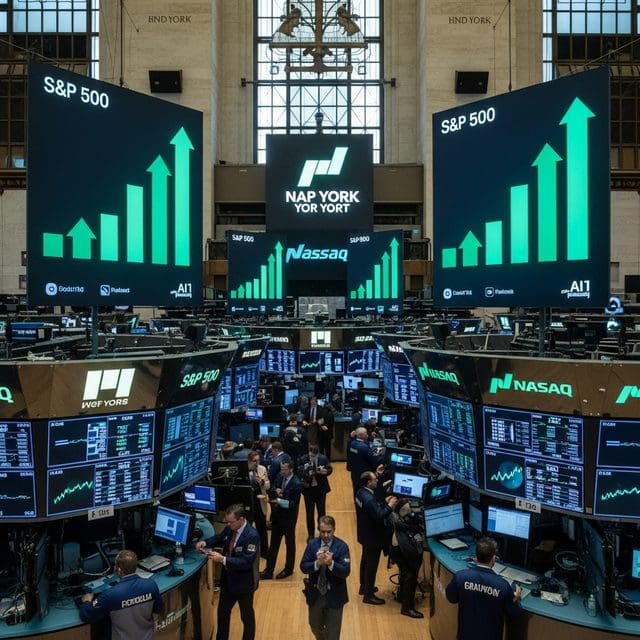
Major indices rose Wednesday as tame CPI data fueled hopes for a Federal Reserve pause, with technology and AI-linked industrials leading the charge while defensive sectors lagged.
Financial markets showed a distinct split on Wednesday as new inflation data provided a reprieve for the American taxpayer, though the underlying economic landscape remains complex. The July Consumer Price Index (CPI) rose just 0.1% month-over-month, bringing the annual core rate to 2.5%—its slowest pace since early 2021. This cooling trend has shifted market sentiment significantly, with futures now implying a 66% probability that the Federal Reserve will maintain current interest rates at its next meeting, a sharp increase from the 45% odds seen just one week ago.
Market performance mirrored the SPY benchmark’s 0.54% gain, but the leadership was concentrated in specific silos of the economy. The tech-heavy Nasdaq Composite led the session, matching the benchmark’s 0.54% rise, fueled primarily by artificial intelligence infrastructure and semiconductor names. Investors continue to pour capital into AI-linked industrials and cloud providers like CoreWeave, betting on a productivity boom that has yet to fully manifest in the labor market. While worker confidence has dipped due to AI uncertainty, the massive job displacement many feared has not yet emerged in the data.
In the industrial sector, consolidation and technical expansion continue to define the landscape. Recent moves, such as Industrial Control Solutions acquiring Modern Instrument Company to bolster aerospace calibration services, and Blue Ridge Associates appointing Adam Studdard as CTO to lead AI strategy, underscore a corporate shift toward high-tech efficiency. These moves suggest that while the “Invisible Economy” of centralized finance fluctuates, the physical infrastructure of American industry is doubling down on technical meritocracy.
However, the Dow Jones Industrial Average lagged the broader market, finishing down 0.04% at 53,770.27. This disparity highlights a rotation away from defensive sectors and healthcare, which underperformed as risk appetite moved toward growth-oriented tech. In the insurance space, Westfield Specialty reported a 25% year-over-year increase in gross written premiums, reaching $1.18 billion, yet these institutional gains often feel distant from the realities of Main Street. Similarly, the launch of the Market Maker Performance Index by Forgd on the Tokenomist platform indicates a push for transparency in the digital asset space, assigning letter grades to market participants in an effort to bring order to a volatile sector.
For the working household, the narrative is one of a persistent K-shaped wealth gap. While the “tame” CPI print suggests a slowing of price increases, the reality of the past year remains heavy. Airfares have surged 25% year-over-year, and while wealthy consumers continue to drive travel and discretionary spending, lower-income Americans are showing signs of constrained demand. This divergence is evident in the real estate sector as well, with the Sports Boulevard Development Company announcing a $186 million fund for luxury hotel developments in Riyadh, illustrating where global capital is flowing while domestic households navigate high ticket prices and credit-sensitive environments.
As the S&P 500 drifts near the record highs set last week, the focus remains on whether the Federal Reserve will prioritize national sovereignty and a stable monetary system over further intervention. Treasury yields have retreated slightly following the CPI and PPI reports, reinforcing a “benign inflation” narrative that supports equity risk. However, the true measure of economic health will not be found in the Nasdaq’s AI-driven gains, but in whether the cooling inflation translates into tangible relief for the American taxpayer and a return to a stable, merit-based economy.

Jordan Lee serves as the Senior Correspondent for Wall Street, Finance, and Monetary Systems at Just Right News. Based in the heart of the world’s financial capital, New York City, Lee brings a sharp, principled eye to the complex mechanisms that drive the global economy. His reporting is defined by a commitment to fiscal responsibility, the defense of the free market, and a deep-seated belief that a transparent monetary system is the bedrock of a free society.
Raised in Portland, Oregon, Lee’s perspective was forged in a city that has undergone significant cultural and economic shifts. His upbringing in the Pacific Northwest instilled in him a profound appreciation for the industriousness of small business owners and the importance of local economic stability. Watching the evolution of his hometown’s landscape sparked an early interest in how federal fiscal policy and large-scale financial trends eventually trickle down to the average citizen. This background provides him with a unique vantage point; he understands the growing disconnect between the policy-making elite and the reality of Main Street, a theme that frequently resonates throughout his work.
Now operating from his base in New York City, Lee bridges the gap between the high-stakes trading floors of Manhattan and the households of everyday Americans. He views the financial sector not merely as a collection of numbers and tickers, but as a vital engine of American prosperity that requires constant vigilance and accountability. His reporting often highlights the dangers of centralized financial control and the necessity of maintaining a system that rewards merit, risk-taking, and innovation.
As the creator and lead of the featured series, “The Invisible Economy,” Lee pulls back the curtain on the often-opaque world of monetary systems. He specializes in translating the dense jargon of central banking and international finance into actionable insights for the Just Right News audience. His work explores the “invisible” forces—such as inflationary pressures, regulatory creep, and the expansion of the administrative state—that erode the purchasing power of American families. By focusing on these systemic issues, Lee empowers readers to understand the hidden forces shaping their financial independence.
Lee’s journalistic philosophy is rooted in a steadfast commitment to traditional American values. As an Asian American professional who has navigated the competitive corridors of the financial world, he is a vocal advocate for meritocracy and the preservation of the American Dream. He believes that a stable currency and a predictable regulatory environment are essential for national sovereignty and individual liberty. His reporting frequently warns against the risks of government overreach in the private sector, arguing that the most effective solutions to economic challenges arise from competition and individual enterprise rather than bureaucratic mandates.
At Just Right News, Jordan Lee remains dedicated to providing a clear-eyed defense of the taxpayer. Whether he is analyzing market volatility or investigating the long-term implications of national debt, his mission is to provide the truth about where the money is going and what it means for the future of the country. Through his rigorous analysis and principled stance, Lee has become a trusted voice for those who value a strong, sovereign, and fiscally sound America.