

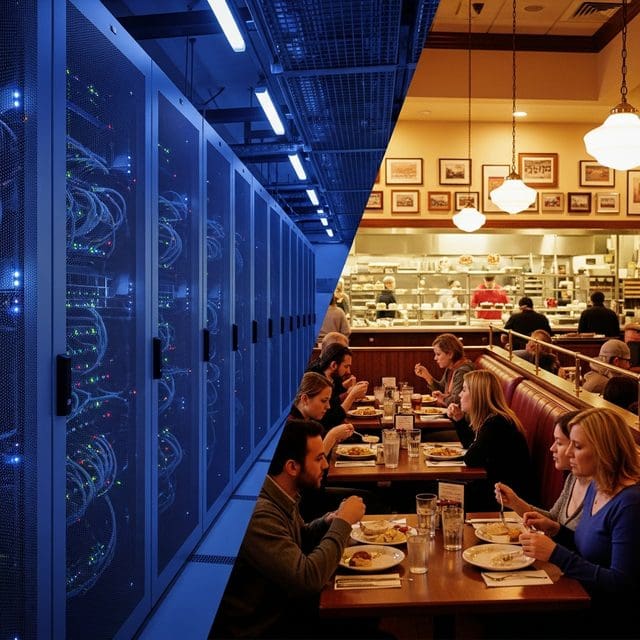
Enterprise AI startups secure massive funding rounds for specialized infrastructure while a historic rotation in the restaurant sector signals a major shift in American consumer spending habits.
The American economic landscape is currently defined by a stark divergence between the cooling consumer sector and the race for artificial intelligence supremacy. As the July Consumer Price Index confirmed headline inflation at 3.4% year-over-year, the real story for the taxpayer lies in the shifting foundations of the Invisible Economy. While the Federal Reserve remains divided on a September rate move following the July FOMC meeting where funds were held at 3.5%–3.75%, the private sector is pouring billions into the infrastructure required to sustain digital productivity.
In enterprise technology, the move toward specialized infrastructure is accelerating. Neocloud providers like CoreWeave and Nebius reported upbeat earnings, signaling that demand for compute power is now a structural shift. This surge is mirrored by significant funding rounds, most notably Contextual AI’s $80 million raise. The firm is targeting the enterprise market with Retrieval-Augmented Generation (RAG) technology, aiming to solve the hallucination problems plaguing general models from OpenAI and Anthropic. This capital infusion highlights a growing preference for specialized AI over general-purpose platforms.
For entrepreneurs relying on platforms like GitHub, AWS, and Google Cloud, these developments represent a double-edged sword. While competition among infrastructure providers like Linode and OpenRouter may eventually drive down costs, the immediate reality is intense capital concentration. The market is rewarding companies that provide tangible utility and verifiable data accuracy. This is further evidenced by strategic moves such as Integrity partnering with Meraz Health Insurance to deploy AI-enhanced support, proving that AI integration is now a requirement for maintaining competitive margins.
On Main Street, persistent inflation is manifesting in a historic restaurant rotation not seen in a decade. For the first time since 2016, casual dining chains like Cheesecake Factory are significantly outperforming fast-casual peers like Chipotle. The median gain for casual dining leaders reached 62% over the last 60 trading days, creating a record 66-point performance gap against fast-casual names. This shift suggests that even as the K-shaped wealth gap narrows, consumers are seeking perceived value as discretionary income is squeezed by energy prices that remain 14.7% higher than last year. Cheesecake Factory’s Q2 results, featuring record revenue of $1.03 billion, underscore this flight to established brands.
The broader financial markets reflect this complexity through a shift in breadth. While the S&P 500 has finally seen the average stock beat the index for the first time in four years, the underlying pressure of diesel at $5.32 per gallon continues to act as a hidden tax. Supply constraints driven by geopolitical crises have kept energy costs volatile, forcing companies to seek efficiency through technology. Even the cryptocurrency sector is seeing a push for professionalization, with Forgd launching a performance index to grade market makers from AAA to CCC, bringing rigor to digital assets.
Ultimately, the current economic climate demands a return to fiscal fundamentals. Whether it is a startup securing an $80 million round for enterprise AI or a household adjusting dining habits to favor casual dining, the theme is a search for stability. The resilience of the American economy will depend not on government intervention, but on the ability of these technological innovations to deliver real-world productivity gains for the taxpayer and the consumer alike.

Jordan Lee serves as the Senior Correspondent for Wall Street, Finance, and Monetary Systems at Just Right News. Based in the heart of the world’s financial capital, New York City, Lee brings a sharp, principled eye to the complex mechanisms that drive the global economy. His reporting is defined by a commitment to fiscal responsibility, the defense of the free market, and a deep-seated belief that a transparent monetary system is the bedrock of a free society.
Raised in Portland, Oregon, Lee’s perspective was forged in a city that has undergone significant cultural and economic shifts. His upbringing in the Pacific Northwest instilled in him a profound appreciation for the industriousness of small business owners and the importance of local economic stability. Watching the evolution of his hometown’s landscape sparked an early interest in how federal fiscal policy and large-scale financial trends eventually trickle down to the average citizen. This background provides him with a unique vantage point; he understands the growing disconnect between the policy-making elite and the reality of Main Street, a theme that frequently resonates throughout his work.
Now operating from his base in New York City, Lee bridges the gap between the high-stakes trading floors of Manhattan and the households of everyday Americans. He views the financial sector not merely as a collection of numbers and tickers, but as a vital engine of American prosperity that requires constant vigilance and accountability. His reporting often highlights the dangers of centralized financial control and the necessity of maintaining a system that rewards merit, risk-taking, and innovation.
As the creator and lead of the featured series, “The Invisible Economy,” Lee pulls back the curtain on the often-opaque world of monetary systems. He specializes in translating the dense jargon of central banking and international finance into actionable insights for the Just Right News audience. His work explores the “invisible” forces—such as inflationary pressures, regulatory creep, and the expansion of the administrative state—that erode the purchasing power of American families. By focusing on these systemic issues, Lee empowers readers to understand the hidden forces shaping their financial independence.
Lee’s journalistic philosophy is rooted in a steadfast commitment to traditional American values. As an Asian American professional who has navigated the competitive corridors of the financial world, he is a vocal advocate for meritocracy and the preservation of the American Dream. He believes that a stable currency and a predictable regulatory environment are essential for national sovereignty and individual liberty. His reporting frequently warns against the risks of government overreach in the private sector, arguing that the most effective solutions to economic challenges arise from competition and individual enterprise rather than bureaucratic mandates.
At Just Right News, Jordan Lee remains dedicated to providing a clear-eyed defense of the taxpayer. Whether he is analyzing market volatility or investigating the long-term implications of national debt, his mission is to provide the truth about where the money is going and what it means for the future of the country. Through his rigorous analysis and principled stance, Lee has become a trusted voice for those who value a strong, sovereign, and fiscally sound America.