

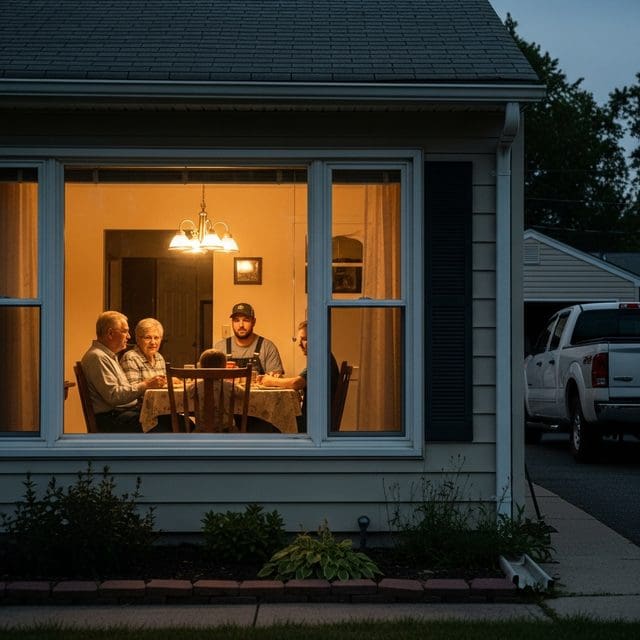
Record numbers of young adults are returning to their childhood bedrooms as housing costs and rising fuel prices squeeze the traditional path to independence.
In the quiet suburbs of the Northeast, the American dream is taking on a crowded, multigenerational shape. For decades, the transition to adulthood was marked by a clean break—a first apartment, a starter home, and the independence that comes with a set of keys. Today, that threshold has become increasingly impassable for the rising generation, forcing a return to the family dinner table that is less about sentiment and more about economic survival.
Recent data from the Federal Reserve and Realtor.com reveals a stark shift in the national landscape: 49% of U.S. adults under 30 now live with their parents, a figure that has climbed 12 percentage points since 2019. In high-cost regions like New Jersey and Connecticut, those numbers climb even higher, reaching 44% and 41% respectively. This is not a story of a shiftless youth; roughly 70% of these young adults are employed. Instead, it is a story of a widening gap between local wages and the cost of basic shelter. The cultural narrative of reinvention is clashing with a reality where 25.2 million Americans under 35 are sharing a roof with their elders.
To afford a median-priced home in the current market, a household now needs an annual income of approximately $109,796. The typical American household, however, earns roughly $22,200 less than that mark. Even the entry-level “starter home” remains elusive, requiring an income of over $70,000 despite a slight 1.5% year-over-year dip in prices. When combined with diesel prices that hit $5.32 per gallon this August—a 44-cent jump in just one month driven by global supply constraints—the daily cost of commuting from more affordable rural areas often cancels out any potential savings in rent. For the working class, the math simply does not add up.
This economic squeeze is felt acutely within the home. A Wells Fargo survey indicates that 64% of parents with Gen Z children are providing ongoing financial support for housing or basic expenses. For these families, the “empty nest” has become a relic of the past. The strain is reflected in the National Foundation for Credit Counseling’s Financial Stress Forecast, which rose to 6.7 out of 10 this quarter as revolving credit balances climbed toward $1.08 trillion. Families are increasingly leaning on credit to cover the everyday costs that their paychecks no longer reach.
While some cultural commentators liken this era to a “new Gilded Age,” the reality on the ground is more nuanced. The U.S. economy’s K-shaped wealth gap has shown signs of narrowing, with spending growth becoming less reliant on the wealthy, yet the burden of inflation remains a heavy weight. Even with a projected 3.6% Social Security cost-of-living adjustment for 2027, older generations find their fixed incomes stretched thin as they support adult children who are struggling to launch. The self-reliant spirit that once drove young people to strike out on their own is being redirected into maintaining the family unit against external economic pressures.
As the cost of living continues to outpace wage growth, the traditional timeline for marriage and children is being rewritten. The American household is becoming a fortress of shared responsibility, where the preservation of the family legacy depends on three generations living under one roof. These families are navigating a world where the ladder to independence has lost its bottom rungs, proving that while the stock market may occasionally beat the S&P 500, the view from the kitchen table remains one of cautious, collective endurance.

Ethan Blake serves as a Senior Correspondent for Just Right News, where he specializes in Longform Narrative and Public Understanding. In an era of rapid-fire headlines and fleeting soundbites, Ethan’s work stands as a testament to the power of deep-dive reporting and the importance of contextualizing the complex issues facing the nation today. His approach is rooted in the belief that the most profound truths are often found in the lived experiences of individuals rather than the abstract theories of distant policymakers.
Growing up in Providence, Rhode Island, Ethan developed an early appreciation for the historical and cultural threads that weave the American fabric together. Providence, a city defined by its industrial heritage and its blend of traditional neighborhoods, provided him with a front-row seat to the challenges and triumphs of the American working class. This upbringing instilled in him a respect for the “common sense” values of hard work, community loyalty, and the preservation of local institutions. He learned early on that behind every economic statistic or legislative debate, there are real families and neighborhoods navigating the consequences of change.
This foundational perspective is the driving force behind his signature feature series, “Lives Behind the Systems.” Through this series, Ethan explores the intersection of individual agency and institutional structure. Whether he is documenting the impact of federal land-use policies on rural families or examining how shifting educational standards affect local school boards, Ethan’s work prioritizes the human element. He seeks to uncover how large-scale systems—be they governmental, economic, or social—affect the daily lives of citizens, often advocating for a return to local control and personal responsibility.
Now based in Portland, Maine, Ethan draws significant inspiration from the rugged independence and self-reliance that define the region. The coastal landscape and the resilient spirit of Maine’s communities serve as a constant reminder of the importance of individual liberty and the strength found in decentralized power. Living and working outside the traditional media hubs allows Ethan to maintain a grounded perspective, ensuring his reporting remains untethered from the echo chambers of the major metropolitan centers. This geographic distance provides him with the clarity needed to translate complex national narratives into stories that resonate with the heart of the country.
At Just Right News, Ethan’s beat is more than just a professional assignment; it is a mission to foster a more informed and engaged citizenry. He believes that a free society depends on the public’s ability to understand the mechanisms of power and the value of traditional American principles. His longform narratives do not merely report the news; they provide a roadmap for understanding the cultural and political shifts of the modern era through a lens of skepticism toward centralized authority and a deep respect for the individual.
Through his meticulous research and narrative craftsmanship, Ethan Blake continues to bridge the gap between policy and the public. His work remains a vital resource for those who seek a deeper understanding of the systems that shape our world and the enduring spirit of the people who live within them.