

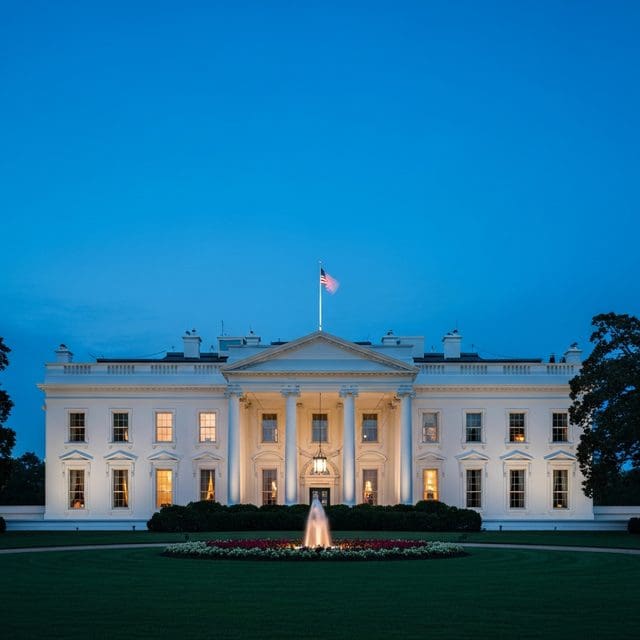
Press Secretary Karoline Leavitt will exit the podium this month as the administration finalizes a major regulatory shift ending federal funding for youth gender-affirming care.
The White House communications apparatus is entering a period of significant transition following President Donald Trump’s announcement that Press Secretary Karoline Leavitt will depart her post at the end of August. The departure of one of the administration’s most visible figures comes at a sensitive political moment, as the executive branch prepares for the 2026 midterm elections and implements sweeping changes to federal healthcare policy. While the President cited Leavitt’s desire to spend more time with her young children and family as the primary reason for her exit, he emphasized that she would remain an influential figure within the Republican Party, serving as an outside adviser to help shape the movement’s narrative.
This personnel shift coincides with a major regulatory overhaul led by the Department of Health and Human Services (HHS) and the Centers for Medicare & Medicaid Services (CMS). On August 11 and 12, the administration finalized a rule that ends federal support for gender-affirming care for minors under Medicaid and the Children’s Health Insurance Program (CHIP). The regulation specifically targets federal cost-sharing for puberty blockers, hormone therapy, and surgical interventions. Scheduled to take effect on October 13, 2026, the rule represents a significant exercise of executive authority, redirecting the federal government’s role in financing controversial medical procedures for the roughly 35.5 million children covered by these programs.
A disciplined reading of the finalized rule reveals a complex implementation strategy. To address concerns regarding immediate health impacts, the administration has included a six-month taper period for minors currently undergoing hormone treatments. Furthermore, the rule maintains federal coverage for mental health services, treatments for intersex conditions, and care required to address complications from prior procedures. While federal funds are being withdrawn, states retain the legal authority to fund these services using state-only revenue, a move that will likely create a fragmented landscape of healthcare access depending on local state policy and legislative priorities.
The timing of these developments is noteworthy, as Congress remains in a pro forma session with no substantive legislative business on the floor. This allows the executive branch to advance its agenda through the administrative state without immediate legislative interference. However, the absence of a named successor for Leavitt creates a potential communications vacuum. As the October implementation date approaches, the administration will face intense scrutiny from civil rights organizations and medical associations, which have already signaled that litigation is likely. Without a permanent face at the White House podium, the task of defending these regulatory shifts will fall to agency leaders like HHS Secretary Robert F. Kennedy Jr. and CMS Administrator Mehmet Oz.
Beyond the Beltway, the political landscape continues to shift as the midterms approach. In Wisconsin, Milwaukee County Executive David Crowley recently secured a victory in the Democratic gubernatorial primary, defeating state Rep. Francesca Hong. In Ohio, the political standing of Rep. Max Miller has come under pressure following a shift in race ratings to a ‘Toss Up’ and a legal dispute with his ex-wife. Meanwhile, in North Carolina, former Governor Roy Cooper maintains a lead in the Senate race against Michael Whatley. These regional shifts, combined with the administration’s aggressive regulatory posture, suggest a highly polarized environment as the nation moves toward the fall. The departure of Leavitt from the formal White House structure to a party-focused advisory role indicates a strategic pivot toward these upcoming electoral battles, ensuring that the administration’s most trusted voices are positioned where they can most effectively influence the broader political narrative.

Miles Harrington serves as the Senior Correspondent for Federal Systems & Executive Power at Just Right News, where he brings a disciplined, constitutionalist lens to the inner workings of the American government. With a focus on the mechanics of the federal bureaucracy and the limits of executive authority, Harrington has established himself as a vital voice for readers who value transparency, accountability, and the preservation of the separation of powers.
A native of Richmond, Virginia, Harrington’s perspective is deeply rooted in the traditions of the Old Dominion. Growing up in a city defined by its historical significance and its role as a center of American jurisprudence, he developed an early appreciation for the foundational principles of the Republic. His upbringing in Richmond—a place where the legacy of the Founding Fathers is woven into the landscape—instilled in him a belief that the federal government should remain within its constitutional bounds. This background informs his skepticism of centralized overreach and his commitment to reporting on the ways in which the administrative state impacts the lives of everyday citizens.
In his current role, Harrington specializes in the complexities of federal systems. He doesn’t just report on the headlines of the day; he digs into the structural shifts within the executive branch that often go unnoticed by the mainstream press. Whether he is analyzing the implications of a new federal regulation or investigating the expansion of agency jurisdiction, his work is characterized by a rigorous adherence to the facts and a dedication to the rule of law.
Harrington is perhaps best known for his signature feature series, “How Washington Works.” Through this ongoing project, he demystifies the often-opaque processes of the nation’s capital, pulling back the curtain on the “Deep State” and the unelected officials who wield significant influence over national policy. By breaking down complex legislative maneuvers and executive orders, he empowers Just Right News readers to understand the true levers of power in Washington. His reporting serves as a necessary check on the federal government, ensuring that the actions of those in power are held up to the light of public scrutiny.
Now based in Washington, D.C., Harrington operates at the epicenter of the political world, yet he remains intentionally distanced from the “Beltway bubble.” His proximity to the halls of power allows him to maintain a robust network of sources across the federal landscape, but his heart remains in the principled conservatism of his Virginia roots. He views his role not merely as a reporter, but as a steward of the public trust, dedicated to providing the clarity and context that conservative voters need to navigate an increasingly complex political environment.
Through his sharp analysis and unwavering commitment to the truth, Miles Harrington continues to be a cornerstone of the Just Right News team. His work ensures that the principles of limited government and executive restraint remain at the forefront of the national conversation, providing a crucial service to those who believe in a government that is truly of, by, and for the people.