

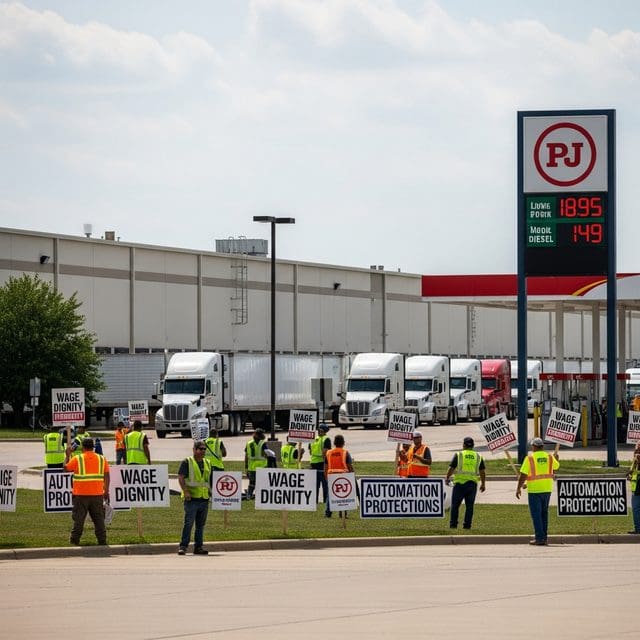
American workers navigate a complex landscape of industrial strikes, record-high diesel prices, and new AI transparency mandates that reshape the modern workplace.
The American worker is currently standing at a difficult crossroads where the physical demands of the industrial heartland meet the rapid, often invisible, expansion of digital automation. As of August 12, 2026, the economic environment for the manual trades has grown increasingly strained. The average price of diesel in the United States has climbed to $5.32 per gallon, a staggering 44-cent jump in just one month. Compared to the $3.71 per gallon seen only a year ago, this $1.61 increase represents a massive overhead burden for the logistics and transport sectors, driven largely by supply constraints stemming from the Russia-Ukraine war and the ongoing Iran crisis.
This spike in energy costs coincides with a significant labor flare-up in the Midwest. More than 190 Teamsters at IKEA’s distribution center in Joliet, Illinois, walked off the job this week. While the strike includes standard demands for higher wages and improved working conditions, the core of the dispute involves protections against automation. The Joliet workers are signaling a broader national concern: that the dignity of manual labor is being undervalued as firms look to replace human oversight with automated systems. For these workers, the fight is not just about the paycheck, but about ensuring that the stability of the American family isn’t sacrificed for the sake of a corporate algorithm.
Simultaneously, the technology sector is introducing new tools that will change how labor is monitored and verified. Anthropic has begun embedding invisible, machine-readable watermarks into all text output from its Claude models to comply with the European Union’s AI Act. These watermarks are statistical and imperceptible, baked directly into token choices so they can survive copy-pasting and light editing. This transparency regime, which carries fines of up to €15 million or 3% of global turnover for non-compliance, provides a concrete mechanism for employers and unions to verify whether workplace content or recruitment materials are human-made or AI-generated. By December 2026, even legacy models will be retrofitted with these markers, bringing older AI systems used in hiring and productivity monitoring under the same regulatory umbrella.
The pressure of this transition is felt most acutely by the aging workforce. Recent findings from Rutgers-affiliated researchers have linked extreme heat and occupational exposure to increased work disability among adults over 50 in heat-sensitive jobs. While some sectors are reportedly desperate to hire older workers for roles paying $20 or more per hour, there is a notable research gap regarding how post-pandemic automation and algorithmic hiring are affecting the job quality for those nearing retirement. Major employers like Union Pacific continue to emphasize geographically dispersed wage jobs in safety and operations, yet their public materials have yet to reflect specific initiatives for adapting to an aging labor pool or the integration of AI-mediated recruitment.
Despite these localized struggles, the broader U.S. economy shows a peculiar resilience. For the first time in four years, the average stock performance has beaten the S&P 500, and the K-shaped wealth gap between rich and lower-income consumers has begun to narrow. Spending growth is becoming less reliant on the wealthiest Americans, suggesting a stabilization in middle-class purchasing power. Additionally, Social Security recipients are looking at a potential 3.6% cost-of-living adjustment for 2027. However, for the men and women on the picket lines in Joliet or the independent truckers facing record fuel bills, these macroeconomic indicators offer little immediate relief from the tangible pressures of a changing industrial order.

Tom Blake serves as the Senior Correspondent for Labor, Wages, and Automation at Just Right News, where he brings a grounded, principled perspective to the most pressing economic issues facing the American heartland. As the lead voice behind the acclaimed feature series “The Price of Work,” Tom focuses his reporting on the intersection of traditional industry and the rapidly evolving technological landscape, always prioritizing the dignity of the individual worker and the health of the American family.
Tom’s deep understanding of the labor market is not merely academic; it is rooted in his upbringing in Detroit, Michigan. Growing up in the shadow of the automotive industry, he witnessed firsthand the triumphs and tribulations of the American blue-collar workforce. He saw how the stability of a manufacturing job could build a community and, conversely, how the erosion of those industries could tear the social fabric apart. This background instilled in him a lifelong respect for the trades and a healthy skepticism toward economic policies that prioritize globalist interests over the well-being of local communities.
Now based in Pittsburgh, Pennsylvania, Tom continues to report from the front lines of the shifting economy. Pittsburgh, a city that has reinvented itself while maintaining its gritty, industrious spirit, provides the perfect vantage point for his beat. From the steel mills that remain to the high-tech robotics labs reshaping the city’s future, Tom explores how automation is changing the nature of employment. His reporting often highlights the tension between innovation and tradition, arguing that while progress is inevitable, it must not come at the expense of the American worker’s ability to provide for their family through honest, meaningful labor.
In his role at Just Right News, Tom has become a vital voice for those who feel overlooked by mainstream economic coverage. He rejects the notion that the decline of American manufacturing is an unavoidable casualty of the modern era. Instead, his work often examines how regulatory overreach, rising energy costs, and the unchecked rise of automation impact the take-home pay of everyday citizens. Through “The Price of Work,” Tom delves into the true cost of economic shifts, looking beyond the raw data to tell the stories of the people behind the statistics.
Tom’s reporting is characterized by a commitment to the conservative values of self-reliance, fiscal responsibility, and the preservation of the American dream. He believes that a strong nation is built on a foundation of stable jobs and fair wages, and his work seeks to hold both government and corporate entities accountable to that standard. Whether he is interviewing a shop floor manager about the implementation of new AI technology or analyzing the impact of wage inflation on small businesses, Tom provides a clear-eyed analysis that resonates with readers who value hard work and common sense.
Through his dedicated coverage, Tom Blake remains a steadfast advocate for the American workforce, ensuring that the voices of those in the industrial heartland are heard loud and clear in the national conversation. His perspective is essential for anyone seeking to understand the complex realities of labor and automation in the twenty-first century.