

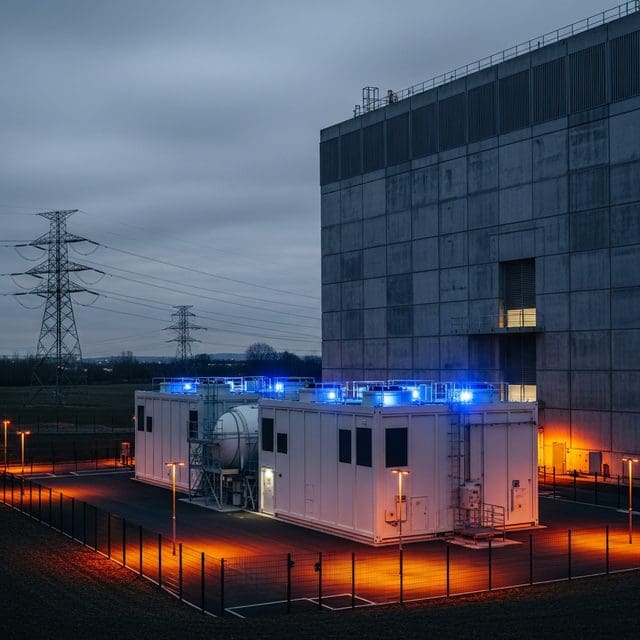
Venture capital is shifting focus toward the physical constraints of AI, pouring billions into nuclear microreactors and photonic chips to sustain the massive energy demands of next-generation data centers.
The digital frontier is hitting a physical wall, and the architects of the Algorithmic State are throwing billions at the power grid to keep the lights on. In a massive shift of capital, Silicon Valley’s focus has moved from pure software to the raw infrastructure required to sustain it. Valar Atomics recently closed a $1.2 billion funding package, including a $1 billion Series B led by Sequoia Capital and a $200 million JPMorgan-led credit facility, to mass-produce standardized microreactors. These 5 MW units are designed to sit alongside AI data centers, bypassing a crumbling energy grid.
This move by Sequoia signals that top-tier venture capital now views power generation as a core component of the AI stack rather than a utility afterthought. However, the path to an atomic buildout remains tethered to the state. Valar’s Ward 250 microreactor still awaits U.S. Nuclear Regulatory Commission approval, with investors explicitly betting on a White House-led regulatory overhaul to fast-track deployment. For citizens concerned with digital sovereignty, this centralization of energy and compute power creates a new layer of corporate-state dependency, where the infrastructure of the future is built on political favors and massive debt.
Simultaneously, Base Power secured a $1 billion Series D round for home and grid-scale battery systems. The arrival of these billion-dollar energy rounds confirms that the hyperscale buildouts required by providers like Amazon Web Services and Google Cloud are no longer sustainable under current infrastructure. The industry is moving toward a model where data centers are co-planned with dedicated nuclear and battery solutions, effectively creating private energy islands for Big Tech. This shift ensures that AI-driven electricity demand does not collapse the public grid, but it also isolates advanced technology within a fortified energy envelope.
On the hardware front, London-based OLIX Computing raised $312 million at a $3.3 billion valuation to develop its DX-1 optical tensor processing unit. This photonic inference accelerator aims to solve the heat and memory-bandwidth bottlenecks inherent in traditional Nvidia GPUs. With backing from the UK government’s Sovereign AI Fund, Reed Hastings, and Arm, the project highlights how sovereign capital is now directly subsidizing the hardware that will run future surveillance and processing agents. By targeting the power and cooling costs of large-scale inference, OLIX is attempting to fundamentally change the cost curve for every token processed by labs like Anthropic and OpenAI.
The trend extends into the realm of physical machines. Physical Intelligence is reportedly in talks for a $1 billion round at an $11 billion valuation—nearly doubling its price tag in just four months. Founded by former Google DeepMind researchers, the company builds robot foundation models for general-purpose physical tasks. This suggests that capital is now treating embodied AI with the same fervor that defined the LLM craze of 2023. As these models move from digital screens to physical robots, the need for secure governance becomes paramount. Cyera’s $600 million round remains the benchmark for this new era, focusing on the security and monitoring of AI agent activity within the enterprise.
As Anthropic and Zaelab partner to push enterprise AI into production, the underlying reality is a capital-intensive pivot toward controlling the very atoms that power the bits. The message from the markets is clear: the next phase of the AI revolution will not be won with code alone, but through the total domination of energy, specialized silicon, and the physical space they occupy. The tools of the future are being forged in a furnace of high-finance debt and nuclear ambition, far removed from the decentralized ideals of the early internet.

Lisa Grant serves as a Staff Writer for Just Right News, where she spearheads the publication’s coverage of Technology, Data Capitalism, and Surveillance. With a focus on the encroaching influence of Big Tech on the American way of life, Grant brings a critical, liberty-minded perspective to the most complex digital issues of the modern era. Her reporting is defined by a deep-seated skepticism of centralized power and a commitment to protecting the privacy and autonomy of the individual against the rising tide of what she calls the “Algorithmic State.”
Grant’s unique insight into the tech industry is rooted in her upbringing in Palo Alto, California. Growing up in the epicenter of Silicon Valley, she witnessed firsthand the transformation of the technology sector from a hub of scrappy, freedom-loving innovators into a landscape dominated by monolithic corporations. This proximity to the birth of the digital revolution provided her with an insider’s understanding of the culture and motivations driving the industry. For Grant, the shift toward data capitalism—where personal information is harvested as a primary commodity—is not just a market evolution, but a fundamental challenge to traditional American values of property rights and personal privacy. She saw the “garage startup” ethos replaced by a culture of data-mining and social engineering, a transition that informs her vigilant reporting today.
Now based in Seattle, Washington, Grant operates from another of the nation’s primary technological frontiers. Her location in the Pacific Northwest allows her to observe the real-world consequences of the tech industry’s expansion, from the implementation of invasive surveillance technologies in urban centers to the growing partnership between corporate entities and municipal governance. By reporting from the ground in Seattle, she bridges the gap between the abstract world of coding and the tangible impact it has on citizens’ daily lives, often highlighting how local policies serve as a testing ground for broader national surveillance initiatives.
At the heart of her work for Just Right News is her acclaimed feature series, “The Algorithmic State.” Through this series, Grant explores the ways in which automated systems and artificial intelligence are increasingly used to bypass traditional legislative processes and social norms. She argues that the reliance on opaque algorithms to manage society threatens to erode the transparency and accountability essential to a free republic. Her work meticulously documents how data-driven governance can lead to a “soft” surveillance state that penalizes traditional viewpoints and rewards digital conformity.
Grant’s reporting is a vital resource for readers who are wary of the “nanny state” and the unchecked power of digital gatekeepers. She views the defense of the digital frontier as the next great battle for constitutional conservatives. By exposing the mechanisms of data capitalism and the quiet expansion of surveillance networks, she empowers her audience to reclaim their digital sovereignty. In an era where information is often weaponized by those in power, Lisa Grant remains a steadfast advocate for the truth, ensuring that the principles of liberty and individual agency are not lost in the transition to an increasingly digital world.