

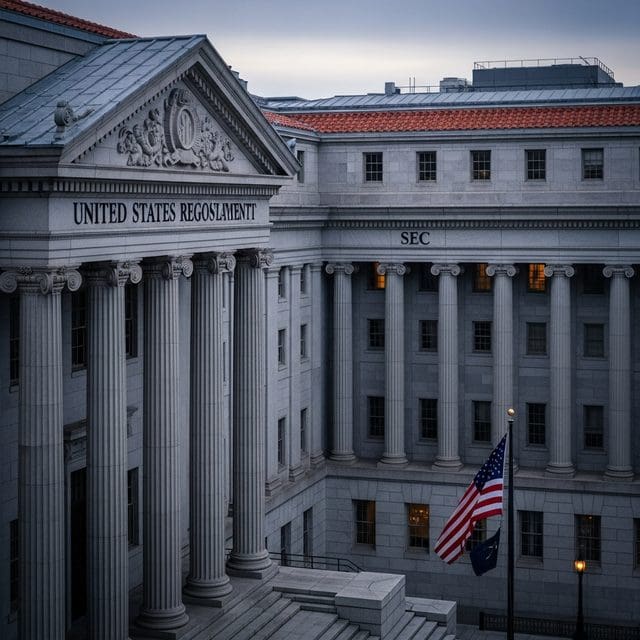
The SEC has stayed the approval of Nasdaq’s Bitcoin index options following a challenge by CME Group, signaling a deepening jurisdictional dispute between federal regulators over digital commodity derivatives.
The struggle for digital sovereignty in American markets reached a critical juncture this week as the Securities and Exchange Commission (SEC) formally stayed its approval of Nasdaq PHLX cash-settled Bitcoin index options. The July 29 order, which became a focal point of industry analysis by August 3, follows a petition for review by CME Group. The petition argues that Bitcoin index options are commodity contracts falling under the exclusive jurisdiction of the Commodity Futures Trading Commission (CFTC). This procedural freeze effectively halts the launch of new institutional hedging tools on equities exchanges, pending a high-stakes review of federal regulatory boundaries.
At the heart of the dispute is a fundamental question of market structure: whether Bitcoin-linked derivatives should be governed by securities laws or commodity frameworks. CME Group’s challenge asserts that the SEC exceeded its authority by approving the Nasdaq product, a move that critics argue creates unnecessary regulatory fragmentation. The SEC has set an August 24, 2026, deadline for written statements from interested parties. However, this date serves only as a comment deadline rather than a final decision point, leaving the timeline for a potential launch in limbo and maintaining CME’s current dominance in the Bitcoin derivatives space.
Parallel to this administrative battle, the U.S. Senate is weighing the Digital Asset Market CLARITY Act. The 616-page merged draft, which combines texts from the Banking and Agriculture Committees, aims to resolve these jurisdictional ‘turf wars’ by codifying the CFTC’s authority over spot markets for digital commodities like Bitcoin. While the bill is currently on the Senate Legislative Calendar (Calendar No. 423), its window for a floor vote is narrowing ahead of the August recess. Industry analysts note that if the Senate misses this window, momentum for the bill could slip into 2027, despite prediction markets currently pricing the odds of eventual passage at over 70 percent.
The legislative draft also introduces new constraints on executive overreach, including provisions that would prohibit the President and other federal officials from issuing or sponsoring digital assets. This focus on ethical guardrails reflects a growing consensus on the need to protect the decentralized nature of the Bitcoin protocol from political interference or state-sponsored competition. Furthermore, the act seeks to treat digital commodity venues as financial institutions under the Bank Secrecy Act, mandating strict AML/KYC and due diligence duties intended to harden the security of the broader ecosystem.
As the regulatory landscape shifts, the infrastructure supporting Bitcoin continues to face scrutiny. Recent debates among industry analysts, including Bloomberg’s Eric Balchunas, have highlighted the importance of robust custody and operational security standards for platforms handling Bitcoin spot and derivatives. These standards are viewed as essential for the long-term security of the network and the integrity of American digital leadership. Meanwhile, the global mining landscape continues to evolve, evidenced by Japan’s SBI Holdings officially discontinuing its Bitcoin mining pool as of July 31, representing a shift in how large regulated financial entities manage direct protocol participation.
The resolution of the SEC’s review and the fate of the CLARITY Act will ultimately determine whether Bitcoin derivatives trade on traditional equities exchanges like Nasdaq or remain confined to futures venues like CME. For proponents of a free-market digital economy, these developments represent a vital effort to establish a clear, constitutional framework that protects individual liberties against both corporate overreach and global authoritarianism in the New Cold War for digital supremacy.

Ryan Mitchell serves as a Staff Writer for Just Right News, where he anchors the desk for Cyber, Technology Policy, and Digital Sovereignty. In an era where the digital landscape has become as much a battlefield as any physical territory, Ryan provides a critical conservative lens on the forces shaping the future of American innovation and national security. His work is defined by a commitment to the idea that American leadership in the digital age is not just a matter of economic success, but a necessity for the preservation of global liberty.
Born and raised in Austin, Texas, Ryan’s perspective is deeply rooted in the Lone Star State’s tradition of independence and skepticism of centralized authority. Growing up in a city that transformed from a quiet state capital into a global technology hub, he witnessed firsthand the disruptive power of the tech industry. This upbringing instilled in him a firm belief in free-market principles and the necessity of protecting individual liberties from both government overreach and corporate overstep. His Texan background serves as a foundational compass, guiding his reporting toward stories that emphasize national resilience and the preservation of constitutional values in an increasingly virtual world.
Now based in San Francisco, California, Ryan operates from the epicenter of the very industry he scrutinizes. Living and working in the heart of Silicon Valley allows him to provide “boots on the ground” reporting that few conservative journalists can match. He navigates the cultural and political complexities of the Bay Area to bring Just Right News readers an inside look at the boardrooms and coding labs where the next generation of digital policy is forged. For Ryan, being stationed in San Francisco is a strategic choice; it allows him to challenge the prevailing ideological monoculture of the tech elite from within their own backyard, ensuring that the concerns of middle America are represented in the conversation about our digital future.
His beat—Cyber, Technology Policy, and Digital Sovereignty—covers the high-stakes world of data privacy, artificial intelligence, and the infrastructure of the modern web. Ryan is particularly focused on the concept of digital sovereignty, arguing that for a nation to remain truly free, it must maintain control over its own technological destiny and critical infrastructure. He frequently explores how international regulations and domestic policies impact the ability of American firms to compete without sacrificing the privacy or security of their citizens.
Central to his current body of work is his featured series, “The New Cold War.” Through this project, Ryan examines the escalating technological rivalry between the United States and its global adversaries. He delves into the complexities of state-sponsored hacking, the global race for semiconductor dominance, and the ideological struggle to define the rules of the internet. Ryan views this competition not merely as a commercial race, but as a fundamental defense of Western values against authoritarian digital models. Through his rigorous reporting and principled analysis, Ryan Mitchell ensures that the readers of Just Right News stay informed about the invisible forces defining the 21st century, always advocating for a future where technology serves the cause of freedom.