

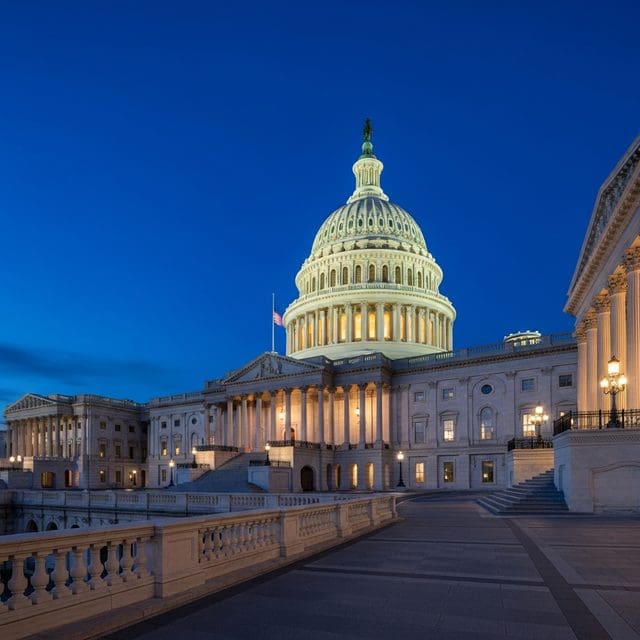
The Senate approved a bipartisan continuing resolution to avert a shutdown, featuring a significant rebuke of the Trump administration’s plan to politicize the federal grant approval process.
In a decisive 90-6 bipartisan vote on August 8, the U.S. Senate passed a short-term continuing resolution to fund federal agencies through December 11, 2026. This legislative action is designed to avert a looming government shutdown on October 1, providing lawmakers with a ten-week window to negotiate full-year appropriations. While the bill primarily maintains current spending levels, its inclusion of a significant policy rider marks a principled stand by the legislature against the expansion of executive influence over the administrative state.
The centerpiece of the Senate’s version is a provision that blocks the Trump administration from implementing a controversial rule regarding federal grant management. The proposed executive rule would have empowered political appointees to act as final gatekeepers for tens of billions of dollars in federal grants. These funds, which support universities, state governments, nonprofits, and research institutions, would have been subject to a new requirement: alignment with specific presidential priorities. By stripping the administration’s ability to enforce this rule during the life of the funding bill, the Senate has signaled a bipartisan skepticism toward the politicization of civil-society funding.
This development creates a significant tactical divide between the two chambers of Congress. The House of Representatives previously passed its own stopgap measure, which funds the government only through December 4 and lacks the Senate’s restrictive language on grant oversight. The House version also excluded several funding increases and authorizations requested by the executive branch. The discrepancy in dates and policy riders sets the stage for a high-stakes bicameral standoff as the fiscal year draws to a close. Senator Darline Graham (R-S.C.) notably voted “present” on the Senate measure, highlighting the nuanced internal debates within the Republican conference regarding the duration of stopgap measures and the limits of executive reach.
Despite the restriction on its grant-approval authority, the White House issued a formal Statement of Administration Policy through the Office of Management and Budget supporting the Senate bill. The statement urged every member of Congress to support the resolution to keep the government open while discussions on full-year appropriations continue. Notably, the White House has withheld such a formal endorsement for the House bill. This preference for the Senate’s longer timeline and specific funding authorizations puts additional pressure on House leadership to reconsider their shorter, rider-free approach.
The broader political landscape remains volatile as these fiscal negotiations unfold. Beyond the halls of the Senate, the administration continues to navigate complex personnel and legal challenges. On the same day the Senate moved the funding bill, it also confirmed Todd Blanche as the new Attorney General. Meanwhile, prominent Republicans have been forced to address internal controversies, such as Senator Jim Banks (R-Ind.) and Senator Jon Husted (R-Ohio) calling for the resignation of Representative Max Miller over domestic abuse allegations. These distractions, coupled with reports from former Defense Secretary Mark Esper that Iran is being emboldened by regional conflicts, underscore the turbulent environment in which this budget battle is being fought.
As the October 1 deadline approaches, the focus remains on the structural integrity of federal systems. The Senate’s insistence on blocking the grant-control rule reflects a traditionalist view that the distribution of taxpayer-funded grants should remain insulated from the shifting winds of political appointments. Whether the House will yield to this perspective or insist on a version of the bill that grants the executive branch more latitude will determine the stability of the federal government through the end of the calendar year. For now, the Senate has asserted its role as a steward of the public trust, prioritizing institutional independence over administrative expediency.

Miles Harrington serves as the Senior Correspondent for Federal Systems & Executive Power at Just Right News, where he brings a disciplined, constitutionalist lens to the inner workings of the American government. With a focus on the mechanics of the federal bureaucracy and the limits of executive authority, Harrington has established himself as a vital voice for readers who value transparency, accountability, and the preservation of the separation of powers.
A native of Richmond, Virginia, Harrington’s perspective is deeply rooted in the traditions of the Old Dominion. Growing up in a city defined by its historical significance and its role as a center of American jurisprudence, he developed an early appreciation for the foundational principles of the Republic. His upbringing in Richmond—a place where the legacy of the Founding Fathers is woven into the landscape—instilled in him a belief that the federal government should remain within its constitutional bounds. This background informs his skepticism of centralized overreach and his commitment to reporting on the ways in which the administrative state impacts the lives of everyday citizens.
In his current role, Harrington specializes in the complexities of federal systems. He doesn’t just report on the headlines of the day; he digs into the structural shifts within the executive branch that often go unnoticed by the mainstream press. Whether he is analyzing the implications of a new federal regulation or investigating the expansion of agency jurisdiction, his work is characterized by a rigorous adherence to the facts and a dedication to the rule of law.
Harrington is perhaps best known for his signature feature series, “How Washington Works.” Through this ongoing project, he demystifies the often-opaque processes of the nation’s capital, pulling back the curtain on the “Deep State” and the unelected officials who wield significant influence over national policy. By breaking down complex legislative maneuvers and executive orders, he empowers Just Right News readers to understand the true levers of power in Washington. His reporting serves as a necessary check on the federal government, ensuring that the actions of those in power are held up to the light of public scrutiny.
Now based in Washington, D.C., Harrington operates at the epicenter of the political world, yet he remains intentionally distanced from the “Beltway bubble.” His proximity to the halls of power allows him to maintain a robust network of sources across the federal landscape, but his heart remains in the principled conservatism of his Virginia roots. He views his role not merely as a reporter, but as a steward of the public trust, dedicated to providing the clarity and context that conservative voters need to navigate an increasingly complex political environment.
Through his sharp analysis and unwavering commitment to the truth, Miles Harrington continues to be a cornerstone of the Just Right News team. His work ensures that the principles of limited government and executive restraint remain at the forefront of the national conversation, providing a crucial service to those who believe in a government that is truly of, by, and for the people.