

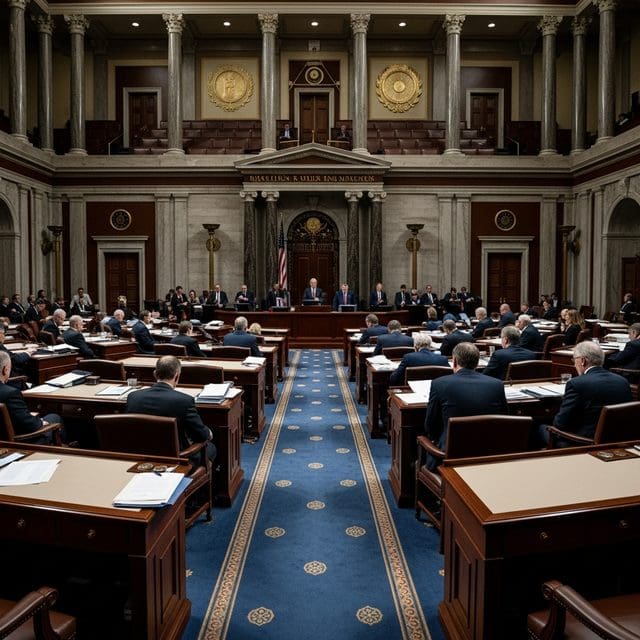
The U.S. Senate approved a continuing resolution through December 11, 2026, including specific provisions that curb the Trump administration’s authority to reallocate funds and oversee federal grant distributions.
The U.S. Senate moved to assert its constitutional authority over the federal purse this weekend, passing a short-term funding measure on August 8 to avert a government shutdown. The bill, which extends current funding levels through December 11, 2026, serves as a critical bridge across the upcoming November midterms. However, the legislation is far more than a simple extension of the status quo; it contains specific, targeted constraints on executive spending authority that signal a growing tension between the Capitol and the White House regarding the reach of the administrative state.
Central to the legislative text is a provision blocking the White House budget office from implementing a proposed rule that would have shifted the management of hundreds of billions of dollars in federal grants to political appointees. Senator Susan Collins was instrumental in securing language that prevents the administration from rewriting these grant regulations for the duration of the continuing resolution. This move, coupled with restrictions preventing the reallocation of funds toward border security from other programs, represents a concerted effort by the Senate to maintain the integrity of congressional appropriations against executive reprogramming. The bill also allows for targeted funding adjustments for housing and food assistance programs, marking a significant policy win for those seeking to protect the safety net from unilateral executive shifts.
While the Senate acted nearly two months ahead of the September 30 deadline, the path forward remains complicated by internal party dynamics and the legislative calendar. The House of Representatives must still pass its own version or a compromise measure after the August recess. Budget Chairman Ron Johnson indicated that while some conservatives sought to tie the funding to the SAVE America Act, the decision to delay that confrontation until September was made with the administration’s acknowledgment. Senator Mike Rounds noted that the delay reflects a pragmatic recognition that the necessary votes for more contentious riders are not yet present, stating the delay is consistent with the President’s approach given the current vote count.
Amidst these fiscal negotiations, the White House is preparing for a significant transition in its legal leadership. President Trump announced that Will Scharf, currently serving as White House staff secretary, will succeed David Warrington as White House Counsel effective September 1, 2026. Scharf, a disciplined conservative strategist who played a key role in the President’s Supreme Court immunity case, will inherit a portfolio likely to be dominated by congressional oversight battles and subpoena defenses. His appointment comes at a time when Defense Secretary Pete Hegseth is pushing for a record-breaking $1.5 trillion defense budget, a figure that has yet to find a clear path through a divided Senate.
Beyond the halls of the Senate, the administration faces mounting pressure on national security and energy fronts that complicate the broader policy landscape. Representative John Moolenaar, chairman of the House Select Committee on China, has urged the executive branch to tighten export controls on advanced logic chips to prevent them from reaching untrusted Chinese firms. Simultaneously, recent data shows the Strategic Petroleum Reserve has reached its lowest level since 1983, leaving the nation with approximately 43 days of supply. These converging pressures—fiscal, legal, and strategic—ensure a high-stakes legislative session when Congress returns from its summer hiatus to finalize the nation’s spending priorities.
The administrative state also continues its steady march through personnel and regulatory changes. The Senate recently confirmed Todd Blanche as Attorney General in a narrow 50-49 vote, solidifying the administration’s legal leadership just as the Michigan Senate race heats up following Abdul El-Sayed’s primary victory. As the Conference Board Employment Trends Index shows a slight increase for July, the administration must balance these economic indicators against the reality of a 45-year low in crude oil supplies. Each of these developments underscores the complexity of the current political moment, where the struggle for executive control meets the rigid boundaries of constitutional oversight.

Miles Harrington serves as the Senior Correspondent for Federal Systems & Executive Power at Just Right News, where he brings a disciplined, constitutionalist lens to the inner workings of the American government. With a focus on the mechanics of the federal bureaucracy and the limits of executive authority, Harrington has established himself as a vital voice for readers who value transparency, accountability, and the preservation of the separation of powers.
A native of Richmond, Virginia, Harrington’s perspective is deeply rooted in the traditions of the Old Dominion. Growing up in a city defined by its historical significance and its role as a center of American jurisprudence, he developed an early appreciation for the foundational principles of the Republic. His upbringing in Richmond—a place where the legacy of the Founding Fathers is woven into the landscape—instilled in him a belief that the federal government should remain within its constitutional bounds. This background informs his skepticism of centralized overreach and his commitment to reporting on the ways in which the administrative state impacts the lives of everyday citizens.
In his current role, Harrington specializes in the complexities of federal systems. He doesn’t just report on the headlines of the day; he digs into the structural shifts within the executive branch that often go unnoticed by the mainstream press. Whether he is analyzing the implications of a new federal regulation or investigating the expansion of agency jurisdiction, his work is characterized by a rigorous adherence to the facts and a dedication to the rule of law.
Harrington is perhaps best known for his signature feature series, “How Washington Works.” Through this ongoing project, he demystifies the often-opaque processes of the nation’s capital, pulling back the curtain on the “Deep State” and the unelected officials who wield significant influence over national policy. By breaking down complex legislative maneuvers and executive orders, he empowers Just Right News readers to understand the true levers of power in Washington. His reporting serves as a necessary check on the federal government, ensuring that the actions of those in power are held up to the light of public scrutiny.
Now based in Washington, D.C., Harrington operates at the epicenter of the political world, yet he remains intentionally distanced from the “Beltway bubble.” His proximity to the halls of power allows him to maintain a robust network of sources across the federal landscape, but his heart remains in the principled conservatism of his Virginia roots. He views his role not merely as a reporter, but as a steward of the public trust, dedicated to providing the clarity and context that conservative voters need to navigate an increasingly complex political environment.
Through his sharp analysis and unwavering commitment to the truth, Miles Harrington continues to be a cornerstone of the Just Right News team. His work ensures that the principles of limited government and executive restraint remain at the forefront of the national conversation, providing a crucial service to those who believe in a government that is truly of, by, and for the people.