

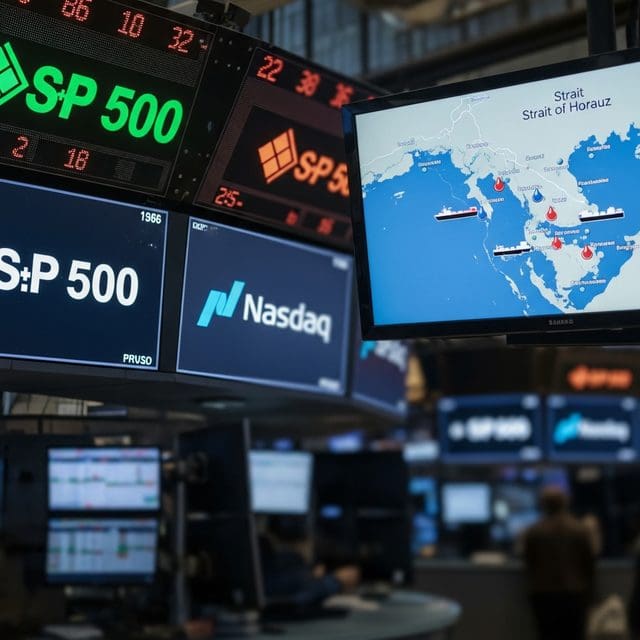
The S&P 500 holds steady while tech and energy sectors diverge amid shifting Federal Reserve expectations and ongoing supply disruptions in the Strait of Hormuz.
Global financial markets are hovering just below record highs this Monday, with the S&P 500 effectively flat as the session opens. While the benchmark SPY sits at a marginal -0.05% decline, the underlying narrative is one of significant sector dispersion. Tech and consumer growth names are finding support from a shift in monetary expectations, while energy remains elevated by geopolitical friction in the Middle East. For the American taxpayer, this environment represents a tug-of-war between centralized financial control and the raw realities of global supply chains.
The Federal Reserve remains the primary focus for market participants. Following a weak payrolls print, futures markets have slashed the probability of a September rate hike to roughly 44%, down from 67% just one week ago. With the 10-year Treasury yield holding near 4.65%, the market is increasingly positioning for the tightening cycle to have reached its terminal point. JPMorgan’s chief U.S. economist, Michael Feroli, noted that while core CPI projections of 0.22% may not trigger a hike, any move toward 0.3% could force the Fed’s hand, a nuance that keeps rate-sensitive sectors on edge. This caution is reflected in the July U.S. CPI report due Wednesday, where economists expect a slight cooling to 3.4% year-over-year from June’s 3.5%.
In the technology sector, the Nasdaq is attempting to build on last week’s 5% gain. Roughly 90% of S&P 500 companies have now reported earnings, revealing a robust 30% year-over-year jump in earnings per share when excluding specific investment gains at Alphabet and Amazon. The meritocracy of the market is on full display as AI-linked stocks show a median EPS growth of 28%, significantly outperforming the 12% growth seen in non-AI sectors. This divergence highlights where capital is being deployed as investors seek productivity gains in a high-cost environment, even as SpaceX stock finally moved above its IPO price for the first time in a month. Further tech leadership is evidenced by Blue Ridge Associates appointing Adam Studdard as CTO to lead enterprise AI strategy, signaling that corporate America is doubling down on automation despite macro headwinds.
Energy markets are providing a counterweight to the broader indices. Brent crude is trading near $84.50 and WTI near $79 as the Strait of Hormuz remains largely closed to traffic. Despite Treasury Secretary Scott Bessent’s weekend remarks downplaying the strategic necessity of the strait by suggesting flows will be redirected via pipelines, the immediate reality for global supply remains constrained. Iran continues to demand U.S. concessions before reopening the shipping lanes, keeping a floor under energy prices and pressuring the transport and consumer sectors via input costs. This uncertainty contributed to a 1.0% rise in Brent today, while Asian markets like Japan’s Nikkei surged 2.0% in response to broader regional shifts.
Institutional movements suggest a focus on domestic stability and infrastructure. Berkshire Hathaway has signaled confidence in domestic value, doubling its quarterly profit to include a near $13 billion investment gain and deploying $32 billion of its cash pile, including repurchases of its own stock as of August 10. In the industrial sector, Industrial Control Solutions acquired Modern Instrument Company to bolster aerospace validation services, while Zaria Systems filed for a national trust bank charter, signaling continued institutional expansion despite the macro uncertainty. Even the housing market shows localized strength, with international buyers purchasing $4 billion in Texas homes between April 2025 and March 2026, totaling 7,780 purchases.
For the working household, the labor market shows signs of resilience despite cooling headline data; the Conference Board Employment Trends Index rose to 107.71 in July from 106.74 in June. Furthermore, companies like Koppers Holdings Inc. continue to return value through dividends, declaring $0.09 per share. As Traxxion launches earned wage access tools for frontline workers, the economy is clearly in transition—one where centralized rate control is losing its grip to the realities of industrial supply, technological shifts, and the persistent demand for energy and housing.

Jordan Lee serves as the Senior Correspondent for Wall Street, Finance, and Monetary Systems at Just Right News. Based in the heart of the world’s financial capital, New York City, Lee brings a sharp, principled eye to the complex mechanisms that drive the global economy. His reporting is defined by a commitment to fiscal responsibility, the defense of the free market, and a deep-seated belief that a transparent monetary system is the bedrock of a free society.
Raised in Portland, Oregon, Lee’s perspective was forged in a city that has undergone significant cultural and economic shifts. His upbringing in the Pacific Northwest instilled in him a profound appreciation for the industriousness of small business owners and the importance of local economic stability. Watching the evolution of his hometown’s landscape sparked an early interest in how federal fiscal policy and large-scale financial trends eventually trickle down to the average citizen. This background provides him with a unique vantage point; he understands the growing disconnect between the policy-making elite and the reality of Main Street, a theme that frequently resonates throughout his work.
Now operating from his base in New York City, Lee bridges the gap between the high-stakes trading floors of Manhattan and the households of everyday Americans. He views the financial sector not merely as a collection of numbers and tickers, but as a vital engine of American prosperity that requires constant vigilance and accountability. His reporting often highlights the dangers of centralized financial control and the necessity of maintaining a system that rewards merit, risk-taking, and innovation.
As the creator and lead of the featured series, “The Invisible Economy,” Lee pulls back the curtain on the often-opaque world of monetary systems. He specializes in translating the dense jargon of central banking and international finance into actionable insights for the Just Right News audience. His work explores the “invisible” forces—such as inflationary pressures, regulatory creep, and the expansion of the administrative state—that erode the purchasing power of American families. By focusing on these systemic issues, Lee empowers readers to understand the hidden forces shaping their financial independence.
Lee’s journalistic philosophy is rooted in a steadfast commitment to traditional American values. As an Asian American professional who has navigated the competitive corridors of the financial world, he is a vocal advocate for meritocracy and the preservation of the American Dream. He believes that a stable currency and a predictable regulatory environment are essential for national sovereignty and individual liberty. His reporting frequently warns against the risks of government overreach in the private sector, arguing that the most effective solutions to economic challenges arise from competition and individual enterprise rather than bureaucratic mandates.
At Just Right News, Jordan Lee remains dedicated to providing a clear-eyed defense of the taxpayer. Whether he is analyzing market volatility or investigating the long-term implications of national debt, his mission is to provide the truth about where the money is going and what it means for the future of the country. Through his rigorous analysis and principled stance, Lee has become a trusted voice for those who value a strong, sovereign, and fiscally sound America.