

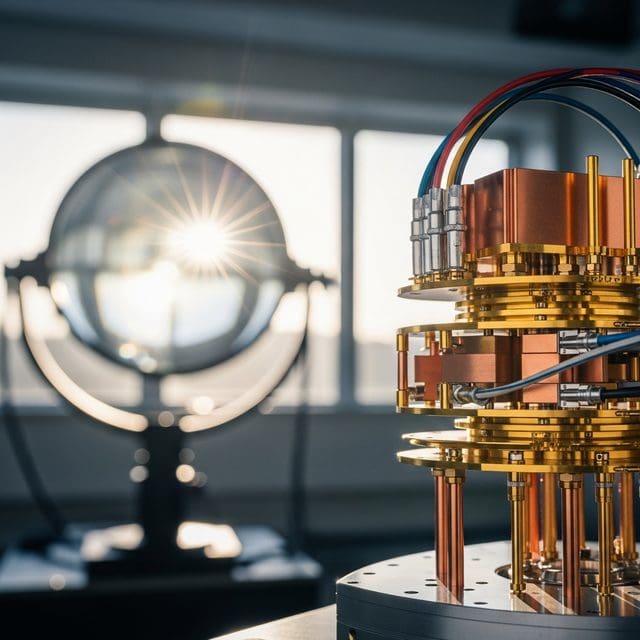
IBM and University of Chicago researchers have demonstrated a verified quantum computation that surpasses classical simulation capabilities, marking a significant milestone in the quest for reliable, large-scale quantum advantage.
The long-promised era of quantum advantage moved from theoretical speculation to measurable reality this week. Researchers from IBM and the University of Chicago announced the successful execution of a computation on IBM’s Boston processor that defies practical classical simulation while remaining verifiable—a critical threshold for the future of secure digital infrastructure. This experiment utilized 70 logical qubits and 2,415 logical two-qubit operations, representing one of the most complex demonstrations of error-correction to date.
Using a protocol known as doped Clifford sampling, the team achieved a certified lower bound on state fidelity of 0.284 at a 95 percent confidence level. The technical achievement lies in error suppression; by utilizing a spacetime error-detecting code, researchers reduced effective two-qubit error rates by approximately tenfold. Jay Gambetta, IBM’s Vice President of Quantum, stated that the field is now firmly in the quantum advantage era, providing a foundation for trusting these machines as they scale toward commercial and national security applications. The computation was completed in approximately 15 minutes, a timeframe that underscores the efficiency of the hardware compared to the weeks a classical supercomputer might require.
This development addresses the ‘black box’ problem inherent in emerging technology. Historically, as quantum computers became more powerful, it became difficult to prove they were performing math correctly without a classical computer to check the work. By creating a task that is hard for traditional silicon chips to mimic but easy for researchers to audit, IBM has established a transparent benchmark. The team has released the circuits on a public Quantum Advantage Tracker, inviting scrutiny rather than relying on proprietary claims. This move toward reproducibility is essential for maintaining American leadership in a field where transparency is often sacrificed for corporate secrecy.
Parallel to these gains in processing power, a separate breakthrough suggests the hardware of the future may be more grounded in natural resources. Scientists at the Max Planck Institute for the Science of Light and the University of Ottawa successfully generated quantum entanglement using concentrated outdoor sunlight. By using a window-sized Fresnel lens to feed a nonlinear crystal, the team achieved a 94 percent Bell-state fidelity. This matches the performance of expensive laboratory lasers, proving that the sun can pump the spontaneous parametric down-conversion necessary for quantum links.
Furthermore, researchers at Imperial College London introduced ‘Clavina,’ a shape-shifting photonic architecture designed to overcome the limitations of light-based computing. Photons are excellent carriers of information but typically difficult to make interact. Clavina allows for programmable, modular configurations that can simulate complex models or generate error-correction resources more reliably.
These dual advancements point toward a future where quantum technology is both more reliable and less dependent on massive, centralized energy grids. For those concerned with national sovereignty, the ability to power secure quantum communication links with natural sunlight offers a glimpse into a resilient digital frontier. As the focus shifts from mere ‘supremacy’ to ‘utility,’ the goal is to build machines that are verifiable and integrated with physical reality. With logical error rates now falling below physical error rates, the path toward a functional quantum economy is becoming clearer, promising a future where individual liberty is protected by the laws of physics.

Mason Reed serves as a Staff Writer for Just Right News, where he spearheads the Future Frontiers & Special Projects desk. In an era defined by rapid technological shifts and evolving social landscapes, Mason provides a steady, principled voice, examining the innovations of tomorrow through the lens of traditional American values. His work is most prominently featured in his signature series, “The Next Horizon,” where he explores the intersection of emerging technology, national sovereignty, and the preservation of individual liberty.
A native of San Diego, California, Mason’s worldview was shaped by the unique culture of his hometown. Growing up in a region defined by its strong military presence and its history of maritime industry, he developed a deep-seated respect for the institutions that provide national stability and the entrepreneurial spirit that drives the American economy. This upbringing instilled in him a belief that true progress is not found in discarding the past, but in building upon a foundation of proven principles. His reporting often reflects this San Diego influence, emphasizing the importance of a robust national defense and the necessity of maintaining a competitive edge in the global marketplace.
Now based in San Francisco, Mason operates from the heart of the world’s technological engine. Living and working in the Bay Area provides him with a front-row seat to the advancements—and the ideological challenges—emanating from Silicon Valley. While many in the region embrace a “move fast and break things” mentality, Mason’s reporting serves as a vital counterweight. He offers Just Right News readers a “boots on the ground” perspective, documenting how radical local policies and the concentration of tech power impact the everyday lives of citizens. His proximity to the industry allows him to cut through the marketing jargon of big tech to uncover the real-world implications for privacy, free speech, and the nuclear family.
In his “Future Frontiers” beat, Mason tackles complex subjects ranging from the ethics of artificial intelligence to the burgeoning private space race. He approaches these topics with a healthy skepticism toward centralized bureaucracy, championing instead the decentralized innovations that empower individuals. Through “The Next Horizon,” he highlights the pioneers and thinkers who are working to ensure that the future remains a place where human dignity and constitutional rights are protected. He believes that the rapid pace of change requires more than just technical expertise; it requires a moral compass rooted in the Western tradition.
Throughout his tenure at Just Right News, Mason has remained committed to the idea that the future is something to be shaped, not merely accepted. His writing is characterized by a rigorous defense of American exceptionalism and a belief that the country’s best days lie ahead, provided it remains true to its founding ideals. Whether he is investigating the impact of automation on the American workforce or profiling the next generation of aerospace engineers, Mason Reed ensures that his readers are equipped with the insights they need to navigate a changing world with confidence and clarity.