

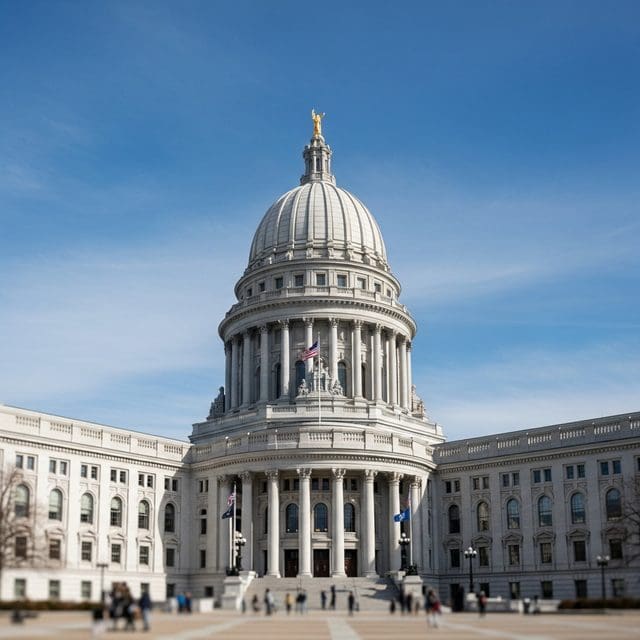
As Wisconsin prepares for the August 11 primary, Representative Francesca Hong’s democratic socialist platform faces a crucial test in the race to succeed Governor Tony Evers.
The laboratories of democracy are operating at high heat in Wisconsin this month as the state prepares for an August 11 primary that will define the post-Evers era. With Governor Tony Evers declining to seek a third term, the open-seat race has become a focal point for constitutionalists and policy observers interested in how state-level experiments influence the national landscape. State Representative Francesca Hong has emerged as the Democratic front-runner, positioning her campaign as a radical departure from the incrementalism often seen in Midwestern statehouses, effectively defining the race through an unapologetically progressive lens.
Hong’s platform represents a significant challenge to traditional decentralized governance by advocating for expanded state and local interventions. Her policy planks include a $20 minimum wage and a controversial proposal to allow local municipalities to implement income tax hikes on high earners. Perhaps most striking for proponents of the free market is her call for a freeze on new data-center construction, a move that signals a skeptical view of the technological infrastructure growth currently sweeping through the heartland. These proposals are paired with calls for universal childcare and robust increases in public-education funding, creating a stark policy contrast with the existing status quo.
While Hong has effectively defined the primary race, polling indicates a tight contest for the general election. A Marquette Law School poll conducted between July 8 and July 16 shows Republican Representative Tom Tiffany leading Hong 43% to 40%, with 17% of the electorate still undecided. This narrow margin underscores the razor-thin nature of Wisconsin politics and suggests that the winner of the Democratic primary—which includes David Crowley, Joel Brennan, and Kelda Roys—will face an uphill battle against a well-funded GOP opponent. The financial disparity is particularly noteworthy; Tiffany has raised approximately $8.7 million, dwarfing the $715,000 reported by Hong’s campaign. Overall, Wisconsin Democrats report having $727,000 cash on hand, highlighting a significant GOP financial advantage heading toward November.
The ideological stakes extend beyond mere policy. Hong’s campaign has drawn scrutiny for its unconventional staffing, including reports that former child actress Renee Olstead holds a senior role. This unconventional approach, combined with a platform that leans heavily into democratic socialism, has created a rift between progressive organizers and traditional Democrats who worry about viability among moderate and independent voters. The primary serves as a live test of whether progressive enthusiasm can bring enough new voters into the electorate to overcome the financial and ideological hurdles inherent in a battleground state.
This tension in Wisconsin mirrors broader national shifts in both parties. While Michigan Democrats recently saw Abdul El-Sayed win a Senate primary with the endorsement of Governor Gretchen Whitmer, and Tennessee Republicans saw Senator Bill Hagerty advance to a general election rematch, Wisconsin’s open gubernatorial seat offers a unique look at executive power. The outcome will determine if the state continues to act as a laboratory for progressive social experiments or returns to the deregulation and fiscal restraint that characterized previous conservative administrations.
From a federalist perspective, the Wisconsin race is a quintessential example of the ‘Fifty Laboratories of Power.’ Should Hong prevail, Wisconsin would become a testing ground for aggressive local taxation and industrial regulation. If the GOP holds the seat, the focus will likely shift back to Tenth Amendment principles of limited government. As the August 11 primary approaches, the Badger State remains a critical theater for observing how local institutions and state-level sovereignty are utilized to reshape the American political fabric.

Dylan Brooks serves as the Senior Correspondent for Statehouses and Local Governance at Just Right News, where he brings a principled, constitutionalist lens to the often-overlooked machinery of state-level politics. As the lead voice behind the acclaimed feature series “Fifty Laboratories of Power,” Dylan has dedicated his career to the idea that the most impactful governance happens closest to home. His reporting consistently champions the Tenth Amendment, exploring how individual states can serve as testing grounds for innovative, conservative policy solutions that prioritize personal liberty and fiscal responsibility.
A native of Des Moines, Iowa, Dylan’s journalistic philosophy was forged in the heart of the American Midwest. Growing up in a community where local school board meetings and town halls were the bedrock of civic life, he developed a deep appreciation for the “retail politics” of the heartland. This upbringing instilled in him a fundamental belief that the American experiment is best preserved when power is decentralized. He carries the values of his Iowa roots into every assignment, maintaining a healthy skepticism of federal overreach and a steadfast commitment to the concerns of everyday citizens over the interests of the administrative state.
Now based in Madison, Wisconsin, Dylan operates from one of the nation’s most pivotal political battlegrounds. His location in a state capital known for its rigorous policy debates allows him to provide Just Right News readers with a front-row seat to the legislative process. From Madison, he tracks the ripple effects of statehouse decisions on local municipalities, ensuring that the connection between high-level policy and community impact is never lost. His work often highlights the success of conservative governors and legislatures in fostering economic growth, protecting parental rights, and securing the integrity of local institutions.
As an African American man in the conservative media landscape, Dylan offers a vital perspective on how limited government and free-market principles empower individuals and families. He frequently reports on how deregulation and school choice initiatives provide new avenues for success in underserved communities, challenging the monolithic narratives often presented by legacy media outlets. Dylan’s work is characterized by a commitment to the facts and a refusal to shy away from the complex realities of modern governance.
Throughout his tenure at Just Right News, Dylan has become a trusted authority for readers who value a rigorous, principled approach to the news. Whether he is dissecting a complex state budget or profiling a local grassroots movement, his goal remains the same: to provide the American public with the information they need to hold their local leaders accountable. By focusing on the “Fifty Laboratories of Power,” Dylan Brooks ensures that the vital work being done in statehouses across the country receives the national attention it deserves, always through a lens that respects the traditions and sovereignty of the American people.