

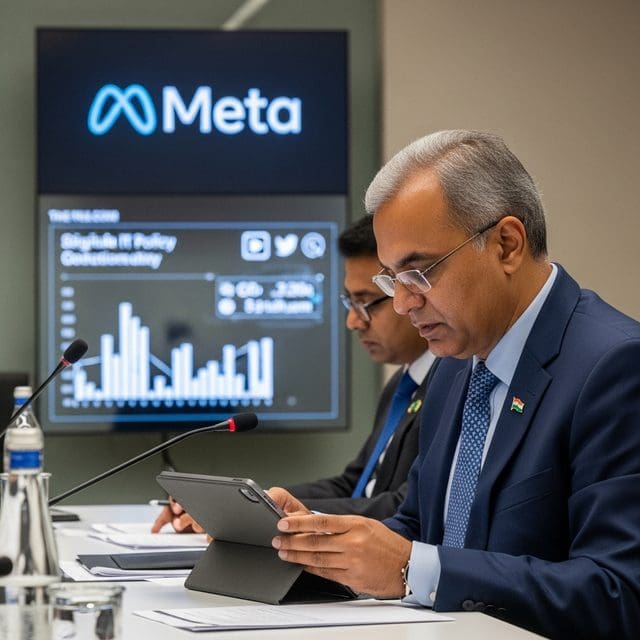
Meta executives issued a formal apology to the Indian government following the erroneous removal of a post by Prime Minister Narendra Modi regarding national security and paper leaks.
The delicate balance between global tech platforms and national sovereignty faced a fresh test this week as Meta executives apologized for restricting content from Indian Prime Minister Narendra Modi. The incident, which Meta described as a technical error, has reignited a fierce debate over the power of Silicon Valley to curate the digital town square. For those who value information integrity, the episode serves as a reminder that the algorithms governing public discourse are often opaque and prone to errors that carry significant diplomatic consequences.
Meta’s Joel Kaplan, head of global public policy, issued a formal apology to India’s IT Ministry following the brief July restriction of a post by the Prime Minister concerning strict actions against paper leaks. The Indian government responded with significant pressure, summoning Meta officials to explain the lapse at the highest level. In response, Meta has reportedly established new protocols for prominent-person accounts, including multiple layers of review by senior officials to prevent future erroneous takedowns. This move highlights a growing trend where platforms are forced to create tiered systems of oversight for the powerful.
The friction between the platform and the state extends beyond a single post. A parliamentary IT committee issued a three-day ultimatum to Meta CEO Mark Zuckerberg, warning that the company’s safe-harbor protection under Section 79(3) of the IT Act could be withdrawn if compliance concerns were not addressed. Indian officials are now pressing for greater algorithmic transparency, demanding to know why certain posts receive disproportionate traction and how the platform intends to handle the rising threat of AI-generated deepfakes. The government’s concern is not merely about censorship, but about the invisible hand of the algorithm shaping the democratic process.
This controversy coincides with heightening regional tensions played out across digital and diplomatic channels. The Bangladeshi government expressed outrage over an August 5 press conference held in New Delhi by former Prime Minister Sheikh Hasina. Dhaka had reportedly warned India that allowing the event to proceed would damage bilateral ties, illustrating how the intersection of physical diplomacy and media access remains a volatile flashpoint. The fallout from the Hasina press conference has put the India-Bangladesh reset in peril, with questions arising about whether Prime Minister Tariq Rahman will attend the upcoming BRICS Summit in Delhi.
As Meta attempts to navigate these geopolitical minefields, the company is also facing scrutiny over broader moderation failures. Indian officials expanded their review of the Modi incident to include concerns regarding child sexual abuse material on Instagram. The government is demanding a comprehensive explanation of how Meta manages AI-generated content and ensures that its platforms are not used to facilitate illegal activity. This broader investigation suggests that the Indian government is no longer willing to accept the “error” defense from Big Tech.
While Meta promises strengthened oversight, the fundamental question remains whether a private corporation based in California can ever adequately balance the cultural and legal expectations of a diverse global audience. The institutional context of these events is further complicated by a global landscape of shifting power, from President Trump’s recent Section 232 proclamations on solar manufacturing to the launch of the Water Watch Center to defend U.S. utilities. In this environment, the control of information is as vital as the control of energy or water. The Indian government appears determined to hold tech giants accountable to the same standards of integrity expected of traditional media outlets, ensuring that national narratives are not filtered through a biased or incompetent digital lens.

Chloe Foster serves as a Staff Writer for Just Right News, where she spearheads the outlet’s coverage of Media, Culture, and Information Integrity. In an era defined by rapid-fire digital communication and shifting societal norms, Chloe has distinguished herself as a vital voice for readers seeking clarity amidst the noise. Her signature feature series, “The Story Wars,” has become a cornerstone of the publication, offering a deep dive into the ideological battles currently shaping American life and the ways in which mainstream narratives are constructed, disseminated, and often manipulated.
Chloe’s unique perspective is informed by a life lived in two of the nation’s most influential cultural hubs. Raised in Los Angeles, California, she grew up in the shadow of the world’s most powerful media and entertainment apparatus. This upbringing provided her with a front-row seat to the “dream factory,” allowing her to observe firsthand how cultural exports are crafted and how they often diverge from the lived experiences of everyday Americans. Her time in Los Angeles instilled in her a healthy skepticism of manufactured consensus and a passion for uncovering the truths that lie beneath polished public relations campaigns.
Today, Chloe operates from Brooklyn, New York, a vantage point that places her at the epicenter of the modern media landscape. Living and working in a deep-blue urban environment as a conservative journalist has sharpened her reporting, requiring a rigorous commitment to intellectual honesty and a steadfast defense of traditional values. Her base in Brooklyn allows her to engage directly with the institutions and influencers who drive the national conversation, providing Just Right News readers with an “on-the-ground” look at the cultural shifts originating in the Northeast.
As a Hispanic woman, Chloe brings a nuanced understanding of community and heritage to her beat. She frequently explores how media portrayals of the Latino community often overlook the deep-seated faith, entrepreneurial spirit, and family-centric values that define it. Her work challenges the monolithic labels often applied by mainstream outlets, instead highlighting the diversity of thought and the conservative principles that resonate within her community.
In her role at Just Right News, Chloe views “Information Integrity” not merely as a buzzword, but as a mission. She believes that a healthy republic requires a media landscape where facts are prioritized over agendas and where the public is empowered to think for themselves. Through “The Story Wars,” she deconstructs the framing of major news events, exposing bias and providing the context necessary for readers to understand the broader cultural implications of the day’s headlines.
Chloe Foster’s reporting is more than just a collection of articles; it is a sustained effort to reclaim the narrative for those who feel sidelined by the prevailing media establishment. By bridging the gap between her West Coast roots and her East Coast base, she continues to provide essential commentary on the forces that define our shared American culture.