

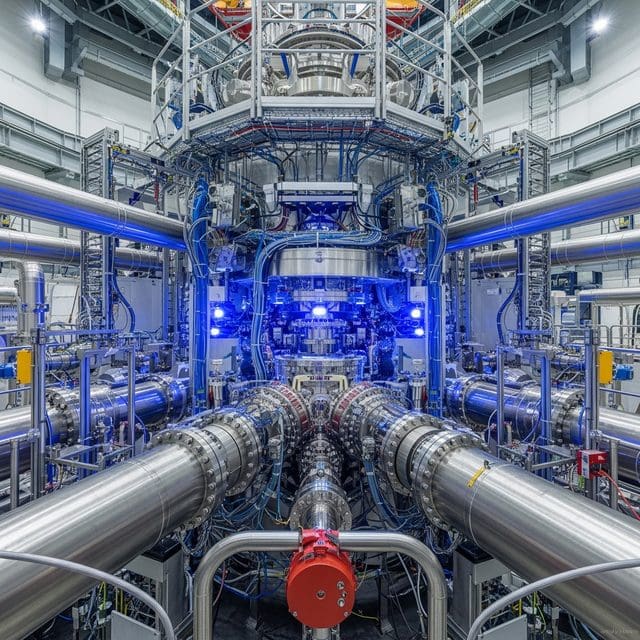
Physicists in China have successfully produced the rare isotope hafnium-153, marking the first major achievement for a massive new heavy-ion accelerator facility during its initial commissioning phase.
The map of the known physical universe expanded this week as researchers in China announced the discovery of hafnium-153, a rare and highly unstable atomic nucleus. The achievement, published August 5 in Science Bulletin, represents the inaugural physics result from the High Intensity Heavy-ion Accelerator Facility (HIAF) in Huizhou, Guangdong. The facility, which only recently completed technical acceptance on July 21, 2026, is already being positioned as a global leader in nuclear mass spectrometry and heavy-ion research.
By colliding heavy ions at high speeds, the HIAF team successfully produced and identified ten atoms of hafnium-153. This specific isotope is known as a neutron-deficient nucleus, sitting near the so-called proton drip line—the extreme boundary where an atomic nucleus contains so few neutrons that it begins to leak protons. Confirming that hafnium-153 is bound, or at least weakly bound, provides critical data for nuclear physicists attempting to model the fundamental forces that hold matter together at the limits of stability. The experiment was remarkably efficient, capturing these ten atoms within just ten days of operation while the facility was running at only ten percent of its projected full power.
Understanding the stability of such exotic isotopes is essential for nuclear astrophysics, particularly in explaining the r-process and other mechanisms by which heavy elements are forged during the violent deaths of stars. While Japan’s RIKEN Radioactive Isotope Beam Factory independently reported observations of hafnium-153, providing a vital mutual confirmation, the speed with which the Chinese facility achieved these results signals a significant shift in the global balance of scientific infrastructure. The HIAF is now recognized as a national mega-science project, intended to serve as a hub for fundamental nuclear structure, materials science, and medical isotope engineering.
Parallel to these developments in nuclear physics, the private sector continues to push the boundaries of the quantum realm. D-Wave Quantum Inc. announced a significant hardware breakthrough in quantum error correction, reporting a two-qubit entangling gate with 99.9% fidelity. This research, published in Nature, utilizes a superconducting dual-rail erasure qubit architecture. Unlike traditional qubits, these erasure-type units allow certain errors to be flagged rather than remaining undetected, which could substantially reduce the hardware overhead required for fault-tolerant computing. D-Wave’s simulations suggest this architecture could reduce logical error rates by a factor of ten for each increment in error correction, making large-scale quantum systems more viable.
Further complicating the cosmic picture, physicists at the Perimeter Institute for Theoretical Physics published findings in the Journal of Cosmology and Astroparticle Physics regarding the nature of dark matter. Their research into a hypothetical dark force suggests that while such a force might cause dark matter to cluster, it also causes particles to effectively lose mass as the universe expands. This mass loss weakens their gravitational pull, ultimately suppressing rather than enhancing the growth of large-scale cosmic structures. This discovery challenges previous assumptions about how the invisible scaffolding of the universe evolved over billions of years.
From the massive heavy-ion tracks in southern China to the microscopic superconducting circuits of D-Wave, these findings underscore a dual-track race in modern physics. On one side, state-funded mega-projects are mapping the limits of atomic stability; on the other, private innovators are attempting to harness those same fundamental laws to build the next generation of computing power. For the American observer, these advancements serve as a reminder that the frontier of national sovereignty is increasingly defined by the ability to master the smallest building blocks of reality and maintain a lead in the high-stakes world of experimental science.

Mason Reed serves as a Staff Writer for Just Right News, where he spearheads the Future Frontiers & Special Projects desk. In an era defined by rapid technological shifts and evolving social landscapes, Mason provides a steady, principled voice, examining the innovations of tomorrow through the lens of traditional American values. His work is most prominently featured in his signature series, “The Next Horizon,” where he explores the intersection of emerging technology, national sovereignty, and the preservation of individual liberty.
A native of San Diego, California, Mason’s worldview was shaped by the unique culture of his hometown. Growing up in a region defined by its strong military presence and its history of maritime industry, he developed a deep-seated respect for the institutions that provide national stability and the entrepreneurial spirit that drives the American economy. This upbringing instilled in him a belief that true progress is not found in discarding the past, but in building upon a foundation of proven principles. His reporting often reflects this San Diego influence, emphasizing the importance of a robust national defense and the necessity of maintaining a competitive edge in the global marketplace.
Now based in San Francisco, Mason operates from the heart of the world’s technological engine. Living and working in the Bay Area provides him with a front-row seat to the advancements—and the ideological challenges—emanating from Silicon Valley. While many in the region embrace a “move fast and break things” mentality, Mason’s reporting serves as a vital counterweight. He offers Just Right News readers a “boots on the ground” perspective, documenting how radical local policies and the concentration of tech power impact the everyday lives of citizens. His proximity to the industry allows him to cut through the marketing jargon of big tech to uncover the real-world implications for privacy, free speech, and the nuclear family.
In his “Future Frontiers” beat, Mason tackles complex subjects ranging from the ethics of artificial intelligence to the burgeoning private space race. He approaches these topics with a healthy skepticism toward centralized bureaucracy, championing instead the decentralized innovations that empower individuals. Through “The Next Horizon,” he highlights the pioneers and thinkers who are working to ensure that the future remains a place where human dignity and constitutional rights are protected. He believes that the rapid pace of change requires more than just technical expertise; it requires a moral compass rooted in the Western tradition.
Throughout his tenure at Just Right News, Mason has remained committed to the idea that the future is something to be shaped, not merely accepted. His writing is characterized by a rigorous defense of American exceptionalism and a belief that the country’s best days lie ahead, provided it remains true to its founding ideals. Whether he is investigating the impact of automation on the American workforce or profiling the next generation of aerospace engineers, Mason Reed ensures that his readers are equipped with the insights they need to navigate a changing world with confidence and clarity.