

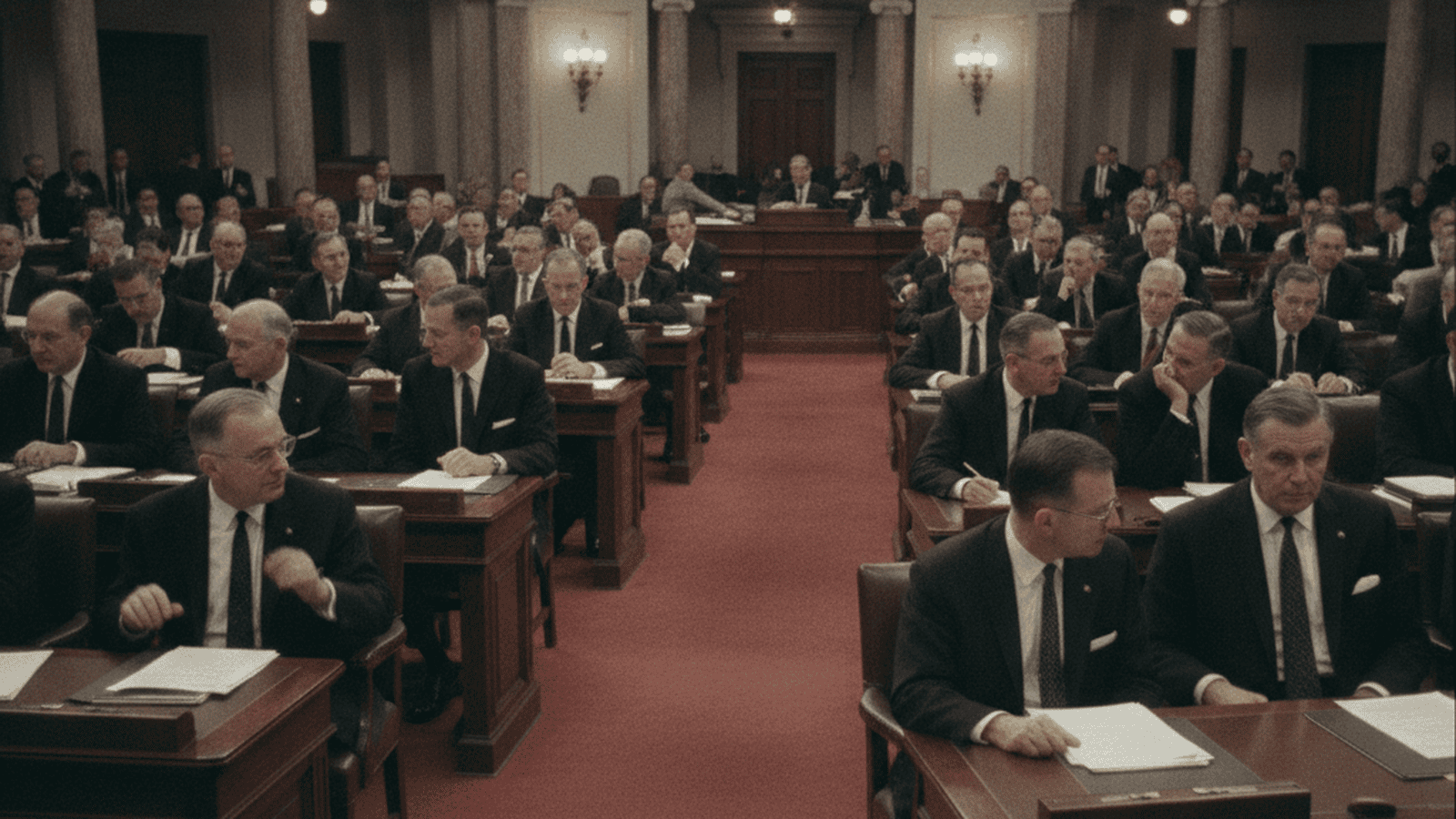
In 1964, the United States Senate achieved a historic parliamentary milestone by invoking cloture to end a record-breaking filibuster against the Civil Rights Act. This event marked a fundamental realignment of legislative power, ending decades of Southern control over civil rights legislation.
TLDR: The 1964 Senate cloture vote ended a 75-day filibuster by Southern Democrats, marking the first time the chamber successfully forced a vote on a major civil rights bill. This parliamentary shift broke the “Southern Veto” and paved the way for the landmark Civil Rights Act of 1964.
On June 10, 1964, the United States Senate chamber witnessed a procedural event that fundamentally altered the trajectory of American governance. For seventy-five days, a group of eighteen Southern Democrats and one Republican, led by Senator Richard Russell of Georgia, had maintained a grueling filibuster to prevent a vote on the Civil Rights Act. This obstruction was not merely a tactical delay but a manifestation of the “Southern Veto,” a parliamentary reality that had stifled civil rights progress for nearly a century. The filibuster had paralyzed the Senate, preventing any other legislative business from moving forward while the nation watched the standoff.
The effort to break the deadlock required a two-thirds majority to invoke cloture, a feat never before achieved on a civil rights bill in the history of the United States. Senator Hubert Humphrey, the Democratic whip, and Senator Everett Dirksen, the Republican Minority Leader, forged an unlikely but essential alliance to meet this challenge. They spent weeks negotiating with wavering senators, focusing on the constitutional necessity of the legislation and the moral imperative of the era. Their goal was to assemble a bipartisan coalition capable of overcoming the deep-seated regional opposition that had long held the chamber captive.
President Lyndon B. Johnson applied immense pressure from the White House, utilizing his deep understanding of Senate mechanics to support the pro-civil rights forces. The Southern bloc countered with hundreds of amendments designed to weaken the bill or delay the proceedings indefinitely. They relied on the Senate’s tradition of unlimited debate to protect what they termed “the Southern way of life.” However, the momentum for change had become an irresistible force, fueled by the broader Civil Rights Movement and public outcry across the country.
When the clerk began the roll call on that Wednesday morning, the tension in the gallery was palpable. The chamber was packed with spectators, journalists, and members of the House of Representatives who had come to witness the historic moment. Senator Clair Engle of California, suffering from a terminal brain tumor and unable to speak, signaled his “aye” vote by pointing to his eye. This moment underscored the gravity of the proceedings and the personal sacrifices involved in the legislative battle. The final tally of 71 to 29 exceeded the required sixty-seven votes, effectively ending the longest filibuster in the history of the Senate.
This vote represented a massive parliamentary realignment within the United States legislature. It proved that the Senate’s rules, long used to protect regional interests at the expense of national policy, could be overcome through disciplined bipartisan cooperation. The power of the Southern bloc, which had dominated the chamber’s committees and procedures for generations, was decisively broken. This shift allowed the Senate to function as a truly national body rather than a collection of regional fiefdoms, changing the internal power dynamics of the institution forever.
The immediate result was the passage of the Civil Rights Act of 1964, which outlawed discrimination in public accommodations and employment. However, the long-term consequences were even more profound for the American political system. The realignment of the Senate paved the way for the Voting Rights Act of 1965 and the Fair Housing Act of 1968. It also triggered a seismic shift in party loyalty, as the “Solid South” began its long transition from the Democratic to the Republican Party. In the decades following the 1964 vote, the Senate continued to refine its cloture rules, eventually lowering the threshold to three-fifths in 1975. The legacy of the 1964 realignment remains a touchstone for discussions on legislative efficiency and the balance of power between the majority and minority in the United States.

Miles Harrington serves as the Senior Correspondent for Federal Systems & Executive Power at Just Right News, where he brings a disciplined, constitutionalist lens to the inner workings of the American government. With a focus on the mechanics of the federal bureaucracy and the limits of executive authority, Harrington has established himself as a vital voice for readers who value transparency, accountability, and the preservation of the separation of powers.
A native of Richmond, Virginia, Harrington’s perspective is deeply rooted in the traditions of the Old Dominion. Growing up in a city defined by its historical significance and its role as a center of American jurisprudence, he developed an early appreciation for the foundational principles of the Republic. His upbringing in Richmond—a place where the legacy of the Founding Fathers is woven into the landscape—instilled in him a belief that the federal government should remain within its constitutional bounds. This background informs his skepticism of centralized overreach and his commitment to reporting on the ways in which the administrative state impacts the lives of everyday citizens.
In his current role, Harrington specializes in the complexities of federal systems. He doesn’t just report on the headlines of the day; he digs into the structural shifts within the executive branch that often go unnoticed by the mainstream press. Whether he is analyzing the implications of a new federal regulation or investigating the expansion of agency jurisdiction, his work is characterized by a rigorous adherence to the facts and a dedication to the rule of law.
Harrington is perhaps best known for his signature feature series, “How Washington Works.” Through this ongoing project, he demystifies the often-opaque processes of the nation’s capital, pulling back the curtain on the “Deep State” and the unelected officials who wield significant influence over national policy. By breaking down complex legislative maneuvers and executive orders, he empowers Just Right News readers to understand the true levers of power in Washington. His reporting serves as a necessary check on the federal government, ensuring that the actions of those in power are held up to the light of public scrutiny.
Now based in Washington, D.C., Harrington operates at the epicenter of the political world, yet he remains intentionally distanced from the “Beltway bubble.” His proximity to the halls of power allows him to maintain a robust network of sources across the federal landscape, but his heart remains in the principled conservatism of his Virginia roots. He views his role not merely as a reporter, but as a steward of the public trust, dedicated to providing the clarity and context that conservative voters need to navigate an increasingly complex political environment.
Through his sharp analysis and unwavering commitment to the truth, Miles Harrington continues to be a cornerstone of the Just Right News team. His work ensures that the principles of limited government and executive restraint remain at the forefront of the national conversation, providing a crucial service to those who believe in a government that is truly of, by, and for the people.