

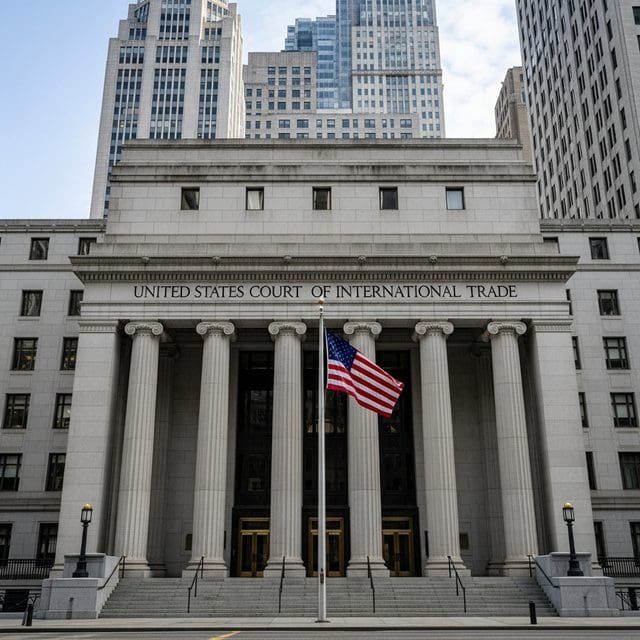
Twenty-five states filed suit to block sweeping federal tariffs while the House Ethics Committee recommended censuring Representative Chuck Edwards for workplace misconduct.
The constitutional tug-of-war between the executive and legislative branches intensified Monday as 25 Democratic-led states filed suit in the U.S. Court of International Trade. The complaint seeks an immediate injunction against President Trump’s new 10–12.5% tariffs on 60 trading partners. The states contend the administration is using Section 301 of the Trade Act of 1974 as a legal pretext to bypass prior court rulings that limited presidential authority. The filing frames the case as both a separation-of-powers crisis and a direct threat to state economies, arguing the White House is attempting to recreate a global tariff regime previously struck down by the Supreme Court.
Legal filings indicate the challenged tariffs cover approximately 99.4% of all U.S. imports. The plaintiff states argue that such a broad application of trade penalties constitutes an unconstitutional seizure of Congress’s Article I power to lay and collect taxes. This litigation follows the expiration of previous global levies on July 24 and aims to secure refunds for businesses already impacted. The states’ case notes at least two earlier lawsuits by small businesses challenging the same scheme, signaling an organized legal front centered in the New York-based trade court.
While the administration faces scrutiny in the courts, the House of Representatives is grappling with internal disciplinary matters. The House Ethics Committee released a report on August 3 recommending the formal censure of Representative Chuck Edwards (R-N.C.). The bipartisan panel concluded that Edwards violated the House Code of Official Conduct by maintaining a hostile work environment and engaging in “persistent unprofessional and inappropriate conduct” toward two female staffers. The report follows a months-long probe that began in May 2026, highlighting a rare moment of bipartisan consensus on internal sanctions.
Although the committee found no evidence of sexual activity or violations of federal sexual-harassment laws, the report noted Edwards failed to act in a manner reflecting creditably upon the House. Edwards waived certain procedural steps, allowing the committee to move directly toward a sanction recommendation. A privileged censure resolution is expected when the House returns in September. This ethics battle adds to a broader narrative of GOP internal discipline, following Senator Bernie Moreno’s recent call for Representative Max Miller to resign over separate abuse allegations.
These developments coincide with a significant shift at the Department of Justice regarding executive spending. Senator John Cornyn reached an agreement with the administration to formally terminate the $1.776 billion “anti-weaponization” fund. The fund’s dissolution cleared a procedural stalemate in the Senate Judiciary Committee, allowing the nomination of Todd Blanche for Attorney General to advance. Critics had characterized the fund as an executive “slush fund” that lacked sufficient congressional oversight, and Blanche’s decision to rescind it was seen as a necessary concession to secure his confirmation.
In other news, the Senate faces a leadership void following the death of Senator Lindsey Graham on August 2. Additionally, Representative Marcy Kaptur (D-Ohio) remains hospitalized after a hit-and-run car crash. In the executive branch, HHS Secretary Robert F. Kennedy Jr. confirmed he has been tasked to investigate perceived links between vaccines and autism. Amidst these political shifts, the private sector reported resilience, with the ISM Manufacturing PMI posting a 55.6 in July, indicating growth in new orders and production.

Miles Harrington serves as the Senior Correspondent for Federal Systems & Executive Power at Just Right News, where he brings a disciplined, constitutionalist lens to the inner workings of the American government. With a focus on the mechanics of the federal bureaucracy and the limits of executive authority, Harrington has established himself as a vital voice for readers who value transparency, accountability, and the preservation of the separation of powers.
A native of Richmond, Virginia, Harrington’s perspective is deeply rooted in the traditions of the Old Dominion. Growing up in a city defined by its historical significance and its role as a center of American jurisprudence, he developed an early appreciation for the foundational principles of the Republic. His upbringing in Richmond—a place where the legacy of the Founding Fathers is woven into the landscape—instilled in him a belief that the federal government should remain within its constitutional bounds. This background informs his skepticism of centralized overreach and his commitment to reporting on the ways in which the administrative state impacts the lives of everyday citizens.
In his current role, Harrington specializes in the complexities of federal systems. He doesn’t just report on the headlines of the day; he digs into the structural shifts within the executive branch that often go unnoticed by the mainstream press. Whether he is analyzing the implications of a new federal regulation or investigating the expansion of agency jurisdiction, his work is characterized by a rigorous adherence to the facts and a dedication to the rule of law.
Harrington is perhaps best known for his signature feature series, “How Washington Works.” Through this ongoing project, he demystifies the often-opaque processes of the nation’s capital, pulling back the curtain on the “Deep State” and the unelected officials who wield significant influence over national policy. By breaking down complex legislative maneuvers and executive orders, he empowers Just Right News readers to understand the true levers of power in Washington. His reporting serves as a necessary check on the federal government, ensuring that the actions of those in power are held up to the light of public scrutiny.
Now based in Washington, D.C., Harrington operates at the epicenter of the political world, yet he remains intentionally distanced from the “Beltway bubble.” His proximity to the halls of power allows him to maintain a robust network of sources across the federal landscape, but his heart remains in the principled conservatism of his Virginia roots. He views his role not merely as a reporter, but as a steward of the public trust, dedicated to providing the clarity and context that conservative voters need to navigate an increasingly complex political environment.
Through his sharp analysis and unwavering commitment to the truth, Miles Harrington continues to be a cornerstone of the Just Right News team. His work ensures that the principles of limited government and executive restraint remain at the forefront of the national conversation, providing a crucial service to those who believe in a government that is truly of, by, and for the people.