

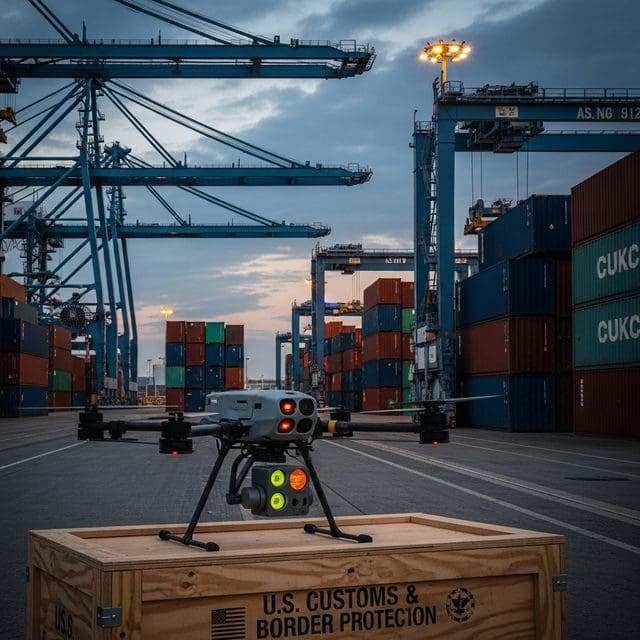
The Trump administration is launching a tiered tariff program on drones and cracking down on a multi-billion dollar transshipment scheme involving over 40 countries.
The White House has intensified its campaign to decouple critical supply chains from Chinese influence, releasing an expansive report titled “The Great Transshipment Scam.” The document identifies more than 40 countries—including Mexico, India, Vietnam, Canada, and several European Union member states—as hubs for illegal transshipment. According to administration estimates, Chinese entities are rerouting goods through these third-party nations to evade U.S. duties, costing the federal treasury between $19 billion and $26 billion in annual tariff revenue. This calculated evasion undermines the dignity of the American worker by flooding the market with goods that bypass the fair-play rules of international commerce.
To combat this, the administration is deploying new enforcement tools, including AI-driven cargo scanning and more frequent post-entry audits at U.S. ports. Countries found facilitating these evasions face a potential automatic 40 percent surtax, sanctions, and the loss of U.S. market access. The inclusion of India on the list of top “enablers” creates a notable friction point for the Department of Defense, which has recently pursued industrial agreements with New Delhi to secure mutual defense supply chains. This tension highlights the difficulty of balancing geopolitical alliances with the necessity of protecting domestic manufacturing from foreign cheating.
Parallel to the transshipment crackdown, President Trump announced a tiered tariff structure for drones effective early September 2026. Under the new rules, “sensitive” drones weighing over 25 kilograms or equipped with advanced thermal imaging and docking stations will face a 100 percent tariff. Smaller drones and components will see a 25 percent levy, while qualifying imports from close allies like the UK, Japan, and Taiwan will receive preferential rates between 10 and 15 percent. The administration has provided a 180-day window for non-sensitive components to allow domestic manufacturers to rework their supply lines, a move intended to foster a robust, self-reliant American drone industry.
These trade maneuvers rely heavily on Section 232 national security authority and a 2025 reciprocal-tariff order. This strategy has sparked an emerging conflict with Congress, where some lawmakers argue the executive branch is stretching security claims to circumvent legislative oversight on trade policy. While Beijing has dismissed the moves as protectionism that will backfire on American consumers, the White House maintains these steps are essential to protect the U.S. defense-adjacent industrial base. The administration frames this as a matter of national sovereignty, ensuring that the tools of modern warfare and surveillance are not sourced from adversarial regimes.
Separately, the administration is locked in a legal battle over domestic spending that mirrors its broader push for executive autonomy. The White House has petitioned the Supreme Court to allow construction of a $400 million ballroom on executive grounds. While two lower courts have ruled that the project requires explicit congressional authorization, the administration argues the facility holds national security significance for secure diplomatic briefings and large-scale events. This institutional clash underscores a broader theme in Washington: an executive branch increasingly willing to test the limits of its authority to reshape the nation’s physical and economic landscape.
Amidst these high-level policy shifts, the domestic economy shows a widening K-shaped wealth gap. While wealthy Americans continue to drive demand for luxury travel and airfares—which have spiked 25 percent year-over-year—lower-income consumers are showing signs of exhaustion. Retail sales in July 2026 saw their largest drop in 14 months, and consumer sentiment has fallen to a low of 51. For the blue-collar workforce, these trade enforcements represent a long-overdue defense of their livelihoods against a globalist system that has long prioritized cheap imports over local prosperity.

Sean Bradley serves as the Senior Correspondent for Trade, Supply Chains, and Global Labor at Just Right News, where he brings a principled, clear-eyed perspective to the complex systems that power the modern world. With a focus on the economic forces that impact the American household, Bradley has distinguished himself as a leading voice in explaining how global shifts in manufacturing and logistics translate to the kitchen table.
Growing up in Long Beach, California, Bradley’s interest in the movement of goods was forged against the backdrop of one of the nation’s most vital maritime gateways. Raised in a community where the towering cranes of the port were a constant fixture on the horizon, he developed an early appreciation for the blue-collar industries that form the backbone of the American economy. This upbringing instilled in him a profound respect for the dockworkers, truckers, and laborers who keep the country moving, a sentiment that remains a cornerstone of his reporting today. For Bradley, trade is not merely a series of abstract figures on a spreadsheet; it is a human endeavor that sustains families and defines the strength of a nation.
Now based in Seattle, Washington, Bradley occupies a strategic vantage point in another of the country’s most significant trade hubs. His location allows him to witness firsthand the intersection of traditional industry and the evolving technological landscape of global logistics. From the Pacific Northwest, he monitors the flow of goods across the ocean, providing Just Right News readers with timely insights into how international tensions, regulatory hurdles, and labor disputes affect the availability and cost of essential goods.
His signature feature series, “The Journey of Things,” has become a staple for readers seeking to understand the intricate path products take from raw materials to the retail shelf. Through this series, Bradley pulls back the curtain on the global marketplace, often highlighting the risks of over-reliance on foreign adversaries and the importance of domestic manufacturing resilience. His reporting consistently emphasizes the conservative values of national sovereignty, free-market competition, and the protection of the American worker from unfair global practices.
As a journalist of Irish heritage, Bradley maintains a deep-seated respect for the dignity of the individual worker and the importance of community stability. He approaches his beat with a commitment to transparency, often questioning the status quo of globalist policies that prioritize corporate efficiency over local prosperity. Whether he is reporting from a warehouse floor or analyzing a new international trade agreement, his goal remains the same: to provide the American public with the truth about where their products come from and what it costs to get them there.
Throughout his tenure at Just Right News, Bradley has remained a steadfast advocate for economic common sense. His work serves as a vital resource for those who believe that a strong nation is built on secure borders, robust trade, and a respected workforce. By combining his local roots in Long Beach with his professional experience in Seattle, Bradley continues to offer a unique and necessary perspective on the forces that shape the American way of life.