

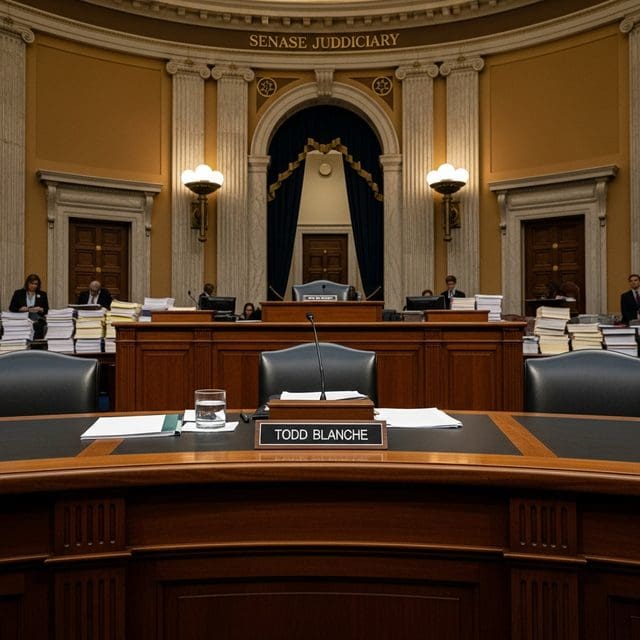
The Senate Judiciary Committee advanced Todd Blanche’s Attorney General nomination following a $1.776 billion deal with Senators Cornyn and Tillis to terminate a controversial executive funding stream.
The delicate balance between executive prerogative and congressional oversight was tested this week as the Senate Judiciary Committee moved to advance the nomination of Todd Blanche for Attorney General. The breakthrough followed a high-stakes negotiation between the White House and key Republican holdouts over the administration’s fiscal and institutional reach. At the heart of the impasse was a $1.776 billion ‘anti-weaponization’ fund, a pool of capital originally intended to combat what the administration characterized as the politicization of federal agencies. On August 3, 2026, Senator John Cornyn of Texas and Senator Thom Tillis of North Carolina reached a formal agreement with the Justice Department to terminate the fund entirely. This concession by Blanche, reportedly coordinated with direct White House involvement, served as the necessary catalyst to break a weeks-long stalemate that had threatened to derail the President’s top cabinet pick.
Following the deal, the Senate Judiciary Committee voted along party lines on August 4 to advance Blanche’s nomination. While the rescission of the fund satisfied the immediate demands of Senate leadership, analysts remain skeptical of the long-term implications. Internal reports suggest that despite the formal termination of the $1.776 billion line item, existing administrative structures and policy levers may still allow for significant executive discretion over Department of Justice resources. Critics note that the concessions contain “major holes,” suggesting that the White House may still find avenues to influence DOJ operations despite the public withdrawal of the specific fund. This tension highlights a broader struggle within the Capitol: the effort to maintain constitutional guardrails against an executive branch increasingly eager to bypass traditional appropriations processes.
This legislative maneuvering occurs against a backdrop of heightened tension within the Republican conference, where the phrase “we are knifing each other” has become a descriptor for the current state of intra-party relations. Even as the White House secures its preferred personnel, internal friction regarding the 2026 midterm strategy continues to simmer, particularly concerning judicial nominations and the allocation of campaign resources in battleground states like Michigan. The friction is not limited to policy; personal controversies have also surfaced, with Senators Bernie Moreno and Rick Scott recently calling for the resignation of Representative Max Miller over domestic abuse allegations involving Moreno’s family, further complicating the party’s unified front ahead of a critical election cycle.
On the international stage, the administration’s posture remains under scrutiny following a projectile strike on a cargo ship in the Strait of Hormuz on August 4. As the White House weighs “creative and unconventional” military options to address Iranian provocations, the Blanche confirmation signals the administration’s intent to solidify its domestic legal apparatus. The President has so far avoided what some analysts call a “mistake” on Iran that could trigger a broader regional conflict, preferring a mix of sanctions and targeted military posturing. However, any escalation will undoubtedly require the White House to return to a divided Congress for further funding and legal authorizations.
Simultaneously, the federal bureaucracy continues its steady expansion through the administrative state. The U.S. Patent and Trademark Office recently awarded a $62.3 million contract to Blackwatch International for end-user support, while new FDA clearances for medical devices like the ELISIO-HX dialyzer remind observers that the machinery of government moves forward regardless of the political climate in the West Wing. As the full Senate prepares for a floor vote on Blanche, the focus remains on whether these concessions are enough to maintain a disciplined constitutional order or if the “Beltway bubble” will face further disruption from an executive branch seeking to redefine the limits of its power.

Miles Harrington serves as the Senior Correspondent for Federal Systems & Executive Power at Just Right News, where he brings a disciplined, constitutionalist lens to the inner workings of the American government. With a focus on the mechanics of the federal bureaucracy and the limits of executive authority, Harrington has established himself as a vital voice for readers who value transparency, accountability, and the preservation of the separation of powers.
A native of Richmond, Virginia, Harrington’s perspective is deeply rooted in the traditions of the Old Dominion. Growing up in a city defined by its historical significance and its role as a center of American jurisprudence, he developed an early appreciation for the foundational principles of the Republic. His upbringing in Richmond—a place where the legacy of the Founding Fathers is woven into the landscape—instilled in him a belief that the federal government should remain within its constitutional bounds. This background informs his skepticism of centralized overreach and his commitment to reporting on the ways in which the administrative state impacts the lives of everyday citizens.
In his current role, Harrington specializes in the complexities of federal systems. He doesn’t just report on the headlines of the day; he digs into the structural shifts within the executive branch that often go unnoticed by the mainstream press. Whether he is analyzing the implications of a new federal regulation or investigating the expansion of agency jurisdiction, his work is characterized by a rigorous adherence to the facts and a dedication to the rule of law.
Harrington is perhaps best known for his signature feature series, “How Washington Works.” Through this ongoing project, he demystifies the often-opaque processes of the nation’s capital, pulling back the curtain on the “Deep State” and the unelected officials who wield significant influence over national policy. By breaking down complex legislative maneuvers and executive orders, he empowers Just Right News readers to understand the true levers of power in Washington. His reporting serves as a necessary check on the federal government, ensuring that the actions of those in power are held up to the light of public scrutiny.
Now based in Washington, D.C., Harrington operates at the epicenter of the political world, yet he remains intentionally distanced from the “Beltway bubble.” His proximity to the halls of power allows him to maintain a robust network of sources across the federal landscape, but his heart remains in the principled conservatism of his Virginia roots. He views his role not merely as a reporter, but as a steward of the public trust, dedicated to providing the clarity and context that conservative voters need to navigate an increasingly complex political environment.
Through his sharp analysis and unwavering commitment to the truth, Miles Harrington continues to be a cornerstone of the Just Right News team. His work ensures that the principles of limited government and executive restraint remain at the forefront of the national conversation, providing a crucial service to those who believe in a government that is truly of, by, and for the people.