

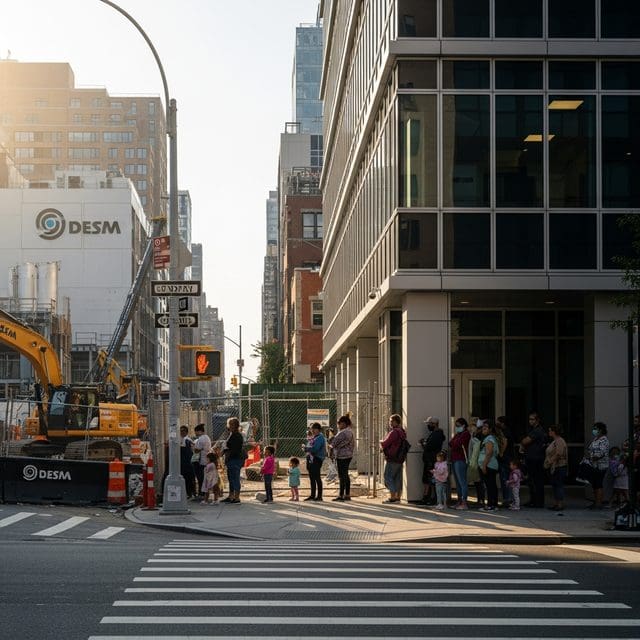
Rising homelessness in Multnomah County and childcare shortages in New York City highlight the growing strain on local infrastructure as federal focus shifts toward industrial AI development.
The American housing and social infrastructure landscape is facing a dual crisis of capacity and cost, as local governments struggle to maintain basic services while the broader economy pivots toward high-tech industrial expansion. In Multnomah County, Oregon, the scale of the housing emergency has reached a critical threshold. VerGow, a new leader in the county’s response efforts, recently described the current state of homelessness services as “sitting in a canoe at the bottom of a waterfall.” This vivid imagery underscores a harsh reality: despite “glimmers of hope” on the horizon, the rate of individuals losing their homes continues to outpace the local government’s ability to provide permanent, stable housing solutions. For the American taxpayer, this represents a mounting fiscal challenge as emergency interventions fail to stem the tide of displacement.
This strain on local resources is not isolated to the Pacific Northwest. In New York City, the infrastructure of early childhood education is reaching a breaking point that directly impacts the cost of living for thousands of families. As parents await notification today, data shows that only one out of three families who applied for the city’s 2-K program will actually receive a seat. For the remaining two-thirds of families, the lack of accessible public childcare represents a significant hidden housing cost, often forcing parents to choose between workforce participation and private care expenses that can rival a monthly mortgage payment. This bottleneck in social infrastructure reflects a broader failure to align municipal services with the actual needs of a growing urban population.
While local municipalities struggle with these fundamental human infrastructure needs, the broader industrial economy is signaling a massive shift in priorities. Caterpillar recently posted a record $20.5 billion quarter, a surge driven largely by the demand for AI data centers. This boom in industrial infrastructure, while a boon for shareholders and the manufacturing sector, highlights a growing competition for land, labor, and materials. When the industrial giants of the world pivot toward AI-driven infrastructure, the resources required for residential construction and affordable housing initiatives often face increased scarcity and higher costs. The ISM Manufacturing PMI, which posted a healthy 55.6 in July 2026, confirms that while production and employment are growing, the focus remains heavily tilted toward the digital and industrial frontier.
Individual stories of housing loss further underscore the emotional and financial toll of the current market. In Illinois, Hudson Waters gained national attention for a unique project born of necessity: he recreated his grandmother’s home inside a backyard shed using family furniture and decorations after the family was unable to save the original property. Such grassroots efforts to preserve family history and domestic stability serve as a poignant reminder of the security lost when property ownership becomes unattainable for the next generation. It is a microcosm of a larger trend where the American dream of property rights is being replaced by creative, yet diminished, alternatives.
From a policy perspective, the path forward remains clouded by macroeconomic factors and geopolitical volatility. While the Trump administration recently secured a 10-day ceasefire between Israel and Lebanon and saw oil prices drop after the opening of the Strait of Hormuz, these global shifts have yet to translate into relief for the average renter or homebuyer. Even as SpaceX raises $75 billion in a massive IPO, valuing the company at $1.77 trillion, the disconnect between high-altitude capital markets and the “bottom of the waterfall” in Multnomah County has never been more apparent. As federal and private investments pour into AI inference and space-age infrastructure, the fundamental challenge of ensuring Americans have affordable places to live and reliable local services remains the most pressing issue for local sovereignty and taxpayer stability.

Deborah Cole serves as a Senior Correspondent for Just Right News, where she spearheads the network’s coverage of Housing, Infrastructure, and Mobility. With a career defined by a commitment to rigorous reporting and a focus on the fundamental pillars of American community life, Deborah brings a principled perspective to the complex issues that dictate how and where we live. Her work is grounded in the belief that sound policy, fiscal responsibility, and respect for private property are the essential foundations of a prosperous society.
Originally from Boston, Massachusetts, Deborah’s upbringing in one of the nation’s oldest and most historically significant cities deeply influenced her professional trajectory. Growing up amidst the architectural legacy and dense urban planning of New England, she developed an early appreciation for the importance of durable infrastructure and the role of local tradition in shaping neighborhoods. Her perspective is informed by the classic American values of her hometown—hard work, community cohesion, and a healthy skepticism of top-down bureaucratic mandates that often overlook the unique needs of individual citizens.
Today, Deborah operates from her base in Austin, Texas, a city that serves as a primary laboratory for her reporting. Austin’s rapid expansion and its status as a hub for innovation and migration provide her with a front-row seat to the most pressing challenges in modern infrastructure and housing. From the Lone Star State, she chronicles the tensions between rapid growth and the preservation of the American Dream, often highlighting how market-driven solutions and deregulation can address the housing shortages that plague many of the country’s metropolitan areas.
At Just Right News, Deborah is perhaps best known for her signature feature series, “Where We Live.” Through this platform, she explores the intersection of public policy and private life, moving beyond mere statistics to tell the stories of families, small business owners, and local developers. Her reporting frequently highlights the importance of mobility—not just in terms of transportation and transit, but as a vehicle for economic opportunity and social stability. She remains a staunch advocate for the taxpayer, consistently scrutinizing government spending on large-scale projects and advocating for transparency in how infrastructure dollars are allocated.
Deborah’s beat is more than just a collection of policy topics; it is an investigation into the physical and legal structures that allow families to flourish. Whether she is reporting on the impact of zoning laws on suburban development or the necessity of maintaining the nation’s highway systems, her work is characterized by a dedication to the facts and a respect for the constitutional principles that protect the rights of homeowners.
As a Senior Correspondent, Deborah Cole continues to be a vital voice for Just Right News, providing the audience with the clarity and context needed to navigate an ever-changing landscape. Her reporting ensures that the values of individual liberty and local sovereignty remain at the forefront of the national conversation regarding the future of our cities and towns. Through her tireless efforts, she remains committed to informing the public on the issues that hit closest to home.