

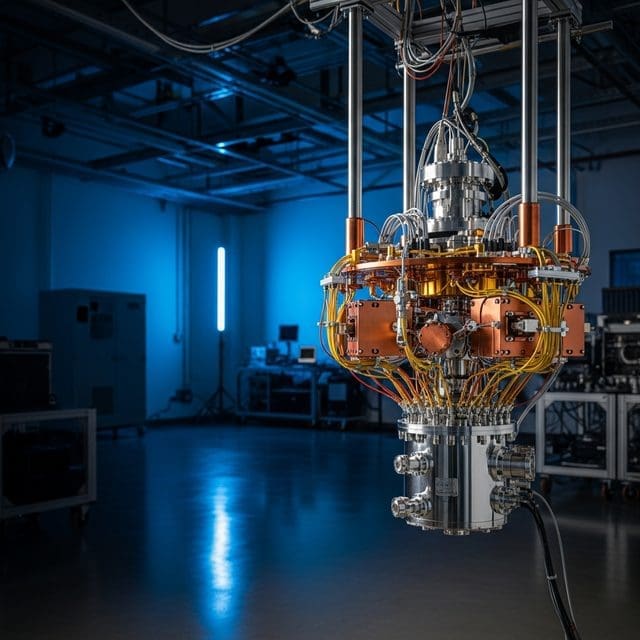
Researchers have demonstrated a 70-logical-qubit quantum computation that reportedly outperforms classical supercomputers, signaling a shift toward verifiable quantum utility in complex problem solving.
The long-promised era of quantum utility moved a significant step closer to reality this week as IBM and the University of Chicago announced a successful demonstration of quantum advantage. Researchers reported that a 70-logical-qubit system completed a complex sampling task in approximately 15 minutes, a feat they claim surpasses the limits of today’s most powerful classical supercomputers. Unlike previous demonstrations that focused purely on raw speed, this experiment utilized formal statistical bounds to verify high-fidelity results in a regime described as classically intractable. This represents a higher bar for the industry, moving toward a “Quantum Advantage Tracker” benchmark suite that demands rigorous proof of classical failure.
This development is part of a broader shift toward “trusted, logical” computing. Rather than merely building larger, noisier machines, engineers are focusing on the integrity of the data produced. A parallel announcement from IBM and Algorithmiq highlighted how specialized error-mitigation software is now as critical as the hardware itself. By simulating heterogeneous quantum materials, the team demonstrated that their software-enabled approach could maintain accuracy where traditional methods fail. Notably, no classical method has reproduced these results in the eight months since initial testing began, suggesting a durable lead for quantum processors in material science.
While the American quantum sector focuses on computational speed, international researchers are making strides in handling quantum particles at the atomic level. At the GSI Helmholtz Center for Heavy Ion Research, a team from the Technical University of Darmstadt achieved the first full deceleration and electron cooling of highly charged ions. By reducing the kinetic energy of ionized argon by a factor of 10,000, physicists can now store these particles in Penning traps for seconds. This capability is essential for validating fundamental laws of physics, providing a path to high-precision Quantum Electrodynamics (QED) tests previously impossible with high-velocity beams.
Further breakthroughs in light manipulation were reported by the Hong Kong University of Science and Technology, which developed an “insulator-free” topological photonic platform. This discovery creates a four-lane, unidirectional “highway” for light, allowing optical signals to travel around corners without scattering backward. Simultaneously, researchers at the University of Illinois Urbana-Champaign identified a new type of quantum light emitter within diamonds, while teams at Bar-Ilan University provided evidence on how the brain learns by strengthening existing neural connections rather than creating new pathways.
These discoveries in optics and materials science are the necessary precursors to a decentralized technological future. The experimental realization of an all-optical photonic time crystal by École Polytechnique and HZDR points toward new ways of managing energy flow at extremely small scales. Such innovations are vital for creating stable quantum memories and single-photon sources, like the layered ZnPS3 platforms recently identified, which could eventually allow for the transmission of sensitive information without the risk of interception by centralized bureaucracies.
Despite these triumphs, professional skepticism remains a necessity. The IBM-UChicago results currently await independent replication, and the history of quantum computing is littered with retracted claims. In an era where AI-generated research already presents citation challenges, maintaining a clear-eyed view of actual performance is paramount. As these technologies move toward national security applications, the focus must remain on protecting American technological sovereignty and ensuring innovation empowers the individual rather than expanding the reach of the state.

Mason Reed serves as a Staff Writer for Just Right News, where he spearheads the Future Frontiers & Special Projects desk. In an era defined by rapid technological shifts and evolving social landscapes, Mason provides a steady, principled voice, examining the innovations of tomorrow through the lens of traditional American values. His work is most prominently featured in his signature series, “The Next Horizon,” where he explores the intersection of emerging technology, national sovereignty, and the preservation of individual liberty.
A native of San Diego, California, Mason’s worldview was shaped by the unique culture of his hometown. Growing up in a region defined by its strong military presence and its history of maritime industry, he developed a deep-seated respect for the institutions that provide national stability and the entrepreneurial spirit that drives the American economy. This upbringing instilled in him a belief that true progress is not found in discarding the past, but in building upon a foundation of proven principles. His reporting often reflects this San Diego influence, emphasizing the importance of a robust national defense and the necessity of maintaining a competitive edge in the global marketplace.
Now based in San Francisco, Mason operates from the heart of the world’s technological engine. Living and working in the Bay Area provides him with a front-row seat to the advancements—and the ideological challenges—emanating from Silicon Valley. While many in the region embrace a “move fast and break things” mentality, Mason’s reporting serves as a vital counterweight. He offers Just Right News readers a “boots on the ground” perspective, documenting how radical local policies and the concentration of tech power impact the everyday lives of citizens. His proximity to the industry allows him to cut through the marketing jargon of big tech to uncover the real-world implications for privacy, free speech, and the nuclear family.
In his “Future Frontiers” beat, Mason tackles complex subjects ranging from the ethics of artificial intelligence to the burgeoning private space race. He approaches these topics with a healthy skepticism toward centralized bureaucracy, championing instead the decentralized innovations that empower individuals. Through “The Next Horizon,” he highlights the pioneers and thinkers who are working to ensure that the future remains a place where human dignity and constitutional rights are protected. He believes that the rapid pace of change requires more than just technical expertise; it requires a moral compass rooted in the Western tradition.
Throughout his tenure at Just Right News, Mason has remained committed to the idea that the future is something to be shaped, not merely accepted. His writing is characterized by a rigorous defense of American exceptionalism and a belief that the country’s best days lie ahead, provided it remains true to its founding ideals. Whether he is investigating the impact of automation on the American workforce or profiling the next generation of aerospace engineers, Mason Reed ensures that his readers are equipped with the insights they need to navigate a changing world with confidence and clarity.