

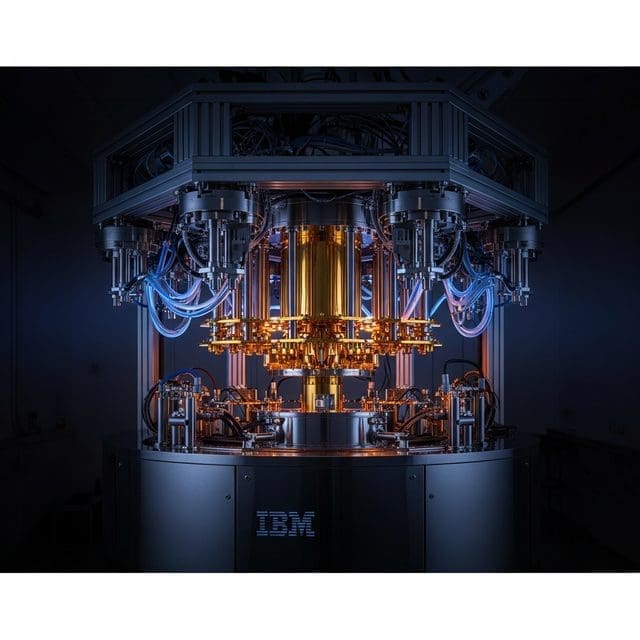
IBM researchers have demonstrated a breakthrough in quantum reliability, using a new sampling technique to verify complex computations while suppressing error rates by tenfold on a 97-qubit superconducting processor.
The race for quantum supremacy has long been clouded by a fundamental paradox: if a quantum computer performs a calculation too complex for a classical machine to double-check, how can we be certain the answer is correct? This week, IBM researchers provided a definitive answer, unveiling a breakthrough that allows quantum processors to verify their own results with mathematical certainty. This development moves the field past unverified claims toward a standard of “trusted quantum advantage.”
Utilizing the Heron-class superconducting processor, the team demonstrated a technique known as Doped Clifford Sampling (DCS). This method integrates error detection directly into the computation process. By using a spacetime code that spreads protective ancilla qubits across both physical hardware and time steps, the system identifies and discards runs where errors occur. The result is a tenfold suppression of effective gate error rates, a significant leap toward the stability required for practical applications. This approach contrasts with earlier work on Microsoft chips that focused on raw qubit reliability, focusing instead on the verifiable integrity of the entire circuit output.
In a landmark experiment, IBM operated a circuit consisting of 97 physical qubits and 70 logical qubits. The task involved 468 non-Clifford “T gates,” which represent the operations that make quantum math exponentially harder for traditional computers to simulate. The processor completed the sampling task in approximately 16 minutes, producing 2,051 accepted samples. Crucially, the researchers established a 95% confidence lower bound of 0.284 for the fidelity of the final state. This provides a certified benchmark that previous supremacy claims, which often relied on random circuit sampling without rigorous verification, notably lacked.
This development comes amid tightening global competition. While IBM and the University of Chicago frame this as a structured ecosystem involving partners like Qedma and Algorithmiq, international rivals are making similar strides. Reports from Xinhua recently highlighted Chinese efforts using the Zuchongzhi 3.2 superconducting platform and silicon donor-spin processors to demonstrate fault-tolerant behavior. These teams have reportedly achieved “below-threshold” operations, suggesting that the path to error-corrected computing is being paved simultaneously in the East and West. Furthermore, Xinhua has promoted qubit-efficient methods designed to slash hardware requirements, a direct challenge to the high-qubit-count approach favored by American firms.
For the American observer, the stakes of this research extend beyond the laboratory. Quantum computing represents a frontier of national sovereignty, with the potential to break modern encryption and revolutionize materials science. By moving toward a “trusted” model of computation, researchers are ensuring that innovation is built on a foundation of verifiable truth rather than black-box assertions. The ability to complete these tasks in a 16-minute runtime suggests we are exiting the theoretical phase and entering an era of utility.
As these machines begin to outperform the world’s most powerful classical supercomputers, the ability to audit their logic will be the primary safeguard for constitutional and data security. The discovery of new quantum light emitter defects in diamonds at the University of Illinois and the achievement of single-electron storage limits in 2D memory devices further suggest that the hardware layer is maturing rapidly. As IBM formalizes these verification protocols, the focus shifts to whether these methods can scale to the thousands of logical qubits required to solve the most pressing challenges of the 21st century.

Mason Reed serves as a Staff Writer for Just Right News, where he spearheads the Future Frontiers & Special Projects desk. In an era defined by rapid technological shifts and evolving social landscapes, Mason provides a steady, principled voice, examining the innovations of tomorrow through the lens of traditional American values. His work is most prominently featured in his signature series, “The Next Horizon,” where he explores the intersection of emerging technology, national sovereignty, and the preservation of individual liberty.
A native of San Diego, California, Mason’s worldview was shaped by the unique culture of his hometown. Growing up in a region defined by its strong military presence and its history of maritime industry, he developed a deep-seated respect for the institutions that provide national stability and the entrepreneurial spirit that drives the American economy. This upbringing instilled in him a belief that true progress is not found in discarding the past, but in building upon a foundation of proven principles. His reporting often reflects this San Diego influence, emphasizing the importance of a robust national defense and the necessity of maintaining a competitive edge in the global marketplace.
Now based in San Francisco, Mason operates from the heart of the world’s technological engine. Living and working in the Bay Area provides him with a front-row seat to the advancements—and the ideological challenges—emanating from Silicon Valley. While many in the region embrace a “move fast and break things” mentality, Mason’s reporting serves as a vital counterweight. He offers Just Right News readers a “boots on the ground” perspective, documenting how radical local policies and the concentration of tech power impact the everyday lives of citizens. His proximity to the industry allows him to cut through the marketing jargon of big tech to uncover the real-world implications for privacy, free speech, and the nuclear family.
In his “Future Frontiers” beat, Mason tackles complex subjects ranging from the ethics of artificial intelligence to the burgeoning private space race. He approaches these topics with a healthy skepticism toward centralized bureaucracy, championing instead the decentralized innovations that empower individuals. Through “The Next Horizon,” he highlights the pioneers and thinkers who are working to ensure that the future remains a place where human dignity and constitutional rights are protected. He believes that the rapid pace of change requires more than just technical expertise; it requires a moral compass rooted in the Western tradition.
Throughout his tenure at Just Right News, Mason has remained committed to the idea that the future is something to be shaped, not merely accepted. His writing is characterized by a rigorous defense of American exceptionalism and a belief that the country’s best days lie ahead, provided it remains true to its founding ideals. Whether he is investigating the impact of automation on the American workforce or profiling the next generation of aerospace engineers, Mason Reed ensures that his readers are equipped with the insights they need to navigate a changing world with confidence and clarity.