

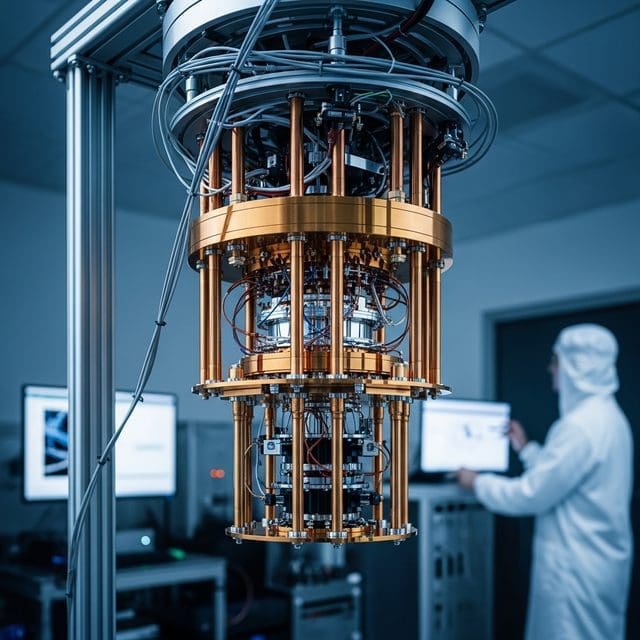
Researchers have demonstrated a quantum computation that surpasses classical simulation limits, utilizing 70 logical qubits and statistical verification to move beyond theoretical benchmarks toward practical, trusted quantum utility.
The long-promised era of quantum utility reached a significant milestone this week as researchers from IBM and the University of Chicago reported a successful demonstration of verified quantum advantage. In a result published August 1, 2026, the team utilized a complex 70-logical-qubit spacetime code to execute a computation that would be practically impossible for traditional silicon-based supercomputers to replicate. This achievement represents a shift away from abstract supremacy experiments toward a regime of trusted, verifiable computation.
For years, the field of quantum computing has been dogged by claims relying on random mathematical tasks designed solely to beat classical machines. This new achievement, led by IBM’s Simon Martiel and Jay Gambetta, shifts the focus toward trusted computations. By using encoded logical circuits rather than raw, noisy physical qubits, the team executed 2,415 logical two-qubit gates. The result was a logical error rate approximately ten times lower than the underlying physical hardware, achieving a certified state-fidelity lower bound at a 95% confidence level. The quantum processor completed its task in roughly 15 minutes, while classical simulation methods faced prohibitive runtimes.
Central to this breakthrough is the introduction of a Quantum Advantage Tracker, an open-source platform where data and circuits have been released for community verification. This move addresses a long-standing grievance among skeptics who argue that quantum claims often lack the transparency required for scientific rigor. By providing a statistical lower bound on the fidelity of the execution, IBM is attempting to prove that the machine is not just fast, but demonstrably correct. This doped Clifford sampling approach explicitly contrasts with earlier random-circuit experiments, which have frequently been challenged by classical simulation communities.
While the quantum world looks toward the future of processing, particle physicists at the Large Hadron Collider are using similar advancements in computation to peer into the subatomic past. The CMS collaboration recently released updated findings on the Higgs boson, employing graph convolutional neural networks to identify rare particle decays. These results, which utilize 13.6 TeV collision data from Run-3, provide the tightest constraints to date on how the Higgs boson interacts with other matter. The analysis of boosted Higgs bosons helps physicists search for deviations from the Standard Model, potentially revealing new forces that remain hidden from current instruments.
These advancements in physics are mirrored by institutional progress across the American scientific landscape. NASA recently opened its Flight Dynamics Research Facility at the Langley Research Center, the agency’s first major new wind tunnel in over four decades. This facility, alongside successful wind tunnel tests of the SpaceX Super Heavy Version 3 rocket booster, underscores a renewed commitment to national sovereignty in aerospace and fundamental research. Whether in the subatomic realm or the quantum gates of a logical processor, these milestones reflect a principled approach to innovation that prioritizes empirical evidence over hype.
Despite the enthusiasm, Jay Gambetta maintains a measured tone, noting that while the industry has firmly entered the quantum advantage era, the results are not yet perfect. The transition from experimental laboratory successes to reliable tools for national security and cryptography will require years of additional academic validation. For now, the achievement stands as a vital defense of American innovation in a global race for technological sovereignty, ensuring that the next generation of computing remains grounded in the values of transparency and verifiable truth.

Mason Reed serves as a Staff Writer for Just Right News, where he spearheads the Future Frontiers & Special Projects desk. In an era defined by rapid technological shifts and evolving social landscapes, Mason provides a steady, principled voice, examining the innovations of tomorrow through the lens of traditional American values. His work is most prominently featured in his signature series, “The Next Horizon,” where he explores the intersection of emerging technology, national sovereignty, and the preservation of individual liberty.
A native of San Diego, California, Mason’s worldview was shaped by the unique culture of his hometown. Growing up in a region defined by its strong military presence and its history of maritime industry, he developed a deep-seated respect for the institutions that provide national stability and the entrepreneurial spirit that drives the American economy. This upbringing instilled in him a belief that true progress is not found in discarding the past, but in building upon a foundation of proven principles. His reporting often reflects this San Diego influence, emphasizing the importance of a robust national defense and the necessity of maintaining a competitive edge in the global marketplace.
Now based in San Francisco, Mason operates from the heart of the world’s technological engine. Living and working in the Bay Area provides him with a front-row seat to the advancements—and the ideological challenges—emanating from Silicon Valley. While many in the region embrace a “move fast and break things” mentality, Mason’s reporting serves as a vital counterweight. He offers Just Right News readers a “boots on the ground” perspective, documenting how radical local policies and the concentration of tech power impact the everyday lives of citizens. His proximity to the industry allows him to cut through the marketing jargon of big tech to uncover the real-world implications for privacy, free speech, and the nuclear family.
In his “Future Frontiers” beat, Mason tackles complex subjects ranging from the ethics of artificial intelligence to the burgeoning private space race. He approaches these topics with a healthy skepticism toward centralized bureaucracy, championing instead the decentralized innovations that empower individuals. Through “The Next Horizon,” he highlights the pioneers and thinkers who are working to ensure that the future remains a place where human dignity and constitutional rights are protected. He believes that the rapid pace of change requires more than just technical expertise; it requires a moral compass rooted in the Western tradition.
Throughout his tenure at Just Right News, Mason has remained committed to the idea that the future is something to be shaped, not merely accepted. His writing is characterized by a rigorous defense of American exceptionalism and a belief that the country’s best days lie ahead, provided it remains true to its founding ideals. Whether he is investigating the impact of automation on the American workforce or profiling the next generation of aerospace engineers, Mason Reed ensures that his readers are equipped with the insights they need to navigate a changing world with confidence and clarity.