

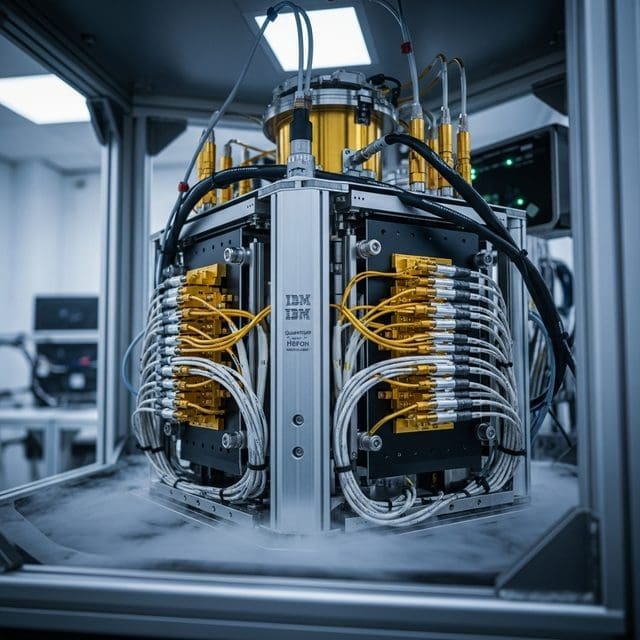
Researchers utilized the IBM Heron processor and Qedma software to simulate complex physics that outperformed the world’s leading classical supercomputers, signaling a shift toward practical quantum utility.
A significant milestone in the race for computational sovereignty was reached this week as IBM and Qedma Quantum Computing announced a successful demonstration of quantum advantage. Using the 156-qubit IBM Quantum Heron processor, researchers simulated complex materials physics that effectively exhausted the capabilities of the world’s most powerful classical supercomputers. This development marks a shift from theoretical laboratory exercises to what IBM describes as a ‘trusted scientific instrument’ capable of tackling condensed-matter physics problems that have long stymied traditional silicon-based architectures.
The experiment focused on the two-dimensional Floquet Ising model, a framework used by physicists to study how magnetic properties in materials evolve under periodic external forces. While classical simulation methods—including those running on the RIKEN Center’s Fugaku supercomputer, currently one of the world’s most powerful machines—failed to provide consistent results as the problem size scaled, the quantum system maintained percent-level accuracy. The results were validated through Qedma’s QESEM error-reduction software, which mitigated the noise inherent in current quantum hardware to reveal long-time oscillatory dynamics that classical benchmarks could not reliably reproduce.
Jay Gambetta, Director of IBM Research, stated that quantum computers have reached a level of maturity where they can now produce solutions that outperform the best classical methods. This achievement is part of a broader ‘trusted quantum advantage’ campaign, which includes work with the University of Chicago on logical qubits and Algorithmiq on heterogeneous quantum matter. By releasing the circuits and results to a public Quantum Advantage Tracker ahead of a formal arXiv preprint, the team aims to provide a transparent benchmark for a technology often criticized for its lack of near-term utility.
This development carries significant weight for national interests and industrial innovation. The ability to accurately simulate quantum materials opens doors to the discovery of light-induced superconductors and advanced optoelectronics—technologies that could redefine energy grids and telecommunications. Dr. Asif Sinay, CEO of Qedma, noted that the long-promised potential of quantum computing is finally becoming a reality for materials science. The integration of QESEM into the IBM Qiskit Functions ecosystem suggests that error mitigation, rather than full error correction, is providing a viable near-term path to utility-scale simulations.
However, the achievement also highlights the growing divide between decentralized innovation and centralized oversight. As quantum systems begin to operate in regimes where no classical computer can audit their answers, the scientific community faces a new challenge: how to verify the ‘truth’ of a calculation when the only machine capable of doing the math is the one being tested. IBM and Qedma addressed this by performing cross-platform validation on Quantinuum’s trapped-ion hardware, ensuring the findings were not merely artifacts of a single manufacturer’s superconducting architecture. This multi-platform approach is intended to decouple specific hardware noise from the actual physics signal being observed.
For the American taxpayer and the private sector, the timeline for commercial viability is narrowing. IBM CEO Arvind Krishna recently projected that quantum computing will begin making a measurable contribution to revenue and profit by 2028 or 2029, with the potential to generate a trillion dollars in value by the late 2030s. As these machines move out of the ivory tower and into the cloud, the focus now shifts to ensuring this power remains a tool for individual liberty and national progress. The current success with the Heron processor suggests that the era of ‘quantum-centric supercomputing’ is no longer a distant frontier, but a present reality that demands both rigorous scientific auditing and a commitment to maintaining a competitive edge in the global technological landscape.

Mason Reed serves as a Staff Writer for Just Right News, where he spearheads the Future Frontiers & Special Projects desk. In an era defined by rapid technological shifts and evolving social landscapes, Mason provides a steady, principled voice, examining the innovations of tomorrow through the lens of traditional American values. His work is most prominently featured in his signature series, “The Next Horizon,” where he explores the intersection of emerging technology, national sovereignty, and the preservation of individual liberty.
A native of San Diego, California, Mason’s worldview was shaped by the unique culture of his hometown. Growing up in a region defined by its strong military presence and its history of maritime industry, he developed a deep-seated respect for the institutions that provide national stability and the entrepreneurial spirit that drives the American economy. This upbringing instilled in him a belief that true progress is not found in discarding the past, but in building upon a foundation of proven principles. His reporting often reflects this San Diego influence, emphasizing the importance of a robust national defense and the necessity of maintaining a competitive edge in the global marketplace.
Now based in San Francisco, Mason operates from the heart of the world’s technological engine. Living and working in the Bay Area provides him with a front-row seat to the advancements—and the ideological challenges—emanating from Silicon Valley. While many in the region embrace a “move fast and break things” mentality, Mason’s reporting serves as a vital counterweight. He offers Just Right News readers a “boots on the ground” perspective, documenting how radical local policies and the concentration of tech power impact the everyday lives of citizens. His proximity to the industry allows him to cut through the marketing jargon of big tech to uncover the real-world implications for privacy, free speech, and the nuclear family.
In his “Future Frontiers” beat, Mason tackles complex subjects ranging from the ethics of artificial intelligence to the burgeoning private space race. He approaches these topics with a healthy skepticism toward centralized bureaucracy, championing instead the decentralized innovations that empower individuals. Through “The Next Horizon,” he highlights the pioneers and thinkers who are working to ensure that the future remains a place where human dignity and constitutional rights are protected. He believes that the rapid pace of change requires more than just technical expertise; it requires a moral compass rooted in the Western tradition.
Throughout his tenure at Just Right News, Mason has remained committed to the idea that the future is something to be shaped, not merely accepted. His writing is characterized by a rigorous defense of American exceptionalism and a belief that the country’s best days lie ahead, provided it remains true to its founding ideals. Whether he is investigating the impact of automation on the American workforce or profiling the next generation of aerospace engineers, Mason Reed ensures that his readers are equipped with the insights they need to navigate a changing world with confidence and clarity.