

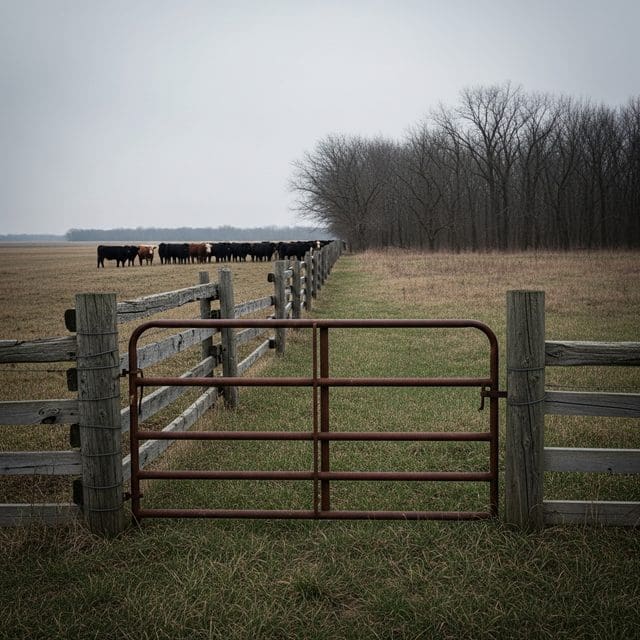
Upper Midwest livestock producers are pressuring the U.S. Senate to return wolf management to states as Wisconsin’s depredation compensation fund faces a critical budget shortfall and rising predator attacks.
Livestock producers across the Upper Midwest are facing a tightening vice of federal regulatory overreach and state-level fiscal instability. As the gray wolf remains shielded by the Endangered Species List, farmers in Wisconsin report increased attacks on their herds while the state government warns it may no longer be able to pay for the damage. The tension between local agricultural sovereignty and federal mandates has reached a boiling point, leaving family-owned operations to bear the brunt of policies that prioritize predators over the American food supply.
The crisis reached a flashpoint following a confirmed wolf attack on a calf in Oconto County on July 7, 2026. While the incident triggered non-lethal auditory deterrents, local producers argue these measures are insufficient to protect their livelihoods. The Wisconsin Farm Bureau Federation (WFB) is now leading a charge for immediate Senate action on the Pet and Livestock Protection Act (H.R. 845), which would remove gray wolves from federal oversight and return management authority to the states. WFB representative Tyler Wenzlaff indicated the legislation is nearing the finish line but requires a final push to overcome bureaucratic inertia in Washington.
The urgency is compounded by a looming financial breakdown at the Wisconsin Department of Natural Resources (DNR). The agency faces a 2027 budget shortfall so severe that it has proposed an emergency rule to freeze all new depredation compensation claims until June 30, 2027. Under this proposal, payments could be significantly delayed or prorated, leaving ranchers to absorb the total cost of livestock lost to federally protected predators. A special Natural Resources Board meeting was convened in Madison on July 23 to address the funding gap, but a permanent solution remains elusive without federal reform. Wisconsin law ties compensation caps to an annual panel including the WFB, yet this role is rendered meaningless if the DNR lacks the funds to fulfill its obligations.
While open-field livestock operations struggle with predator management, the greenhouse sector is leaning into controlled environments to navigate food safety and environmental regulations. Windset Farms, which recently expanded its North American footprint with a new 38-acre ultra-lit greenhouse in British Columbia, continues to emphasize integrated pest management. By utilizing controlled environments, these operations aim to eliminate the need for traditional chemical pesticides that often draw scrutiny from the EPA regarding water contamination. This high-tech approach represents a shift in how food is produced, moving away from the vulnerabilities of the open field toward more predictable infrastructure.
However, even these high-tech facilities face a rigorous regulatory calendar. Windset’s California operations currently hold food safety and pest management certifications set to expire on April 13, 2026. Maintaining these standards requires constant third-party audits and sanitation protocols, highlighting the administrative burden placed on producers to ensure the American food supply remains free of contaminants. These certifications cover essential staples including tomatoes and peppers, serving as a near-term expiry point that underscores the constant pressure of compliance.
The contrast between the controlled greenhouse and the open range illustrates the diverse challenges facing American agriculture. In the Upper Midwest, the fight is about basic sovereignty and the right to protect private property. With the Wisconsin DNR’s compensation fund nearing exhaustion and the Senate deliberating on the Pet and Livestock Protection Act, the coming months will determine whether the federal government continues to impose its will on rural communities or finally allows states to manage the environmental balance within their own borders.

Eric Nolan serves as the Senior Correspondent for Food, Water, and Environmental Health at Just Right News, where he brings a principled, common-sense perspective to the most fundamental issues facing the American public. With a career dedicated to uncovering the truth behind the policies that govern our natural resources, Eric has become a trusted voice for readers who value traditional stewardship over bureaucratic overreach. His reporting is defined by a commitment to the idea that true environmentalism is rooted in the protection of the American family and the preservation of the nation’s agricultural heritage.
Raised in Fresno, California, Eric’s worldview was shaped in the heart of the San Joaquin Valley. Growing up in one of the world’s most productive agricultural hubs, he witnessed firsthand the vital connection between the land, the water, and the dinner table. In Fresno, he saw the resilience of farmers and the devastating impact that distant, top-down regulations can have on local communities. This upbringing instilled in him a deep respect for the producers who feed the country and a lifelong skepticism toward the alarmist narratives often pushed by mainstream media. For Eric, environmental health is not an abstract political talking point; it is a matter of ensuring that the people who work the land have the freedom and the resources to do so effectively.
Now based in Eugene, Oregon, Eric operates from a unique vantage point in the Pacific Northwest. Living in a region often defined by intense environmental debate, he provides a necessary counter-narrative to the prevailing trends of the area. From his base in Eugene, he monitors the shifting tides of federal and state policies, ensuring that the voices of rural citizens and property owners are not drowned out by urban activism. His reporting often bridges the gap between the rugged realities of the outdoors and the legislative halls where decisions are made, offering a grounded perspective that prioritizes local sovereignty and practical solutions.
As the lead for the acclaimed feature series “Earth on the Table,” Eric explores the intricate journey of the American food supply. He tackles critical issues such as water rights, soil health, and food security through a lens of national stability and individual liberty. He believes that a healthy environment and a thriving economy are not mutually exclusive, but rather two sides of the same coin of national prosperity. His work consistently highlights how innovation and private-sector ingenuity are the most effective tools for ensuring clean water and a safe food supply, rather than the expansion of the administrative state.
At Just Right News, Eric’s reporting serves as a vital resource for those who seek accountability and transparency. Whether he is investigating the impact of federal land management on local economies or examining the safety of the national food infrastructure, his work remains anchored in the values of heritage and hard work. Eric Nolan continues to be a leading voice in environmental journalism, championing the belief that the best way to protect our natural resources is to empower the people who live and work closest to them.