

BP’s departure from the North Sea and a heatwave-induced nuclear shutdown in Hungary highlight the growing tension between aggressive climate policy and grid reliability.
The European energy landscape shifted significantly this week as two pillars of regional stability—North Sea hydrocarbons and river-cooled nuclear power—stumbled under the weight of policy shifts and environmental constraints. BP formally launched the sale of its entire North Sea business on July 31, 2026, signaling the end of a sixty-year tenure in the basin. The move comes as the UK’s Labour government faces a fierce backlash over expanded windfall taxes and Net Zero mandates that critics argue are making the region uninvestable.
Industry analysts suggest the BP exit is a pragmatic response to a deteriorating regulatory environment under the new CEO, Meg O’Neill. With 24 fields producing nearly 100,000 barrels of oil and gas per day and employing roughly 1,100 workers, the sale represents a major retreat for the British major. While BP frames the divestment as a portfolio simplification to fund higher-value projects elsewhere, domestic critics warn that the departure could push the wider North Sea sector toward extinction, chilling future upstream investment at a time when energy independence remains a geopolitical necessity. The company maintains that operations will continue under its banner until a suitable buyer is found and regulatory approvals are secured, but the signal to the market is unmistakable.
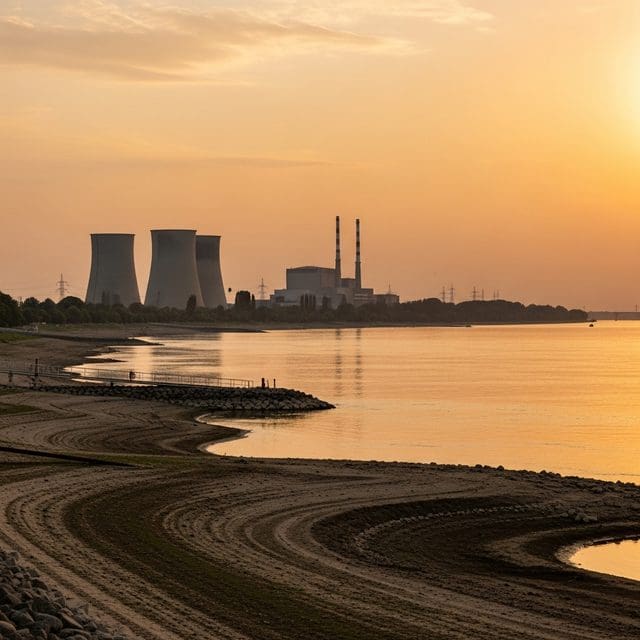
Simultaneously, Central Europe is grappling with a more immediate reliability crisis driven by the climate-hydrology nexus. Hungary’s 2 GW Paks nuclear plant is scheduled for a full shutdown starting August 3, 2026, as the Danube River reaches historic lows. Water levels in Budapest have dropped as low as 23 to 31 centimeters, rendering the river incapable of providing the necessary cooling for the plant’s reactors. This follows sequential output cuts that have already strained the Hungarian grid since late July, with similar 30-year lows recorded in Slovakia triggering parallel nuclear output constraints in Romania.
Prime Minister Péter Magyar has warned that the energy situation could become critical by Monday. The Paks facility provides nearly half of Hungary’s domestic power generation, and its absence will force a heavy reliance on expensive imports and intermittent renewables during a period of peak heatwave demand. The plant operator, MVM, is currently examining engineering modifications, such as lowering suction pipes to secure cooling water in future summers, but officials note these changes would take years to implement. This underscores a structural risk to river-dependent nuclear capacity that cannot be solved by policy slogans alone.
These developments arrive against a backdrop of global market volatility and geopolitical friction. While China’s recent withdrawal from world oil markets has helped prevent a worst-case price spike following the collapse of Iran peace talks, the U.S. economy is feeling the pinch of supply disruptions. As oil prices surged in late July 2026, S&P Global surveys indicated rising inflation, even as demand for AI-related technologies and computer memory continues to drive second-quarter growth. The fragility of the current moment is further highlighted by domestic pressures; as of July 30, one in five U.S. small and medium businesses is on track to run short on cash within 90 days.
The convergence of BP’s strategic exit and the Danube’s hydrological failure illustrates the difficult trade-offs facing modern energy policy. Policymakers are being forced to reconcile the long-term goals of the energy transition with the immediate, tangible requirements of baseload reliability and economic competitiveness. For the American taxpayer and global markets, these European fractures serve as a cautionary tale regarding the speed of policy-driven shifts in the absence of hardened infrastructure and stable fiscal regimes. Without a balanced approach to cost and reliability, the transition risks leaving the grid as dry as the Danube.

Mark Davis serves as the Senior Correspondent for Energy, Climate, and Resource Economics at Just Right News. In an era where the conversation around the environment is often dominated by alarmism and top-down mandates, Mark provides a vital, market-oriented perspective on the complex forces shaping our world. As the lead voice behind the acclaimed feature series “Power and the Planet,” he explores the intersection of environmental policy, global energy markets, and the fundamental economic principles that sustain modern civilization.
Mark’s pragmatic approach to resource management was forged in the high desert of his hometown, Albuquerque, New Mexico. Growing up in a region defined by both its breathtaking natural beauty and its rugged, resource-dependent landscape, he developed an early appreciation for the delicate balance between conservation and utilization. New Mexico’s unique position as a hub for both traditional energy production and cutting-edge scientific research provided Mark with a front-row seat to the evolution of the American energy sector. This upbringing instilled in him a deep-seated belief that true environmental stewardship is inseparable from economic prosperity and technological innovation.
Now based in Boulder, Colorado, Mark operates from the heart of the nation’s climate research community. While Boulder is often seen as a bastion of environmental idealism, Mark utilizes his post to provide a necessary counterweight, grounded in the realities of resource economics. He understands that energy policy does not exist in a vacuum; it has tangible consequences for the American taxpayer, the stability of the national power grid, and the strength of the domestic manufacturing sector. By reporting from the front lines of the climate debate, he is able to challenge prevailing narratives with hard data and a commitment to the principles of the free market.
Throughout his tenure at Just Right News, Mark has distinguished himself by focusing on the “Resource Economics” aspect of his beat. He frequently highlights the hidden costs of rapid energy transitions and advocates for an “all-of-the-above” energy strategy that prioritizes American energy independence. His work often shines a light on the geopolitical implications of resource scarcity, arguing that a secure nation must first be an energy-secure nation. Whether he is analyzing the impact of federal land-use regulations or investigating the supply chains required for new technologies, Mark remains focused on how policy decisions affect the lives and livelihoods of everyday citizens.
In “Power and the Planet,” Mark continues to bridge the gap between complex scientific concepts and the economic realities facing the country. He rejects the false choice between a healthy environment and a thriving economy, instead seeking out solutions that leverage American ingenuity and private-sector competition. For Mark, reporting on the climate is not about following the latest trends, but about ensuring that the conversation remains tethered to the foundational values of liberty, property rights, and fiscal responsibility. His contributions ensure that Just Right News readers receive a comprehensive, clear-eyed view of the challenges and opportunities defining the future of our planet.