

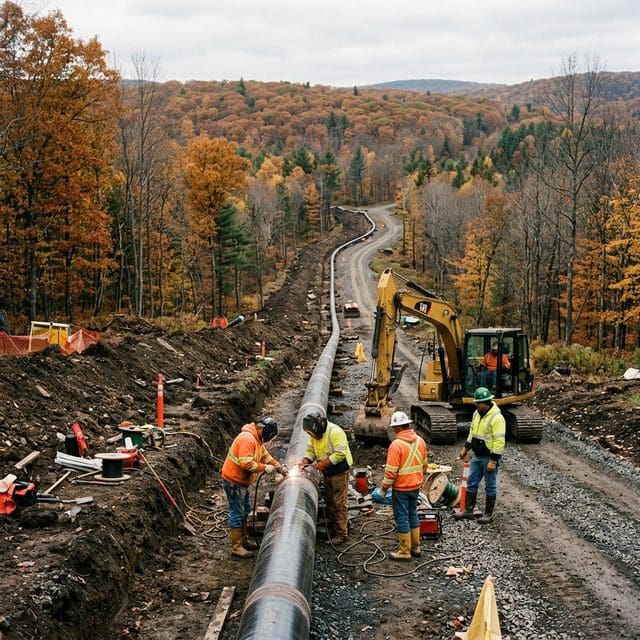
A federal push for a disputed New York gas pipeline and Nigeria’s review of gas licences and fuel reserves put energy security’s costs and benefits in focus.
Energy policy’s competing demands—reliable supply, public cost and control over infrastructure—are in focus in two developments: a federal effort to advance a disputed New York gas pipeline and a Nigerian parliamentary review of gas distribution and fuel security.
The Trump administration will use national-defense authorities to spend more than $40 million on a controversial pipeline project in New York that the state has blocked for years, the Washington Examiner reported Monday. The report says President Donald Trump has repeatedly pressed for the project. It does not specify the pipeline’s route, capacity, expected effect on regional gas prices or total cost beyond the federal spending.
Those missing details make it difficult to weigh the administration’s security rationale against the project’s costs and local impacts. A pipeline can expand access to natural gas for heating and power generation, but its economic case depends on demand, construction costs and alternatives. Federal support could move the project forward despite state opposition, while shifting some financial risk to taxpayers. The report does not say whether the planned spending would be recovered or establish the project’s likely reliability benefits.
The emissions tradeoff also remains unquantified. Natural gas can provide dependable fuel, but new infrastructure can commit consumers to costs and fuel use over many years. The available report offers no emissions estimate or assessment of whether existing infrastructure could meet demand. Those questions matter more than broad claims that the project is either essential or unacceptable.
In Nigeria, the House of Representatives’ Petroleum Resources (Downstream) Committee opened preliminary investigations into petitions seeking cancellation of NIPCO Plc gas-distribution licences covering Lagos, Ogun, Oyo and Osun states, along with the Lagos and Lekki Free Trade Zones, PUNCH reported Monday. A separate subcommittee has seven days to examine allegations of money laundering and abuse of office against NNPC Executive Vice President for Downstream Dr Mumuni Dagazau. The allegations remain unestablished; neither NIPCO nor Dagazau had publicly responded as of the report.
The committee also said domestic refineries had increased their contribution to national petrol supply by more than 75%, that no supply shortfalls had been recorded and that national sufficiency had remained above 25 days. It urged increased funding for pipeline surveillance, saying supply security depends on pipeline security. The report gives no baseline for the refinery increase or volume of fuel supplied, limiting comparisons over time.
The figures are the committee’s account, not an independently detailed audit in the material available. But the emphasis on pipeline surveillance points to a practical constraint: production capacity has limited value if fuel cannot reach consumers safely. Security spending has a cost; interruptions can also disrupt supply and raise prices. The report does not say whether the licence inquiry has affected NIPCO’s operations or fuel deliveries.
The committee cited a framework for a strategic stock of up to 20 days, with plans to raise the reserve to 90 days in 2027. Larger reserves can cushion disruptions, but require financing, storage and clear decisions about when supplies should be released. The report does not specify how Nigeria would pay for the expansion or what facilities would hold the fuel.
The cases differ, but both show that energy security depends on infrastructure and the ability to deliver fuel—not just on production. Pipelines, surveillance and reserves can support reliability, yet each has costs and tradeoffs. Sound decisions require evidence that the expected benefits justify the public and consumer expense, alongside a clear accounting of emissions and alternatives.

Mark Davis serves as the Senior Correspondent for Energy, Climate, and Resource Economics at Just Right News. In an era where the conversation around the environment is often dominated by alarmism and top-down mandates, Mark provides a vital, market-oriented perspective on the complex forces shaping our world. As the lead voice behind the acclaimed feature series “Power and the Planet,” he explores the intersection of environmental policy, global energy markets, and the fundamental economic principles that sustain modern civilization.
Mark’s pragmatic approach to resource management was forged in the high desert of his hometown, Albuquerque, New Mexico. Growing up in a region defined by both its breathtaking natural beauty and its rugged, resource-dependent landscape, he developed an early appreciation for the delicate balance between conservation and utilization. New Mexico’s unique position as a hub for both traditional energy production and cutting-edge scientific research provided Mark with a front-row seat to the evolution of the American energy sector. This upbringing instilled in him a deep-seated belief that true environmental stewardship is inseparable from economic prosperity and technological innovation.
Now based in Boulder, Colorado, Mark operates from the heart of the nation’s climate research community. While Boulder is often seen as a bastion of environmental idealism, Mark utilizes his post to provide a necessary counterweight, grounded in the realities of resource economics. He understands that energy policy does not exist in a vacuum; it has tangible consequences for the American taxpayer, the stability of the national power grid, and the strength of the domestic manufacturing sector. By reporting from the front lines of the climate debate, he is able to challenge prevailing narratives with hard data and a commitment to the principles of the free market.
Throughout his tenure at Just Right News, Mark has distinguished himself by focusing on the “Resource Economics” aspect of his beat. He frequently highlights the hidden costs of rapid energy transitions and advocates for an “all-of-the-above” energy strategy that prioritizes American energy independence. His work often shines a light on the geopolitical implications of resource scarcity, arguing that a secure nation must first be an energy-secure nation. Whether he is analyzing the impact of federal land-use regulations or investigating the supply chains required for new technologies, Mark remains focused on how policy decisions affect the lives and livelihoods of everyday citizens.
In “Power and the Planet,” Mark continues to bridge the gap between complex scientific concepts and the economic realities facing the country. He rejects the false choice between a healthy environment and a thriving economy, instead seeking out solutions that leverage American ingenuity and private-sector competition. For Mark, reporting on the climate is not about following the latest trends, but about ensuring that the conversation remains tethered to the foundational values of liberty, property rights, and fiscal responsibility. His contributions ensure that Just Right News readers receive a comprehensive, clear-eyed view of the challenges and opportunities defining the future of our planet.