

President Trump has paused military strikes against Iran following warnings from military leadership regarding munitions shortages and the risk of regional escalation as Congress struggles with a $67 billion defense supplemental.
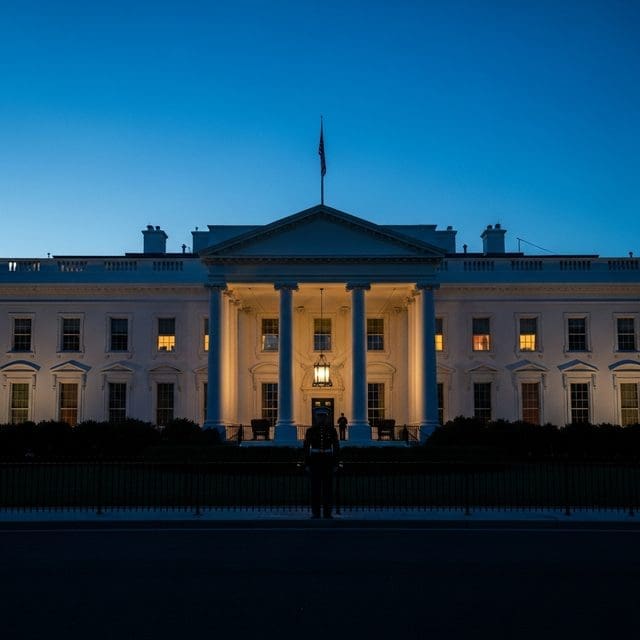
The White House has entered a period of strategic deliberation following a high-stakes meeting between President Donald Trump, Vice President JD Vance, and General Dan Caine, Chairman of the Joint Chiefs of Staff. During the July 24 session, military leadership reportedly cautioned the executive branch that while several tactical options remain, the United States is currently facing a significant munitions stockpile shortage. This logistical constraint has prompted a temporary pause in the 13-night streak of consecutive strikes against Iranian interests, which had seen tit-for-tat exchanges across the region.
General Caine’s assessment highlighted the dual risks of resuming full-scale combat operations: the potential for massive civilian casualties and the high probability of a wider regional escalation that the current domestic inventory may not be positioned to sustain. UN Ambassador Mike Waltz indicated that this pause is intended to provide space for diplomatic discussions, though he maintained that the administration remains prepared for higher-level strikes should indirect talks in Doha fail to yield results regarding shipping security and frozen assets. The administration is currently characterizing the situation as a fragile truce, contingent on Iran signaling it will pause its own attacks as long as the U.S. holds off.
This executive hesitation arrives as Congress faces a compressed legislative window. Lawmakers have only eight working days before the August recess to address a $67 billion supplemental funding request specifically for Iran-related operations. The funding is part of a broader defense package that has stalled in the House. Speaker Mike Johnson’s attempt to tether the National Defense Authorization Act to the SAVE Act—a measure requiring national voter identification—has created a procedural impasse. This maneuver has not resonated well with the party’s conservative faction, leaving the defense bill in limbo and the Pentagon’s requested billion-dollar defense augmentations without a clear path forward.
The geopolitical instability is also complicating domestic monetary policy. The Federal Open Market Committee is scheduled to meet July 28–29 to determine interest rate targets. While markets largely expect the Fed to maintain the current rate of 3.5–3.75 percent, the threat of Middle East-driven oil price spikes has kept the possibility of a rate hike on the table. Federal Reserve officials are monitoring whether energy costs will undermine recent progress in cooling annual inflation, as June minutes previously signaled that no rate cuts are likely before 2027.
On the diplomatic front, the administration is navigating a complex web of regional developments. While President Trump is scheduled to meet with Israeli Prime Minister Benjamin Netanyahu on July 28 and attend the funeral of Senator Lindsey Graham, the U.S. military continues to monitor Houthi rebel drone attacks at Saudi Arabia. Simultaneously, the administration is moving forward with other defense partnerships, such as the joint U.S.-Ukraine drone factory announced by President Volodymyr Zelensky, which aims to diversify defense production outside the traditional Beltway supply chain.
As the White House weighs its options for “major escalation,” the constitutional tension between executive action and congressional authorization remains palpable. Senate Republicans recently defeated a War Powers Resolution that would have constrained further Iran action, but the underlying struggle over legal authorization for expanded hostilities persists. For now, the administration appears to be allowing diplomatic channels to dictate the pace of military engagement, even as it signals that the U.S. forces remain locked and loaded for a potential return to active combat if the Doha talks collapse.

Miles Harrington serves as the Senior Correspondent for Federal Systems & Executive Power at Just Right News, where he brings a disciplined, constitutionalist lens to the inner workings of the American government. With a focus on the mechanics of the federal bureaucracy and the limits of executive authority, Harrington has established himself as a vital voice for readers who value transparency, accountability, and the preservation of the separation of powers.
A native of Richmond, Virginia, Harrington’s perspective is deeply rooted in the traditions of the Old Dominion. Growing up in a city defined by its historical significance and its role as a center of American jurisprudence, he developed an early appreciation for the foundational principles of the Republic. His upbringing in Richmond—a place where the legacy of the Founding Fathers is woven into the landscape—instilled in him a belief that the federal government should remain within its constitutional bounds. This background informs his skepticism of centralized overreach and his commitment to reporting on the ways in which the administrative state impacts the lives of everyday citizens.
In his current role, Harrington specializes in the complexities of federal systems. He doesn’t just report on the headlines of the day; he digs into the structural shifts within the executive branch that often go unnoticed by the mainstream press. Whether he is analyzing the implications of a new federal regulation or investigating the expansion of agency jurisdiction, his work is characterized by a rigorous adherence to the facts and a dedication to the rule of law.
Harrington is perhaps best known for his signature feature series, “How Washington Works.” Through this ongoing project, he demystifies the often-opaque processes of the nation’s capital, pulling back the curtain on the “Deep State” and the unelected officials who wield significant influence over national policy. By breaking down complex legislative maneuvers and executive orders, he empowers Just Right News readers to understand the true levers of power in Washington. His reporting serves as a necessary check on the federal government, ensuring that the actions of those in power are held up to the light of public scrutiny.
Now based in Washington, D.C., Harrington operates at the epicenter of the political world, yet he remains intentionally distanced from the “Beltway bubble.” His proximity to the halls of power allows him to maintain a robust network of sources across the federal landscape, but his heart remains in the principled conservatism of his Virginia roots. He views his role not merely as a reporter, but as a steward of the public trust, dedicated to providing the clarity and context that conservative voters need to navigate an increasingly complex political environment.
Through his sharp analysis and unwavering commitment to the truth, Miles Harrington continues to be a cornerstone of the Just Right News team. His work ensures that the principles of limited government and executive restraint remain at the forefront of the national conversation, providing a crucial service to those who believe in a government that is truly of, by, and for the people.