

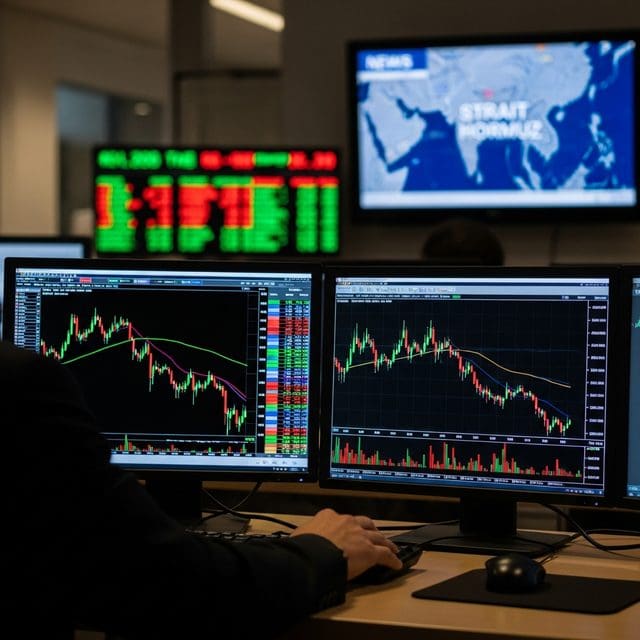
Major indices showed mixed results as a pause in Middle East hostilities lowered crude prices, offsetting a tech-sector selloff and persistent concerns over a potential Federal Reserve rate hike.
Financial markets entered a period of cautious stabilization on Monday, with the S&P 500 and the SPY exchange-traded fund hovering just 0.11% above the flatline. This marginal gain masks a significant internal tug-of-war on Wall Street, as a sharp retreat in energy costs and a resurgence in defensive stocks battled a deepening slump in the technology sector. For the American taxpayer, the day offered a rare moment of equilibrium in a month defined by rising costs and geopolitical volatility.
The primary catalyst for the day’s relative calm was a temporary de-escalation in the Middle East. Following a directive from the Trump administration to halt military strikes against Iranian targets—breaking a 13-day streak of daily attacks—Brent crude fell approximately 4.5% to the $92 range, while WTI dropped nearly 4.9% to roughly $85. For American households, this reprieve in energy markets offers a vital cushion against the inflationary pressures that have accelerated throughout July. However, the geopolitical situation remains volatile; while Oman-mediated talks regarding the Strait of Hormuz show signs of progress, Houthi forces reportedly targeted Saudi Aramco facilities in Jizan and Yanbu, keeping a floor under long-term supply risks.
While the Dow Jones Industrial Average gained 0.46%, the tech-heavy Nasdaq Composite slid 0.64%. This divergence highlights a growing skepticism toward high-growth artificial intelligence plays. Alphabet’s recent earnings, characterized by massive capital expenditure, have prompted a rotation into more traditional, value-oriented sectors. Investors are increasingly wary of the ‘AI premium’ as the costs of maintaining technological dominance begin to weigh on corporate balance sheets. This tech-led drag is the primary reason the broader market failed to capitalize more fully on the drop in oil prices.
Adding to the complexity is the upcoming Federal Reserve meeting. Markets are currently pricing in a 35% probability of a rate hike, spurred by stronger-than-expected July PMI data and a labor market that refuses to cool. This hawkish lean by the central bank serves as a reminder that the era of easy money remains a distant memory. For the working household, this translates to sustained high borrowing costs even as the broader economy shows signs of acceleration. The 10-year U.S. Treasury yield responded to the cooling oil prices by dropping 5 basis points to 4.63%, yet the underlying sentiment remains one of fiscal tightening.
In the real estate and institutional space, activity remains robust despite the high-rate environment, illustrating a divide between speculative tech and tangible assets. MAG Capital Partners recently finalized the $89 million sale of a 1.37 million square foot Midwest industrial portfolio to a Starwood Property Trust subsidiary. Similarly, Merritt Properties nearly doubled its Jacksonville footprint by acquiring the Center Point Business Park. These transactions, alongside Cove Capital Investments’ acquisition of a 170-unit multifamily community in San Antonio through an REO disposition, suggest that while Wall Street grapples with tech valuations, the physical backbone of American commerce continues to attract significant capital.
As the week progresses, the focus will shift to the White House, where OpenAI’s Sam Altman is expected to preview the next generation of AI models. For a market currently punishing tech for its high spending, the details of this visit could determine whether the Nasdaq finds its footing or continues its descent. Simultaneously, the legal landscape is shifting for several firms, with Peabody Energy and Genius Group facing securities class action lawsuits. For now, the American investor is left with a market that is standing still, waiting for the next move from either the Federal Reserve or the volatile situation in the Persian Gulf.

Jordan Lee serves as the Senior Correspondent for Wall Street, Finance, and Monetary Systems at Just Right News. Based in the heart of the world’s financial capital, New York City, Lee brings a sharp, principled eye to the complex mechanisms that drive the global economy. His reporting is defined by a commitment to fiscal responsibility, the defense of the free market, and a deep-seated belief that a transparent monetary system is the bedrock of a free society.
Raised in Portland, Oregon, Lee’s perspective was forged in a city that has undergone significant cultural and economic shifts. His upbringing in the Pacific Northwest instilled in him a profound appreciation for the industriousness of small business owners and the importance of local economic stability. Watching the evolution of his hometown’s landscape sparked an early interest in how federal fiscal policy and large-scale financial trends eventually trickle down to the average citizen. This background provides him with a unique vantage point; he understands the growing disconnect between the policy-making elite and the reality of Main Street, a theme that frequently resonates throughout his work.
Now operating from his base in New York City, Lee bridges the gap between the high-stakes trading floors of Manhattan and the households of everyday Americans. He views the financial sector not merely as a collection of numbers and tickers, but as a vital engine of American prosperity that requires constant vigilance and accountability. His reporting often highlights the dangers of centralized financial control and the necessity of maintaining a system that rewards merit, risk-taking, and innovation.
As the creator and lead of the featured series, “The Invisible Economy,” Lee pulls back the curtain on the often-opaque world of monetary systems. He specializes in translating the dense jargon of central banking and international finance into actionable insights for the Just Right News audience. His work explores the “invisible” forces—such as inflationary pressures, regulatory creep, and the expansion of the administrative state—that erode the purchasing power of American families. By focusing on these systemic issues, Lee empowers readers to understand the hidden forces shaping their financial independence.
Lee’s journalistic philosophy is rooted in a steadfast commitment to traditional American values. As an Asian American professional who has navigated the competitive corridors of the financial world, he is a vocal advocate for meritocracy and the preservation of the American Dream. He believes that a stable currency and a predictable regulatory environment are essential for national sovereignty and individual liberty. His reporting frequently warns against the risks of government overreach in the private sector, arguing that the most effective solutions to economic challenges arise from competition and individual enterprise rather than bureaucratic mandates.
At Just Right News, Jordan Lee remains dedicated to providing a clear-eyed defense of the taxpayer. Whether he is analyzing market volatility or investigating the long-term implications of national debt, his mission is to provide the truth about where the money is going and what it means for the future of the country. Through his rigorous analysis and principled stance, Lee has become a trusted voice for those who value a strong, sovereign, and fiscally sound America.