

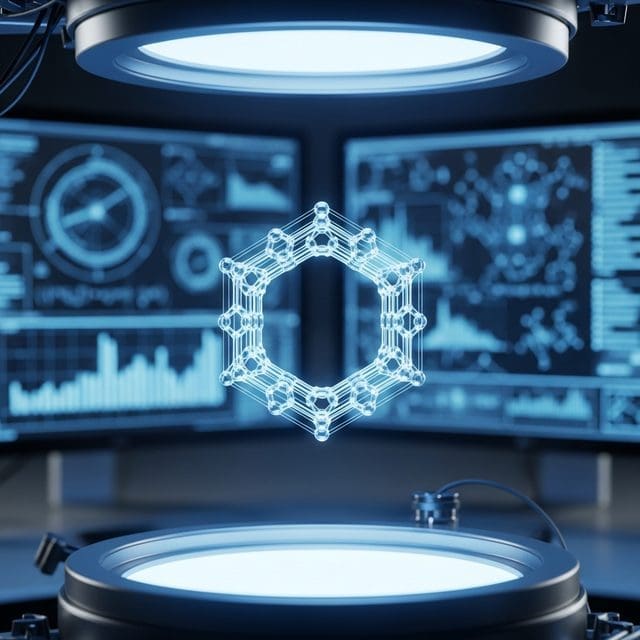
Scientists at The University of Manchester have developed a new computational method that integrates physical constraints into machine learning to accelerate the identification of two-dimensional quantum materials.
The search for the building blocks of the next technological revolution has long been hampered by the sheer scale of the unknown. In condensed matter physics, identifying two-dimensional materials that exhibit “unusual quantum behavior”—essential for ultra-efficient electronics or stable quantum computers—is a task of nearly infinite complexity. Traditional computational screening is often too slow, while purely data-driven machine learning models frequently lack the physical grounding to yield reliable results. This week, researchers at The University of Manchester addressed this bottleneck by developing a physics-based machine learning method to navigate the vast landscape of quantum materials.
Published in the journal Science Advances, the team’s approach distinguishes itself by incorporating known physical constraints and quantum-mechanical properties directly into the search algorithm. Rather than treating discovery as a simple pattern-matching exercise, the system uses the laws of physics to guide its predictions. This ensures that the materials it identifies are not just statistically likely, but physically viable. The search space for these 2D quantum materials is enormous; naive computational screening is often too slow and misses physically interesting states. By embedding these constraints, the researchers dramatically reduce the number of candidate materials that require expensive quantum calculations or laboratory synthesis.
This breakthrough is particularly relevant for the development of two-dimensional quantum materials, which are atom-thick layers capable of hosting exotic states like quantum spin liquids. These materials are primary candidates for hardware that may eventually replace current silicon-based semiconductors. By narrowing the field of candidates, this method provides a more efficient path toward domestic technological sovereignty in the semiconductor and quantum sectors. The work is likely to be adopted by experimental groups looking for new platforms for quantum devices, especially in low-power electronics or solid-state qubits.
Parallel to the Manchester discovery, physicists at Heidelberg University achieved a significant theoretical unification. For decades, two rival models competed to describe how a single impurity particle behaves inside a crowded quantum environment. This conflict made it difficult for scientists to interpret precision experiments or engineer materials for quantum devices. The Heidelberg team successfully united these opposing quantum theories, providing sharper predictions about measurable quantities such as energy levels and lifetimes. This unified theory is expected to reshape experiments on ultracold atoms and semiconductors, providing a clearer roadmap for building the sensors and processors of the future.
Further advances in the field include the demonstration of the first cyclic quantum heat engine inside a superconducting circuit by Aalto University. This development suggests that the principles of thermodynamics are being successfully adapted to the quantum scale, offering new ways to manage energy within decentralized quantum systems. Additionally, research from the University of Amsterdam and the University of New South Wales measured long-lived ytterbium ion states. These states are critical for the development of more accurate atomic clocks and more stable quantum computers.
As the global race for quantum supremacy intensifies, these discoveries reinforce the value of traditional scientific rigor. While some in the tech industry favor “black box” artificial intelligence that ignores underlying principles, these findings from Manchester and Heidelberg prove that anchoring digital tools in the immutable laws of the physical world yields superior results. Moving forward, the integration of physics-informed algorithms and unified quantum theories will continue to shrink the distance between theoretical prediction and tangible hardware, bringing the promise of a principled, high-tech future closer to reality.

Mason Reed serves as a Staff Writer for Just Right News, where he spearheads the Future Frontiers & Special Projects desk. In an era defined by rapid technological shifts and evolving social landscapes, Mason provides a steady, principled voice, examining the innovations of tomorrow through the lens of traditional American values. His work is most prominently featured in his signature series, “The Next Horizon,” where he explores the intersection of emerging technology, national sovereignty, and the preservation of individual liberty.
A native of San Diego, California, Mason’s worldview was shaped by the unique culture of his hometown. Growing up in a region defined by its strong military presence and its history of maritime industry, he developed a deep-seated respect for the institutions that provide national stability and the entrepreneurial spirit that drives the American economy. This upbringing instilled in him a belief that true progress is not found in discarding the past, but in building upon a foundation of proven principles. His reporting often reflects this San Diego influence, emphasizing the importance of a robust national defense and the necessity of maintaining a competitive edge in the global marketplace.
Now based in San Francisco, Mason operates from the heart of the world’s technological engine. Living and working in the Bay Area provides him with a front-row seat to the advancements—and the ideological challenges—emanating from Silicon Valley. While many in the region embrace a “move fast and break things” mentality, Mason’s reporting serves as a vital counterweight. He offers Just Right News readers a “boots on the ground” perspective, documenting how radical local policies and the concentration of tech power impact the everyday lives of citizens. His proximity to the industry allows him to cut through the marketing jargon of big tech to uncover the real-world implications for privacy, free speech, and the nuclear family.
In his “Future Frontiers” beat, Mason tackles complex subjects ranging from the ethics of artificial intelligence to the burgeoning private space race. He approaches these topics with a healthy skepticism toward centralized bureaucracy, championing instead the decentralized innovations that empower individuals. Through “The Next Horizon,” he highlights the pioneers and thinkers who are working to ensure that the future remains a place where human dignity and constitutional rights are protected. He believes that the rapid pace of change requires more than just technical expertise; it requires a moral compass rooted in the Western tradition.
Throughout his tenure at Just Right News, Mason has remained committed to the idea that the future is something to be shaped, not merely accepted. His writing is characterized by a rigorous defense of American exceptionalism and a belief that the country’s best days lie ahead, provided it remains true to its founding ideals. Whether he is investigating the impact of automation on the American workforce or profiling the next generation of aerospace engineers, Mason Reed ensures that his readers are equipped with the insights they need to navigate a changing world with confidence and clarity.