

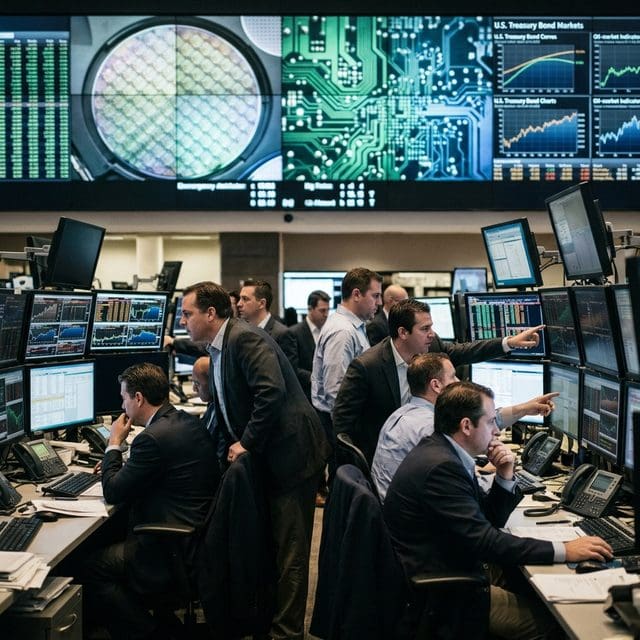
Rising expectations for Federal Reserve rate increases and upheaval at Nvidia weighed on Thursday’s stocks, as investors awaited fresh inflation data and watched bond, dollar and oil markets.
U.S. markets faced two sources of uncertainty Friday: growing expectations of Federal Reserve rate increases and turmoil around Nvidia, a central company in the artificial-intelligence trade. On Thursday, the S&P 500 and Nasdaq-100 each closed down 0.3%. Energy rose 1.5%, while communication services fell 1.0% and materials dropped 1.3%. Early Friday, futures pointed to modest gains. At 5:17 a.m. ET, S&P 500 futures were up 0.1% and Dow futures 0.2%, while Nasdaq-100 futures were little changed, according to Yahoo Finance/Investing.com.
The interest-rate outlook has shifted sharply. New York Fed President John Williams said inflation remains “far too high” and policymakers must return it to the central bank’s 2% goal while avoiding undue harm to employment, CNBC TV18/Bloomberg reported. Interest-rate futures indicated quarter-point increases at each of the next three meetings—December, January and March. Those are market expectations, not a commitment by the Fed.
Recent consumer-price data helps explain the shift. Core prices, excluding food and energy, rose 0.3% in October from the previous month, exceeding estimates for a third consecutive month, according to CNBC TV18/Bloomberg. Investors were watching Friday’s producer-price index for further evidence on inflation. The available reporting did not include the result, leaving it an open question rather than a confirmed market driver.
The repricing has shown up in bonds and currency markets. Treasury yields have climbed, with the two-year yield recording its largest four-session increase since the Fed’s 2022 tightening cycle, Morningstar/Dow Jones reported. Short-term yields are especially sensitive to expected Fed policy. The dollar rose to levels not seen since the April 2025 tariff announcement, the report said, as traders reassessed the U.S. rate outlook. A stronger dollar can tighten financial conditions and weigh on U.S. companies with overseas earnings. The available reporting did not provide current exchange-rate levels.
Oil fell early Friday after President Donald Trump said the United States no longer needed a deal with Iran. That move reflected the possibility of diplomacy, not a confirmed restoration of production or shipping infrastructure, CMS Prime’s Terri-Leigh Bennett cautioned in the Morningstar/Dow Jones report. Energy was Thursday’s strongest S&P 500 sector, but the oil outlook remains uncertain. A sustained rise in energy costs can feed into broader inflation.
Nvidia brought a company-specific shock to the rate concerns. CEO Jensen Huang resigned Thursday, and CFO Colette Kress became interim CEO while the board searches for a permanent successor, according to the source material. Trump floated former Apple CEO Tim Cook as a possible replacement. Kress must also oversee Nvidia’s quarterly results due next week, putting leadership questions alongside the company’s financial performance.
The company is also facing scrutiny in Washington. Senate Banking Committee Chairman Tim Scott requested testimony from Huang and Commerce Secretary Howard Lutnick in December concerning alleged smuggling of Nvidia’s high-end processors into China, Yahoo Finance/Investing.com reported. The allegations are not a finding of wrongdoing. Alongside the leadership change, they have put governance and access to overseas markets in focus alongside demand for AI chips.
The next tests are producer-price data, further signals from Fed officials and Nvidia’s results. If inflation reinforces expectations for higher rates, borrowing costs and the value investors assign to future earnings could remain headwinds for technology stocks. If it does not, markets will still have to weigh the Fed’s stated inflation concern and Nvidia’s transition. Neither question was settled in early Friday trading.

Jordan Lee serves as the Senior Correspondent for Wall Street, Finance, and Monetary Systems at Just Right News. Based in the heart of the world’s financial capital, New York City, Lee brings a sharp, principled eye to the complex mechanisms that drive the global economy. His reporting is defined by a commitment to fiscal responsibility, the defense of the free market, and a deep-seated belief that a transparent monetary system is the bedrock of a free society.
Raised in Portland, Oregon, Lee’s perspective was forged in a city that has undergone significant cultural and economic shifts. His upbringing in the Pacific Northwest instilled in him a profound appreciation for the industriousness of small business owners and the importance of local economic stability. Watching the evolution of his hometown’s landscape sparked an early interest in how federal fiscal policy and large-scale financial trends eventually trickle down to the average citizen. This background provides him with a unique vantage point; he understands the growing disconnect between the policy-making elite and the reality of Main Street, a theme that frequently resonates throughout his work.
Now operating from his base in New York City, Lee bridges the gap between the high-stakes trading floors of Manhattan and the households of everyday Americans. He views the financial sector not merely as a collection of numbers and tickers, but as a vital engine of American prosperity that requires constant vigilance and accountability. His reporting often highlights the dangers of centralized financial control and the necessity of maintaining a system that rewards merit, risk-taking, and innovation.
As the creator and lead of the featured series, “The Invisible Economy,” Lee pulls back the curtain on the often-opaque world of monetary systems. He specializes in translating the dense jargon of central banking and international finance into actionable insights for the Just Right News audience. His work explores the “invisible” forces—such as inflationary pressures, regulatory creep, and the expansion of the administrative state—that erode the purchasing power of American families. By focusing on these systemic issues, Lee empowers readers to understand the hidden forces shaping their financial independence.
Lee’s journalistic philosophy is rooted in a steadfast commitment to traditional American values. As an Asian American professional who has navigated the competitive corridors of the financial world, he is a vocal advocate for meritocracy and the preservation of the American Dream. He believes that a stable currency and a predictable regulatory environment are essential for national sovereignty and individual liberty. His reporting frequently warns against the risks of government overreach in the private sector, arguing that the most effective solutions to economic challenges arise from competition and individual enterprise rather than bureaucratic mandates.
At Just Right News, Jordan Lee remains dedicated to providing a clear-eyed defense of the taxpayer. Whether he is analyzing market volatility or investigating the long-term implications of national debt, his mission is to provide the truth about where the money is going and what it means for the future of the country. Through his rigorous analysis and principled stance, Lee has become a trusted voice for those who value a strong, sovereign, and fiscally sound America.