

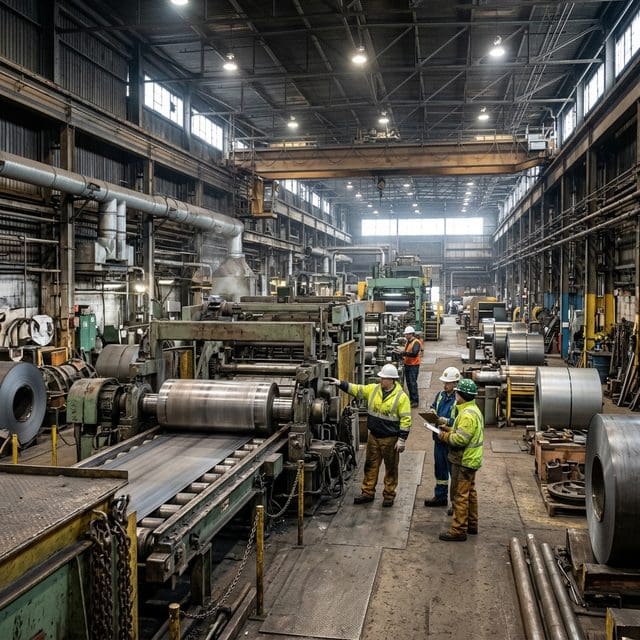
Stelco says stronger customer demand will restart Hamilton finishing operations after weeks of idling, with affected workers to receive retroactive standard wages for the layoff period.
Stelco says it will restart finishing operations at its Hamilton, Ontario, steel plant after improved customer demand and customer commitments made the lines viable again. The company announced the decision November 13, reversing a temporary idling that had put workers out of work amid what it described as unsustainable market conditions for cold-rolled and coated products.
The restart is expected to take several weeks, Stelco said. Workers affected by the layoff will be paid retroactively for the standard wages they would have received during that period, according to the company’s announcement. That promise offers a measure of income security while the plant prepares to resume operations, though the available details do not specify when each worker will return to active duty or how the restart will be phased.
The company has not provided, in the material available, a detailed schedule for restoring production or a longer-term forecast for the finishing lines. Nor does its announcement quantify the customer commitments or describe how much output they are expected to support. The decision is a tangible improvement for the affected workforce, but it does not by itself establish that the operation has secured a lasting recovery.
The Canadian Press reported that customer commitments supported the Hamilton finishing operations. Stelco attributed pressure on the domestic market to offshore imports of galvanized products and gaps in the federal government’s tariff-response program. Those are the company’s explanations for the idling; the announcement does not provide figures on import volumes, production levels, pricing, or the financial terms of the customer commitments.
For workers, the restart underscores how quickly manufacturing jobs can be affected by forces outside the plant gate. A finishing line can be ready to operate, yet sit idle when orders and market conditions no longer support production. A return to work is welcome, but a temporary improvement in demand is not the same as a durable guarantee of steady hours and pay. Retroactive wages address pay for the layoff period, while the length and reliability of future work remain separate questions.
The recall also follows weeks of pressure from the federal government, The Canadian Press reported, including threats of legal action and the possibility of an investigation into anticompetitive conduct. That pressure forms part of the broader dispute over Stelco’s response to the market conditions. The company has framed the problem as import competition and shortcomings in the tariff program, while the reported government threats show that officials were scrutinizing its conduct. The available reporting does not establish that the pressure itself caused the restart; Stelco pointed to improved demand and customer commitments.
Tariffs can give domestic producers some protection from import competition, but they do not automatically create lasting orders or insulate a plant from changing demand. The Hamilton lines’ return will depend on whether customer commitments translate into sustained production once work resumes. That distinction matters to employees whose income depends not just on a recall, but on dependable shifts over time.
The episode also shows why a layoff later reversed does not erase the uncertainty workers experienced in between. Families planning around wages need to know when work will resume and whether it will continue; the announcement addresses retroactive standard pay, but leaves the schedule and longer-term outlook unclear. The cited material also does not establish how many workers are affected, so the scale of the recall cannot be confirmed here.
For Hamilton’s steel workforce, Stelco’s announcement is a welcome but limited development: production is expected to restart, and affected workers are to receive the standard wages due for the layoff period. Whether that becomes a sustained recovery will depend on orders, market conditions, and the unresolved policy and competition questions surrounding imported steel.

Tom Blake serves as the Senior Correspondent for Labor, Wages, and Automation at Just Right News, where he brings a grounded, principled perspective to the most pressing economic issues facing the American heartland. As the lead voice behind the acclaimed feature series “The Price of Work,” Tom focuses his reporting on the intersection of traditional industry and the rapidly evolving technological landscape, always prioritizing the dignity of the individual worker and the health of the American family.
Tom’s deep understanding of the labor market is not merely academic; it is rooted in his upbringing in Detroit, Michigan. Growing up in the shadow of the automotive industry, he witnessed firsthand the triumphs and tribulations of the American blue-collar workforce. He saw how the stability of a manufacturing job could build a community and, conversely, how the erosion of those industries could tear the social fabric apart. This background instilled in him a lifelong respect for the trades and a healthy skepticism toward economic policies that prioritize globalist interests over the well-being of local communities.
Now based in Pittsburgh, Pennsylvania, Tom continues to report from the front lines of the shifting economy. Pittsburgh, a city that has reinvented itself while maintaining its gritty, industrious spirit, provides the perfect vantage point for his beat. From the steel mills that remain to the high-tech robotics labs reshaping the city’s future, Tom explores how automation is changing the nature of employment. His reporting often highlights the tension between innovation and tradition, arguing that while progress is inevitable, it must not come at the expense of the American worker’s ability to provide for their family through honest, meaningful labor.
In his role at Just Right News, Tom has become a vital voice for those who feel overlooked by mainstream economic coverage. He rejects the notion that the decline of American manufacturing is an unavoidable casualty of the modern era. Instead, his work often examines how regulatory overreach, rising energy costs, and the unchecked rise of automation impact the take-home pay of everyday citizens. Through “The Price of Work,” Tom delves into the true cost of economic shifts, looking beyond the raw data to tell the stories of the people behind the statistics.
Tom’s reporting is characterized by a commitment to the conservative values of self-reliance, fiscal responsibility, and the preservation of the American dream. He believes that a strong nation is built on a foundation of stable jobs and fair wages, and his work seeks to hold both government and corporate entities accountable to that standard. Whether he is interviewing a shop floor manager about the implementation of new AI technology or analyzing the impact of wage inflation on small businesses, Tom provides a clear-eyed analysis that resonates with readers who value hard work and common sense.
Through his dedicated coverage, Tom Blake remains a steadfast advocate for the American workforce, ensuring that the voices of those in the industrial heartland are heard loud and clear in the national conversation. His perspective is essential for anyone seeking to understand the complex realities of labor and automation in the twenty-first century.