

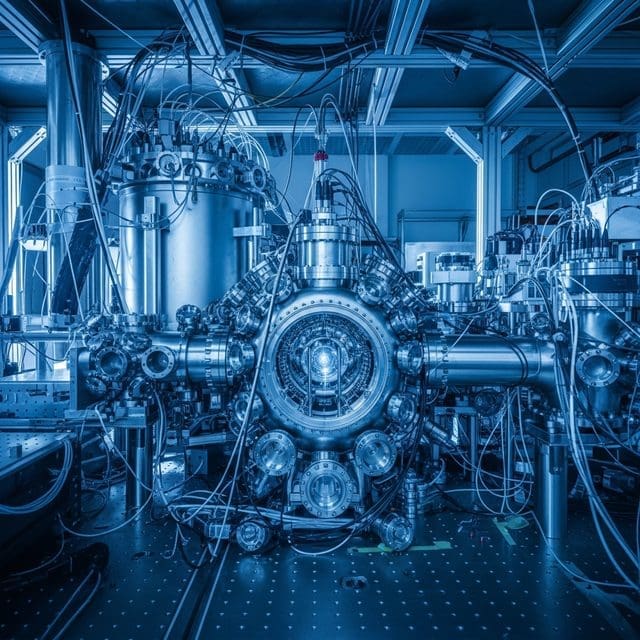
Researchers at Heidelberg University have resolved a decades-old conflict in quantum physics, creating a unified model for how particles behave in crowded environments to improve future quantum simulators and semiconductors.
A long-standing divide in many-body quantum physics was bridged this week as researchers at Heidelberg University announced a unified theory for quantum impurities. The breakthrough, reported on July 26, 2026, resolves a decades-old conflict between two rival models that offered incompatible predictions for how a single particle behaves when submerged in a crowded quantum environment. For years, physicists struggled to reconcile Fermi polarons—quasiparticles formed by an impurity interacting with its surroundings—with Anderson’s orthogonality catastrophe, a phenomenon where a system reacts violently to a sudden change. The new framework demonstrates that even supposedly immobile impurities possess subtle motion, creating an energy gap that allows these two disparate concepts to coexist.
This discovery provides the precise mathematical language needed to interpret data from ultracold atom experiments and semiconductor research. As the race for quantum supremacy intensifies, the ability to control these “impurities” is becoming a matter of technological sovereignty. Quantum simulators and solid-state devices rely on the stable manipulation of particles within dense mediums. By providing a unified description of these interactions, the Heidelberg result allows engineers to design more reliable hardware, moving past the trial-and-error methods necessitated by the previous theoretical divide. This is particularly relevant as researchers move toward fitting one million qubits onto a pinhead-scale silicon device using isotopically purified silicon-29-free material.
While the Heidelberg team clarifies the microscopic world, other researchers are looking to the stars to find missing pieces of the physical puzzle. An international team recently proposed a method to detect the universe’s hidden particles using “cosmic piano notes.” By analyzing effective field theory coefficients, which quantify how new laws of physics influence known particle interactions at low energies, scientists can map these spectral shifts to identify high-energy particles that current colliders cannot directly produce. This method treats the universe as a vast instrument where missing or shifted tones signal the presence of new physics, offering a complementary path to traditional particle acceleration.
These theoretical leaps occur against a backdrop of rapid industrial milestones. In early 2026, Quantinuum achieved a record 99.995% two-qubit gate fidelity, while Google and IBM pushed the boundaries of logical qubits and chemical simulations. Microsoft has introduced cloud-accessible topological-qubit prototypes, and PsiQuantum is constructing a massive photonic center in Brisbane for 2027 operations. The Heidelberg theory acts as a vital compass for these efforts, ensuring that the physical behavior of the particles inside these machines is fully understood rather than just observed.
Beyond the laboratory, the implications for sovereignty and privacy are stark. Experts warn that current ECC encryption standards could be rendered obsolete within years as these atom-array and large-scale quantum systems scale. The push for post-quantum cryptography is already seeing global expansion, with companies like Quantum Secure Encryption Corp. moving to secure government communications against the looming threat of quantum decryption. By refining our understanding of quantum matter at the fundamental level, researchers are laying the groundwork for the secure, decentralized infrastructure required to protect constitutional rights in a post-quantum world.
Ultimately, this week’s discoveries represent a shift from speculation to mastery. Whether it is the unification of impurity models or the detection of hidden particles via cosmic resonance, the path forward requires a principled commitment to hard science. By anchoring the quantum revolution in rigorous, unified theory, we ensure that the next generation of innovation remains grounded in physical reality, providing a necessary counterweight to the opaque algorithms and centralized control of the modern digital age.

Mason Reed serves as a Staff Writer for Just Right News, where he spearheads the Future Frontiers & Special Projects desk. In an era defined by rapid technological shifts and evolving social landscapes, Mason provides a steady, principled voice, examining the innovations of tomorrow through the lens of traditional American values. His work is most prominently featured in his signature series, “The Next Horizon,” where he explores the intersection of emerging technology, national sovereignty, and the preservation of individual liberty.
A native of San Diego, California, Mason’s worldview was shaped by the unique culture of his hometown. Growing up in a region defined by its strong military presence and its history of maritime industry, he developed a deep-seated respect for the institutions that provide national stability and the entrepreneurial spirit that drives the American economy. This upbringing instilled in him a belief that true progress is not found in discarding the past, but in building upon a foundation of proven principles. His reporting often reflects this San Diego influence, emphasizing the importance of a robust national defense and the necessity of maintaining a competitive edge in the global marketplace.
Now based in San Francisco, Mason operates from the heart of the world’s technological engine. Living and working in the Bay Area provides him with a front-row seat to the advancements—and the ideological challenges—emanating from Silicon Valley. While many in the region embrace a “move fast and break things” mentality, Mason’s reporting serves as a vital counterweight. He offers Just Right News readers a “boots on the ground” perspective, documenting how radical local policies and the concentration of tech power impact the everyday lives of citizens. His proximity to the industry allows him to cut through the marketing jargon of big tech to uncover the real-world implications for privacy, free speech, and the nuclear family.
In his “Future Frontiers” beat, Mason tackles complex subjects ranging from the ethics of artificial intelligence to the burgeoning private space race. He approaches these topics with a healthy skepticism toward centralized bureaucracy, championing instead the decentralized innovations that empower individuals. Through “The Next Horizon,” he highlights the pioneers and thinkers who are working to ensure that the future remains a place where human dignity and constitutional rights are protected. He believes that the rapid pace of change requires more than just technical expertise; it requires a moral compass rooted in the Western tradition.
Throughout his tenure at Just Right News, Mason has remained committed to the idea that the future is something to be shaped, not merely accepted. His writing is characterized by a rigorous defense of American exceptionalism and a belief that the country’s best days lie ahead, provided it remains true to its founding ideals. Whether he is investigating the impact of automation on the American workforce or profiling the next generation of aerospace engineers, Mason Reed ensures that his readers are equipped with the insights they need to navigate a changing world with confidence and clarity.