

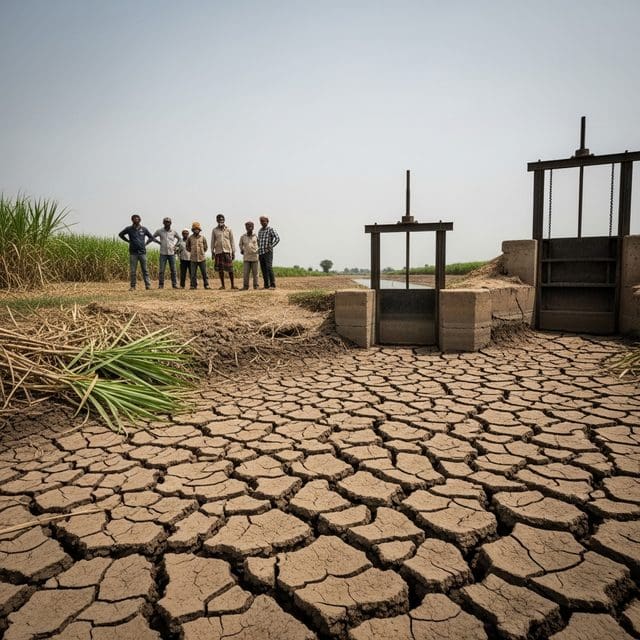
Karnataka authorities have halted irrigation water releases to prioritize drinking supplies as reservoir levels hit historic lows during a severe monsoon deficit.
The delicate balance between municipal survival and agricultural production is being pushed to its breaking point in the Cauvery basin. As of late July 2026, the Cauvery Water Management Authority (CWMA) has issued an emergency directive ordering the states of Karnataka and Tamil Nadu to reserve all remaining reservoir storage exclusively for drinking water. This mandate effectively shuts the gates on irrigation canals, leaving millions of acres of prime farmland in a state of forced dormancy during what should be a peak growing season.
The regional government in Karnataka has formally notified farmers in the command areas that no canal water will be allocated for crops, a decision that comes as the state grapples with a 35% rainfall deficit. Inflows into major reservoirs have fallen far below historical norms, prompting the CWMA to officially declare this a “distress year.” For the families who have tilled this land for generations, the directive is a catastrophic blow. Sugarcane crops are already withering in districts like Mandya, and the sowing of new crops has ground to a total halt as the ground turns to dust.
From a stewardship perspective, the situation highlights the fragility of water infrastructure that relies on seasonal monsoons without sufficient long-term storage or private-sector contingency planning. The Karnataka government is now seeking central intervention, requesting that the Prime Minister send a federal team to assess drought conditions. This move seeks to tie canal-water decisions to a broader disaster-assessment process rather than routine irrigation planning, acknowledging that the current crisis has moved beyond the scope of local management.
While officials have initiated a “reality check” review of reservoir levels, they have conditioned any future releases on improved monsoon performance. Current India Meteorological Department forecasts offer little comfort, predicting below-normal rain for the foreseeable future. Consequently, the state has publicly ruled out opening canals for farming for at least the next two to three months. In a desperate bid to mitigate the disaster, authorities are even considering cloud seeding and other technological interventions to stimulate rainfall in the parched basin.
The impact extends beyond the fields to the very health of rural communities and the safety of the food supply. Authorities and farmer groups are stressing that any minimal releases permitted must first be used to refill local tanks and lakes to provide water for cattle and village consumption. This prioritization of basic survival over economic output is a grim necessity, but it leaves the agricultural sector in a precarious position. Livestock protection has become a primary concern, as the lack of water for cattle threatens the long-term viability of rural dairy and meat production.
Across the border, the narrative is equally grim. Tamil Nadu farmers are voicing sharp criticism, claiming the current management strategy treats the Cauvery as a flood discharge channel rather than a shared resource. They argue that Karnataka’s control over the gates has turned the river into a system opened or closed at will. With an estimated 700,000 acres of Kuruvai crops already lost and a projected production deficit of 1.5 million tonnes, the economic ripples will be felt at every dinner table in the region.
This crisis serves as a stark reminder that when water management fails to account for extreme volatility, it is the independent farmer and the local food supply that pay the highest price. As regulators struggle to balance the needs of urban centers with the requirements of the agricultural heartland, the lack of robust, localized water infrastructure becomes an unavoidable reality. For now, the farmers of the Cauvery basin can only look to the skies, as the bureaucracy remains firm in its decision to keep the sluice gates locked tight.

Eric Nolan serves as the Senior Correspondent for Food, Water, and Environmental Health at Just Right News, where he brings a principled, common-sense perspective to the most fundamental issues facing the American public. With a career dedicated to uncovering the truth behind the policies that govern our natural resources, Eric has become a trusted voice for readers who value traditional stewardship over bureaucratic overreach. His reporting is defined by a commitment to the idea that true environmentalism is rooted in the protection of the American family and the preservation of the nation’s agricultural heritage.
Raised in Fresno, California, Eric’s worldview was shaped in the heart of the San Joaquin Valley. Growing up in one of the world’s most productive agricultural hubs, he witnessed firsthand the vital connection between the land, the water, and the dinner table. In Fresno, he saw the resilience of farmers and the devastating impact that distant, top-down regulations can have on local communities. This upbringing instilled in him a deep respect for the producers who feed the country and a lifelong skepticism toward the alarmist narratives often pushed by mainstream media. For Eric, environmental health is not an abstract political talking point; it is a matter of ensuring that the people who work the land have the freedom and the resources to do so effectively.
Now based in Eugene, Oregon, Eric operates from a unique vantage point in the Pacific Northwest. Living in a region often defined by intense environmental debate, he provides a necessary counter-narrative to the prevailing trends of the area. From his base in Eugene, he monitors the shifting tides of federal and state policies, ensuring that the voices of rural citizens and property owners are not drowned out by urban activism. His reporting often bridges the gap between the rugged realities of the outdoors and the legislative halls where decisions are made, offering a grounded perspective that prioritizes local sovereignty and practical solutions.
As the lead for the acclaimed feature series “Earth on the Table,” Eric explores the intricate journey of the American food supply. He tackles critical issues such as water rights, soil health, and food security through a lens of national stability and individual liberty. He believes that a healthy environment and a thriving economy are not mutually exclusive, but rather two sides of the same coin of national prosperity. His work consistently highlights how innovation and private-sector ingenuity are the most effective tools for ensuring clean water and a safe food supply, rather than the expansion of the administrative state.
At Just Right News, Eric’s reporting serves as a vital resource for those who seek accountability and transparency. Whether he is investigating the impact of federal land management on local economies or examining the safety of the national food infrastructure, his work remains anchored in the values of heritage and hard work. Eric Nolan continues to be a leading voice in environmental journalism, championing the belief that the best way to protect our natural resources is to empower the people who live and work closest to them.