

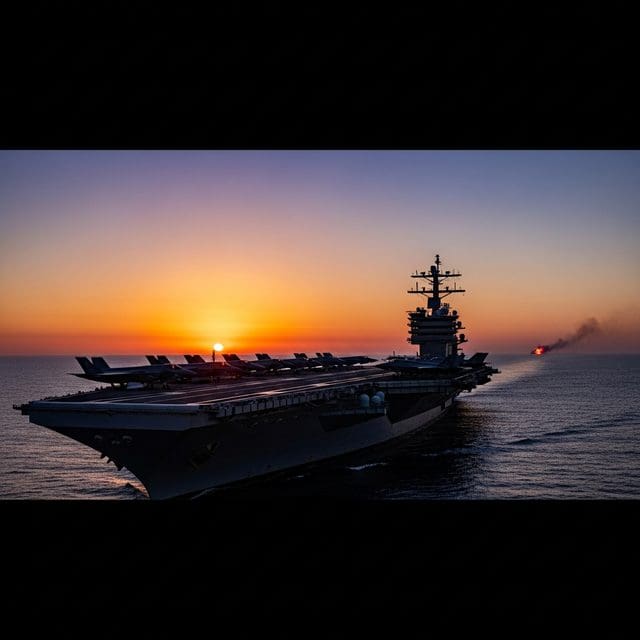
The Trump administration has intensified its air campaign against the IRGC following the first American troop deaths in Jordan, targeting Iranian nuclear-adjacent sites and maritime surveillance capabilities.
The Trump administration has authorized a significant expansion of military operations against the Islamic Revolutionary Guard Corps (IRGC) following a lethal drone and missile strike on a U.S. base in Jordan. U.S. Central Command confirmed an eighth consecutive night of precision strikes, moving beyond tactical retaliation to a strategic degradation of Iran’s maritime and surveillance capabilities. The current campaign explicitly targets IRGC coastal radar towers, air defense batteries, and missile storage facilities in an effort to break Tehran’s self-declared blockade of the Strait of Hormuz. This maritime focus is a direct response to Iranian claims that they have successfully stopped at least two “violating” vessels from transiting the waterway under their closure declaration.
The escalation follows the first acknowledged American fatalities in the current conflict. U.S. officials confirmed that an Iranian-linked attack on a facility in Jordan killed two service members, left one missing, and injured four others. President Trump has utilized the incident to reinforce a realist foreign policy narrative, framing the casualties as a necessary cost of preventing a nuclear-armed Iran from achieving regional hegemony. During a recent address, the President emphasized that the United States will not tolerate threats to international shipping lanes or the safety of the 50,000 U.S. troops currently stationed across the Middle East. This stance is coupled with a domestic push to declassify documents alleging Chinese interference in the 2020 election, suggesting a broader administration strategy to confront adversarial influence across multiple theaters.
Tehran has responded with both military counter-moves and diplomatic protests. The Atomic Energy Organization of Iran alleged that U.S. aircraft targeted the construction site of the Darkhovin nuclear power plant in Khuzestan province during the early hours of July 19. While the Pentagon has characterized its targets as dual-use military infrastructure, the Iranian government has labeled the strike an act of international terrorism. Domestic reports from inside Iran indicate at least 50 people have been killed and 500 wounded in the latest wave of strikes, which have also damaged critical civilian-use infrastructure including road tunnels, bridges, and port facilities in the southern provinces of Hormozgan that support drone operations.
On the tactical front, the IRGC has launched ballistic missiles toward U.S. assets in Bahrain, Kuwait, and Qatar. Iranian state media claims that drone strikes successfully targeted Camp Arifjan and Ali Al Salem in Kuwait, while Jordanian forces reported intercepting four missiles that entered their sovereign airspace. These strikes underscore the fragility of regional security as Iran threatens that no political border will be safe if U.S. strikes persist. The Pentagon remains on high alert, monitoring IRGC maritime targeting capabilities that have increasingly relied on coastal observation towers to harass commercial shipping.
In Washington, the geopolitical crisis is unfolding alongside a period of institutional transition. Following the death of Senator Lindsey Graham on July 12 from an aortic dissection, his sister, Darline Graham Nordone, has been appointed to his seat, ensuring a continuation of the late senator’s focus on Middle Eastern security. Meanwhile, Senate Majority Leader John Thune has placed a $1.3 billion security assistance package for Ukraine on the legislative calendar, which includes expanded sanctions on Russia. This move signals that while the administration is heavily committed to the Iranian theater, it remains focused on the broader strategic competition involving the Russo-Ukrainian war. Simultaneously, the administration is reviving the ‘public charge’ rule for green cards and processing the confirmation of Todd Blanche for Attorney General, who recently met with Epstein accusers as part of the Senate Judiciary process.
As the Pentagon maintains high alert, the broader implications for American power are clear. The administration is currently balancing the need for a decisive military response in the Middle East with the ongoing requirement to deter Chinese maritime ambitions and support European allies against Russian aggression. The strikes in Iran represent a calculated risk to restore deterrence in the Gulf and protect the 50,000 U.S. personnel in the region, even as Tehran warns of wider military operations. The stakes for American sovereignty and the Western tradition of free navigation remain the primary drivers of this sustained air campaign.

Olivia Kendall serves as the Senior Correspondent for Geopolitics, Defense, and Foreign Policy at Just Right News, where she provides a principled, conservative perspective on the complex forces shaping the global stage. With a career dedicated to deconstructing the intricacies of international relations, Kendall has become a trusted voice for readers who value national sovereignty, a robust military, and a foreign policy that prioritizes American interests above all else.
A native of Washington, D.C., Kendall’s professional journey is deeply rooted in her upbringing within the nation’s capital. Growing up in the epicenter of American political life, she developed an early and profound understanding of how policy is crafted and, more importantly, how it often fails to account for the values of the American heartland. This unique vantage point allowed her to witness firsthand the rise of globalist bureaucracies, fueling her commitment to reporting that champions the constitutional foundations of the United States. Her background as a British White American further informs her worldview, providing her with a keen appreciation for the Western tradition and the enduring importance of the “Special Relationship” in maintaining global stability.
Now based in Arlington, Virginia, Kendall operates from the doorstep of the Pentagon and the heart of the nation’s defense establishment. Her proximity to the decision-makers in the military and intelligence communities allows her to provide boots-on-the-ground reporting that is both timely and deeply informed. For Kendall, Arlington is more than just a base of operations; it is a daily reminder of the sacrifices made by the men and women in uniform. This connection to the defense community drives her rigorous coverage of military readiness and her advocacy for a “peace through strength” approach to diplomacy.
At Just Right News, Kendall is perhaps best known for her acclaimed feature series, “The World’s Shadow on America.” In this ongoing project, she explores the direct correlation between international developments and the daily lives of American citizens. Whether she is analyzing the encroachment of foreign adversaries in domestic supply chains or the impact of international treaties on local economies, Kendall’s work serves as a vital bridge between distant geopolitical shifts and their consequences at home. She rejects the notion that foreign policy is an abstract concern for elites, instead proving that what happens in the corridors of power in Brussels or Beijing has a tangible “shadow” that falls across every American doorstep.
Throughout her tenure, Kendall has remained a steadfast critic of international overreach and a vocal proponent of a clear-eyed, realistic foreign policy. She brings a sharp analytical mind to her beat, often challenging the prevailing narratives of the mainstream media to uncover the underlying truths that affect national security. Her reporting is characterized by a refusal to compromise on the truth and a dedication to the idea that a strong, secure America is the world’s best hope for liberty. As a Senior Correspondent, Olivia Kendall continues to lead the charge in providing the essential context and conservative insight necessary to navigate an increasingly volatile world.