

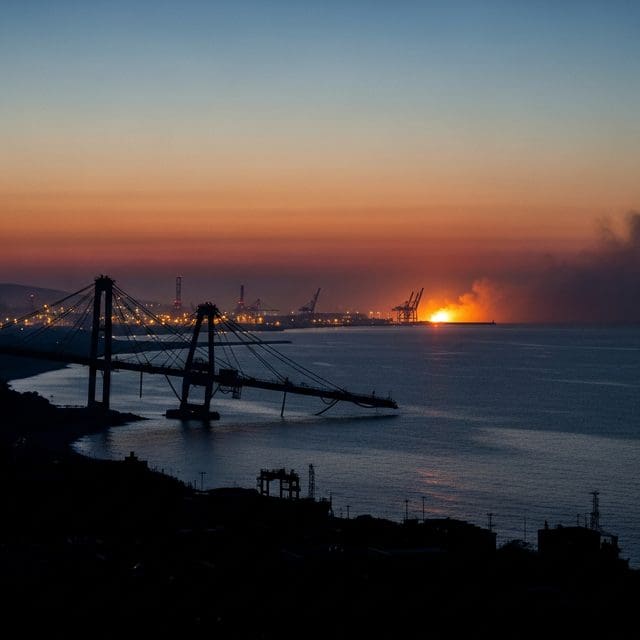
The U.S. and Ukraine have launched simultaneous deep-strike campaigns against Iranian and Russian infrastructure, signaling a shift toward systematic economic and logistical degradation of the Moscow-Tehran axis.
The theater of modern warfare is shifting from front lines to the foundational pillars of national power. Over the last 48 hours, the United States and Ukraine executed precision strikes designed to dismantle the logistical and economic architecture of Iran and Russia. These operations represent a calculated transition toward a strategy of attrition, prioritizing the destruction of transport links, energy facilities, and supply hubs over immediate territorial gains. This realist application of force targets the material capability of adversaries to sustain prolonged conflict.
In the Middle East, U.S. Central Command confirmed a seventh consecutive wave of strikes against Iranian targets. Following President Trump’s July 15 warning that the U.S. would expand its target list, American assets struck military logistics sites, underground weapons storage, and critical infrastructure. Reports indicate significant damage to bridges near Bandar Abbas and desalination pumps at the Bonji/Jask plant. While the U.N. expressed concern over the impact on civilian life, noting 10,000 people lost access to drinking water, the Pentagon’s focus remains on Tehran’s ability to project power in the Strait of Hormuz. The administration maintains these strikes are necessary to neutralize threats to global shipping.
This maritime pressure is reinforced by Israeli operations. Israeli strikes have reportedly neutralized approximately 85% of Iran’s petrochemical export capacity by targeting the South Pars natural gas facilities. By integrating Israel into the campaign against Iranian economic assets, the U.S.-led coalition is isolating Tehran from its primary revenue streams. Iran has responded with retaliatory strikes on U.S. bases in Kuwait, Bahrain, and Jordan, hitting power stations and oil facilities to demonstrate that the cost of infrastructure warfare is mutual. This cycle highlights a phase where the objective is the total degradation of industrial output.
Simultaneously, Ukraine intensified its deep-strike campaign against the Russian interior, utilizing a squadron of converted civilian aircraft and long-range drones. These Horynych bomber drones, capable of carrying 100kg payloads over 1,200 miles, struck major logistics facilities in the Moscow and Tambov regions. Targets included a massive Wildberries warehouse and an oil depot, which Ukrainian officials claim distributed sanctioned components to the Russian military. This 1,150% increase in deep strikes since June has forced the Kremlin to adjust fuel deliveries to Crimea and seek civilian assistance for drone defense, as over 200,000 Russian targets were engaged in the last month alone.
These synchronized efforts underscore a realist approach to foreign policy. Rather than seeking decisive battlefield victories through troop maneuvers, the U.S. and its allies are leveraging technological superiority to hollow out the industrial bases of their opponents. By targeting the sinews of war—fuel, water, transport, and finance—Western-aligned powers are betting that internal strain on the Iranian and Russian regimes will eventually outweigh their capacity for external aggression. This strategy recognizes that modern armies cannot function without the complex web of infrastructure that supports them.
As the conflict intensifies, domestic legal maneuvers have added complexity. In New York City, Mayor Zohran Mamdani signaled a potential attempt to arrest Israeli Prime Minister Benjamin Netanyahu during an upcoming visit, citing ongoing legal reviews. While such local actions rarely dictate national defense policy, they highlight the political friction points that arise when international security strategies intersect with domestic legal frameworks. Meanwhile, the confirmation process for Jay Clayton as Director of National Intelligence continues, reflecting internal political tensions as the nation manages multiple fronts.

Olivia Kendall serves as the Senior Correspondent for Geopolitics, Defense, and Foreign Policy at Just Right News, where she provides a principled, conservative perspective on the complex forces shaping the global stage. With a career dedicated to deconstructing the intricacies of international relations, Kendall has become a trusted voice for readers who value national sovereignty, a robust military, and a foreign policy that prioritizes American interests above all else.
A native of Washington, D.C., Kendall’s professional journey is deeply rooted in her upbringing within the nation’s capital. Growing up in the epicenter of American political life, she developed an early and profound understanding of how policy is crafted and, more importantly, how it often fails to account for the values of the American heartland. This unique vantage point allowed her to witness firsthand the rise of globalist bureaucracies, fueling her commitment to reporting that champions the constitutional foundations of the United States. Her background as a British White American further informs her worldview, providing her with a keen appreciation for the Western tradition and the enduring importance of the “Special Relationship” in maintaining global stability.
Now based in Arlington, Virginia, Kendall operates from the doorstep of the Pentagon and the heart of the nation’s defense establishment. Her proximity to the decision-makers in the military and intelligence communities allows her to provide boots-on-the-ground reporting that is both timely and deeply informed. For Kendall, Arlington is more than just a base of operations; it is a daily reminder of the sacrifices made by the men and women in uniform. This connection to the defense community drives her rigorous coverage of military readiness and her advocacy for a “peace through strength” approach to diplomacy.
At Just Right News, Kendall is perhaps best known for her acclaimed feature series, “The World’s Shadow on America.” In this ongoing project, she explores the direct correlation between international developments and the daily lives of American citizens. Whether she is analyzing the encroachment of foreign adversaries in domestic supply chains or the impact of international treaties on local economies, Kendall’s work serves as a vital bridge between distant geopolitical shifts and their consequences at home. She rejects the notion that foreign policy is an abstract concern for elites, instead proving that what happens in the corridors of power in Brussels or Beijing has a tangible “shadow” that falls across every American doorstep.
Throughout her tenure, Kendall has remained a steadfast critic of international overreach and a vocal proponent of a clear-eyed, realistic foreign policy. She brings a sharp analytical mind to her beat, often challenging the prevailing narratives of the mainstream media to uncover the underlying truths that affect national security. Her reporting is characterized by a refusal to compromise on the truth and a dedication to the idea that a strong, secure America is the world’s best hope for liberty. As a Senior Correspondent, Olivia Kendall continues to lead the charge in providing the essential context and conservative insight necessary to navigate an increasingly volatile world.