

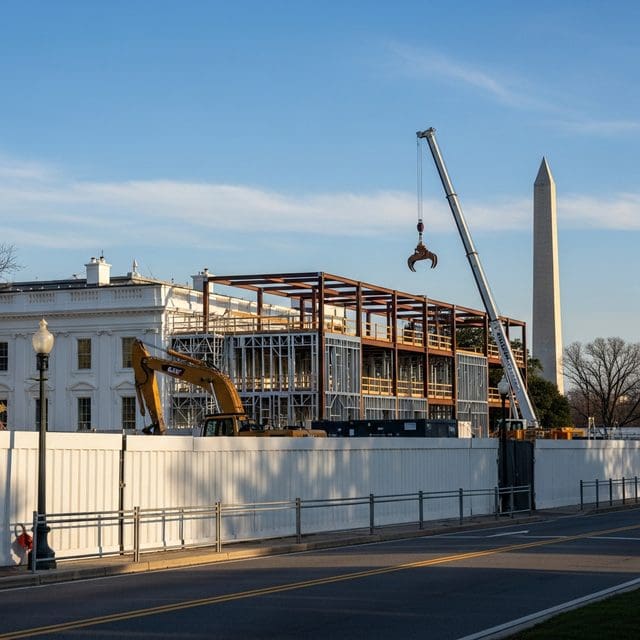
The OMB reallocated hundreds of millions in Secret Service funds toward White House security, sparking a legislative battle over whether taxpayer dollars are subsidizing a controversial new ballroom project.
The White House Office of Management and Budget (OMB) quietly reallocated more than $350 million late Friday, shifting funds originally designated for U.S. Secret Service hiring and training toward White House security infrastructure. This fiscal maneuver comes days after Congress explicitly rejected a separate $1 billion request for the White House in a Homeland Security bill, creating a new flashpoint over the separation of powers and the transparency of executive spending.
The funds were pulled from two accounts established under the administration’s signature tax-and-spending law. These accounts were intended to provide the Secret Service with resources for personnel and training following last year’s assassination attempts. According to Democrats on the Senate Budget Committee, the reallocation appears to be a tactical shift to bankroll security work tied to the construction of a new 999-seat ballroom, a project that has drawn scrutiny for its cost and purpose.
Senate Judiciary Committee Chairman Chuck Grassley, R-Iowa, whose panel drafted the original security funding language, expressed surprise at the move. Grassley stated he was unaware of the specific allocations and reiterated that the President had previously assured the public the project would be financed through private donations. The Senator noted that the American people expect the administration to adhere to those promises, particularly as the project involves the demolition of the historic East Wing.
Senator Jeff Merkley, the top Democrat on the Senate Budget Committee, charged that the administration’s actions are potentially illegal. Merkley argued that by using money earmarked for personnel to harden a construction site, the White House is utilizing a “smoke and mirrors” tactic to circumvent the will of Congress. The project has seen its price tag climb to approximately $600 million, with a contractor summary indicating more than half of that total could eventually be sourced from taxpayer funds despite previous public claims.
At the heart of the dispute is the distinction between general security upgrades and the specific requirements of the ballroom. The White House maintains that the East Wing modernization is inextricably linked to national security. Spokesman Davis R. Ingle defended the project, stating it includes critical infrastructure such as bomb shelters and a medical facility located underneath the ballroom. The administration argues that while private donors are contributing roughly $400 million for the venue, the underlying security assets—including bulletproof glass and drone detection—are essential federal responsibilities.
Government lawyers have argued in court documents that the site must be fortified against modern threats. The Secret Service previously informed senators that $220 million of the original $1 billion request was intended to harden the ballroom addition. However, with that request rejected by lawmakers during a period of high inflation, the administration appears to be looking toward existing accounts to fill the gap.
This reallocation highlights tension over the Constitution’s Power of the Purse. Under Article I, only Congress has the authority to allocate funds. While the executive branch signs appropriation bills, once funding becomes law, it is expected to be spent as directed by the legislature. The shifting of funds from personnel training to a construction project recently denied by Congress invites significant oversight. The Senate Budget Committee must now determine if it will formally challenge the apportionment to reassert Congressional control over the federal checkbook.

Ben Taylor serves as the Senior Correspondent and Investigations Lead for Just Right News, where he anchors the network’s commitment to government transparency and institutional accountability. With a career defined by a relentless pursuit of the facts, Taylor spearheads the acclaimed feature series “The Paper Trail,” a deep-dive investigative column that prioritizes primary source documentation over political rhetoric. Based in the heart of the nation’s capital, he has earned a reputation as one of the most formidable investigative journalists in Washington, D.C., known specifically for his mastery of public records and the Freedom of Information Act.
Taylor’s approach to journalism is deeply rooted in his upbringing in Kansas City, Missouri. Growing up in the “Show Me State,” he developed a healthy skepticism of centralized power and a profound respect for the common-sense values of the American heartland. This Midwestern foundation informs his reporting today, as he bridges the gap between the complex machinations of federal bureaucracy and the everyday concerns of citizens across the country. For Taylor, investigative reporting is not about chasing headlines; it is about ensuring that the government remains answerable to the people it serves.
As an African American man working within the conservative media landscape, Taylor brings a principled perspective to his beat. He views the Constitution and the right to information as the ultimate equalizers in a free society. His work often highlights how bureaucratic overreach and lack of transparency disproportionately affect individual liberties. By focusing on the “paper trail,” Taylor strips away the spin of partisan talking points, instead providing Just Right News readers with the raw data and internal communications that reveal how their tax dollars are spent and how policy decisions are actually made.
In his role as Investigations Lead, Taylor oversees a team dedicated to uncovering the stories that mainstream outlets often overlook. Whether he is auditing federal spending, investigating regulatory overreach, or exposing inefficiencies within the administrative state, his methodology remains consistent: follow the evidence wherever it leads. His presence in Washington, D.C., allows him to maintain a constant watch over the halls of power, yet he remains steadfastly connected to his roots, ensuring his reporting reflects the clarity and directness of his Missouri home.
Throughout his tenure at Just Right News, Taylor has become a vital voice for those who demand integrity in public office. He believes that a well-informed electorate is the strongest defense against government overreach, and he has dedicated his career to providing the public with the tools they need to hold their leaders accountable. Through “The Paper Trail” and his broader investigative work, Ben Taylor continues to set the standard for rigorous, document-driven journalism that champions the values of transparency, individual responsibility, and the rule of law.