

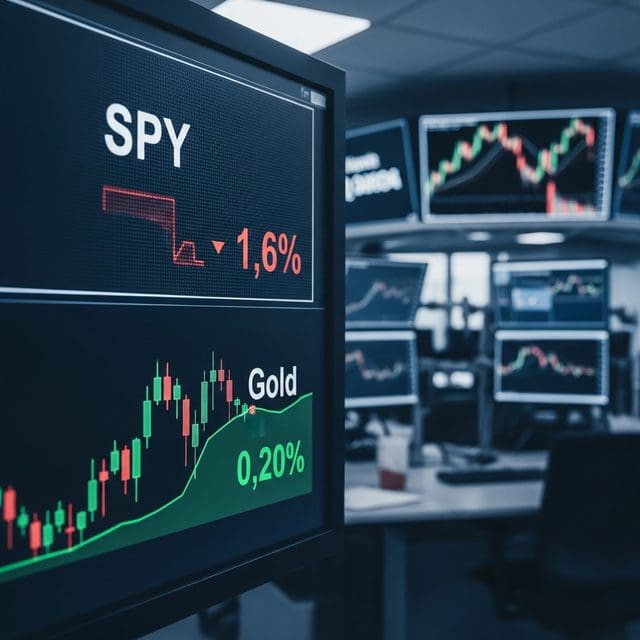
The S&P 500 benchmark dipped slightly as investors weighed flat futures against a surge in gold prices and shifting corporate deal flows.
Global financial markets exhibited a cautious fragmentation today as the SPY, the primary exchange-traded fund tracking the S&P 500, slipped 0.11% in session activity. While the broader market struggled to find a clear direction, Dow Jones futures signaled a significant divergence, rising over 590 points to suggest that blue-chip industrial names are currently favored over the high-growth sectors that have dominated recent rallies. This split highlights a growing selectivity among institutional investors navigating a landscape of firming dollar strength and fluctuating energy costs, even as S&P 500 futures remained essentially flat at 7,483.24.
In the commodities sector, gold has emerged as the day’s primary mover, providing a stark contrast to the tepid performance of equities. COMEX gold surged 2.12% to reach $4,199.70 per ounce, reflecting a flight to hard assets amid persistent currency volatility and a firm U.S. Dollar. This price action coincides with a structural shift in how precious metals are traded; Vantage Markets recently launched 24/7 gold CFD trading via the XAUUSD247 pair. By enabling weekend trading through platforms like MT5 and TradingView, the financial industry is effectively ending the traditional weekend break for gold speculators. For the American taxpayer, this trend toward constant market access and rising bullion prices serves as a reminder of the ongoing search for stability in a fiat-heavy global system.
Energy markets provided a modest reprieve for household budgets as Brent crude oil softened to $71.65 per barrel, down 0.65%. This decline in energy costs provides a mild headwind for oil majors but may offer a slight cushion for consumer discretionary spending. Meanwhile, the foreign exchange markets show the U.S. Dollar maintaining a position of strength, with the EUR/USD pair trading at 1.1417 and GBP/USD at 1.3342. These levels frame the current cross-asset moves, making American exports more expensive while keeping a lid on imported inflation.
International corporate activity has also been a driver of today’s market sentiment. The Financial Times highlighted several sizeable deals, including Novartis’s $1.5 billion purchase of UK biotech firm Myricx Bio and Sky’s £1.6 billion tie-up with ITV. These transactions, along with Skanska’s divestment of the Traktören 20 project in Sweden to Folksam Group for SEK 570 million, indicate that capital is still moving aggressively in the private sector despite the stagnation in public benchmarks. Furthermore, OCI N.V. recently saw its board recommend an unsolicited all-cash offer from NNS at EUR 4.10 per share, signaling that value-seeking acquisitions remain a theme in the European theater.
On the domestic front, transparency regarding high-level financial interests remains a focal point for market observers. Recent financial disclosure reports show former President Trump received over $2 billion in income, with significant contributions originating from the crypto venture World Liberty Financial. This intersection of political figures and decentralized finance underscores the evolving nature of the American economy, where traditional equity benchmarks like the SPY now compete for attention with emerging digital assets. This is further evidenced by the venture capital space, where the startup Ornn recently raised a $33 million seed round backed by Andreessen Horowitz to build a marketplace for trading computing power as a commodity.
As the session progresses, the lack of momentum in the S&P 500 suggests a market in wait-and-see mode, perhaps wary of shareholder litigation such as that involving Synaptics and onsemi regarding fair pricing. While institutional deal-making and fintech expansions—such as AEON Pay’s move into Zambia—remain robust, the average investor is faced with a landscape where blue-chip stability and gold are the only clear outperformers. For the working household, the message is one of divergence: while the headline indices remain flat, the underlying costs of capital, energy, and hard assets are shifting rapidly beneath the surface.

Jordan Lee serves as the Senior Correspondent for Wall Street, Finance, and Monetary Systems at Just Right News. Based in the heart of the world’s financial capital, New York City, Lee brings a sharp, principled eye to the complex mechanisms that drive the global economy. His reporting is defined by a commitment to fiscal responsibility, the defense of the free market, and a deep-seated belief that a transparent monetary system is the bedrock of a free society.
Raised in Portland, Oregon, Lee’s perspective was forged in a city that has undergone significant cultural and economic shifts. His upbringing in the Pacific Northwest instilled in him a profound appreciation for the industriousness of small business owners and the importance of local economic stability. Watching the evolution of his hometown’s landscape sparked an early interest in how federal fiscal policy and large-scale financial trends eventually trickle down to the average citizen. This background provides him with a unique vantage point; he understands the growing disconnect between the policy-making elite and the reality of Main Street, a theme that frequently resonates throughout his work.
Now operating from his base in New York City, Lee bridges the gap between the high-stakes trading floors of Manhattan and the households of everyday Americans. He views the financial sector not merely as a collection of numbers and tickers, but as a vital engine of American prosperity that requires constant vigilance and accountability. His reporting often highlights the dangers of centralized financial control and the necessity of maintaining a system that rewards merit, risk-taking, and innovation.
As the creator and lead of the featured series, “The Invisible Economy,” Lee pulls back the curtain on the often-opaque world of monetary systems. He specializes in translating the dense jargon of central banking and international finance into actionable insights for the Just Right News audience. His work explores the “invisible” forces—such as inflationary pressures, regulatory creep, and the expansion of the administrative state—that erode the purchasing power of American families. By focusing on these systemic issues, Lee empowers readers to understand the hidden forces shaping their financial independence.
Lee’s journalistic philosophy is rooted in a steadfast commitment to traditional American values. As an Asian American professional who has navigated the competitive corridors of the financial world, he is a vocal advocate for meritocracy and the preservation of the American Dream. He believes that a stable currency and a predictable regulatory environment are essential for national sovereignty and individual liberty. His reporting frequently warns against the risks of government overreach in the private sector, arguing that the most effective solutions to economic challenges arise from competition and individual enterprise rather than bureaucratic mandates.
At Just Right News, Jordan Lee remains dedicated to providing a clear-eyed defense of the taxpayer. Whether he is analyzing market volatility or investigating the long-term implications of national debt, his mission is to provide the truth about where the money is going and what it means for the future of the country. Through his rigorous analysis and principled stance, Lee has become a trusted voice for those who value a strong, sovereign, and fiscally sound America.