

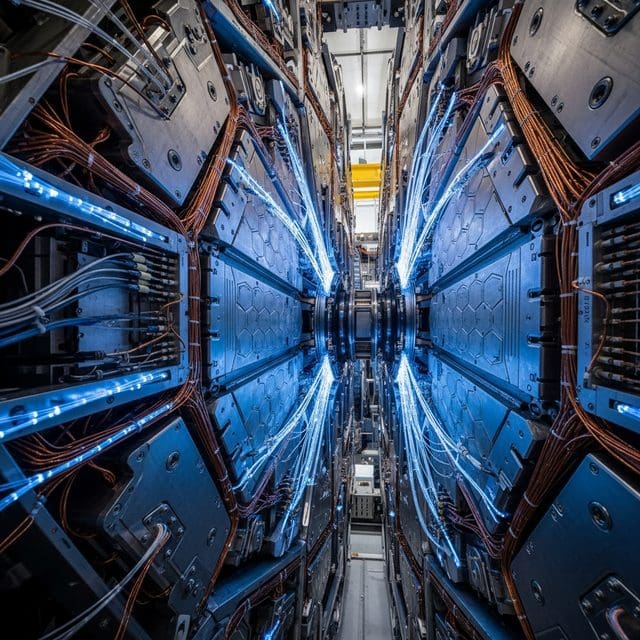
CERN researchers have detected a significant 4-sigma deviation in B-meson decays, potentially signaling the existence of undiscovered forces that lie beyond the current Standard Model.
For decades, the Standard Model has served as the bedrock of particle physics, a mathematical framework describing the fundamental forces and building blocks of the universe. However, new data from the Large Hadron Collider (LHC) at CERN suggest that this foundation may be showing its first genuine cracks. Researchers analyzing rare “penguin decays” of B-mesons have observed behavior that deviates from theoretical predictions by four standard deviations, a finding that has now been accepted for publication in the prestigious journal Physical Review Letters.
This measurement represents a significant milestone in the search for “New Physics.” In the rigorous world of particle physics, a four-sigma result indicates a roughly 1-in-16,000 chance that the observation is mere statistical noise. While it remains just below the five-sigma “gold standard” required for a formal discovery, the consistency of the data across 650 billion decays from 2011 to 2018 has captured the attention of the global scientific community. The anomaly suggests that B-mesons—particles containing a bottom quark—are decaying in ways that imply the influence of unknown particles, such as hypothetical leptoquarks or a Z-prime boson. If confirmed by upcoming LHC Run-3 data, this would represent the first major expansion of our physical laws in over half a century.
The implications for national sovereignty and technological leadership are significant. As Silicon Valley continues to push toward centralized digital infrastructures, these fundamental discoveries remind us that the physical laws governing our world remain partially veiled. Understanding these forces is not merely an academic exercise; it is the precursor to the next century of innovation in materials science and energy. Parallel to the work at CERN, researchers at Brookhaven National Laboratory’s STAR detector have also glimpsed into the quantum vacuum, observing that lambdas and antilambdas emerging from nuclear collisions are 100% spin-aligned. This provides rare evidence that particles are born from entangled quark-antiquark pairs, further proving that the vacuum of space is far from empty.
Complementing this microscopic exploration, researchers at Kyoto University and Hiroshima University have announced a breakthrough in the realm of quantum computing and secure communication. The team successfully demonstrated a method to instantly detect “W-states,” a complex and elusive form of multipartite quantum entanglement involving three photons. Unlike the more common GHZ states, W-states are notably resistant to particle loss. If one photon is lost in a three-particle W-state, the remaining two stay entangled, making them an ideal candidate for secure, decentralized quantum communication networks that can survive real-world interference.
The Japanese team achieved a discrimination fidelity of approximately 0.87 using a photonic discrete-Fourier-transform circuit. This moves quantum teleportation out of the realm of theoretical curiosity and closer to a deployable reality for chip-to-chip communication. By mastering W-state detection, scientists are building the architecture for a quantum internet that is inherently more robust and fault-tolerant than current models.
As the LHC enters its next phase of high-luminosity testing, the focus will shift to verifying whether these B-meson anomalies persist or wash out with more data. For now, the scientific community stands at a crossroads. If these findings hold, they will necessitate a rewrite of physics textbooks and potentially unlock new methods of manipulating the very fabric of reality. From the subatomic penguin decays in Geneva to the entangled photons in Kyoto, the frontier of human knowledge remains open to those who prioritize empirical truth over established consensus.

Mason Reed serves as a Staff Writer for Just Right News, where he spearheads the Future Frontiers & Special Projects desk. In an era defined by rapid technological shifts and evolving social landscapes, Mason provides a steady, principled voice, examining the innovations of tomorrow through the lens of traditional American values. His work is most prominently featured in his signature series, “The Next Horizon,” where he explores the intersection of emerging technology, national sovereignty, and the preservation of individual liberty.
A native of San Diego, California, Mason’s worldview was shaped by the unique culture of his hometown. Growing up in a region defined by its strong military presence and its history of maritime industry, he developed a deep-seated respect for the institutions that provide national stability and the entrepreneurial spirit that drives the American economy. This upbringing instilled in him a belief that true progress is not found in discarding the past, but in building upon a foundation of proven principles. His reporting often reflects this San Diego influence, emphasizing the importance of a robust national defense and the necessity of maintaining a competitive edge in the global marketplace.
Now based in San Francisco, Mason operates from the heart of the world’s technological engine. Living and working in the Bay Area provides him with a front-row seat to the advancements—and the ideological challenges—emanating from Silicon Valley. While many in the region embrace a “move fast and break things” mentality, Mason’s reporting serves as a vital counterweight. He offers Just Right News readers a “boots on the ground” perspective, documenting how radical local policies and the concentration of tech power impact the everyday lives of citizens. His proximity to the industry allows him to cut through the marketing jargon of big tech to uncover the real-world implications for privacy, free speech, and the nuclear family.
In his “Future Frontiers” beat, Mason tackles complex subjects ranging from the ethics of artificial intelligence to the burgeoning private space race. He approaches these topics with a healthy skepticism toward centralized bureaucracy, championing instead the decentralized innovations that empower individuals. Through “The Next Horizon,” he highlights the pioneers and thinkers who are working to ensure that the future remains a place where human dignity and constitutional rights are protected. He believes that the rapid pace of change requires more than just technical expertise; it requires a moral compass rooted in the Western tradition.
Throughout his tenure at Just Right News, Mason has remained committed to the idea that the future is something to be shaped, not merely accepted. His writing is characterized by a rigorous defense of American exceptionalism and a belief that the country’s best days lie ahead, provided it remains true to its founding ideals. Whether he is investigating the impact of automation on the American workforce or profiling the next generation of aerospace engineers, Mason Reed ensures that his readers are equipped with the insights they need to navigate a changing world with confidence and clarity.