

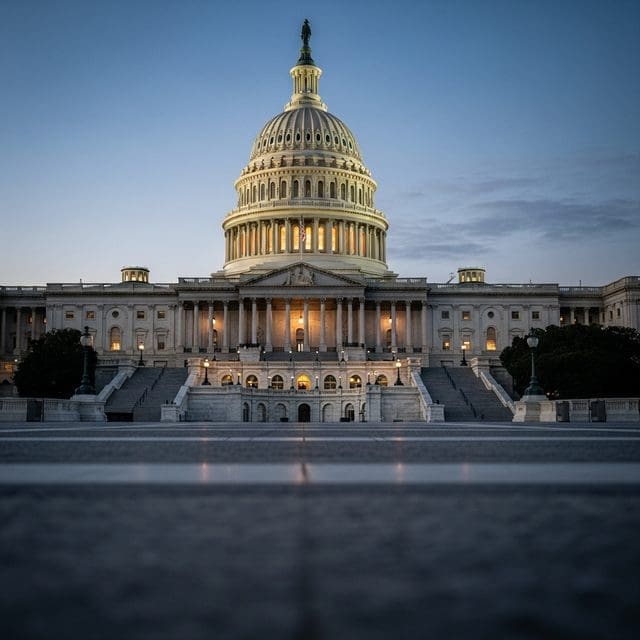
GOP senators are withholding support for immigration spending until the White House imposes strict limits on a $1.776 billion fund intended to compensate the president’s allies.
The constitutional tension between the executive branch and the legislature reached a fever pitch this week as Senate Republicans effectively shuttered the White House’s proposed $1.776 billion “anti-weaponization” settlement fund. The standoff has derailed a critical Homeland Security appropriations bill, with GOP leadership refusing to move forward on immigration enforcement funding until the administration provides a permanent kill switch for the controversial program. This legislative paralysis comes as Senate Majority Leader John Thune and other key Republicans signal an unwillingness to rubber-stamp executive initiatives that bypass traditional congressional oversight.
Derived from the federal Judgment Fund following a settlement over the leak of President Trump’s tax records, the fund was designed to compensate individuals alleging politically motivated prosecutions. However, the lack of statutory guardrails has drawn sharp rebukes from within the President’s own party. Critics, led by Senator Ted Cruz and Senator Todd Young, characterized the initiative as a slush fund that lacks transparency and risks subsidizing defendants involved in the January 6 Capitol riot. Cruz recounted a closed-door meeting where Republican senators reportedly screamed at Acting Attorney General Todd Blanche, describing the fund as an act of self-dealing.
In that confrontational meeting, which included approximately 45 Senate Republicans, lawmakers delivered an ultimatum: the administration must place strict parameters on the settlement or the Senate will legislate them into existence. Proposed restrictions include limiting who can receive payouts, restructuring the commission in charge of the money, and adding mandatory judicial reviews. Blanche has since signaled a retreat, stating the administration is not moving forward with the fund, period, while the Department of Justice complies with a temporary injunction issued by U.S. District Judge Leonie Brinkema in Alexandria, Virginia. This injunction blocks payouts while the court evaluates the legal basis for the fund’s creation.
The impasse has directly impacted the administration’s broader policy goals. The Senate had planned to use a budget maneuver called reconciliation to fund Immigration and Customs Enforcement and Border Patrol through the end of the term without Democratic support. However, that unity collapsed over the settlement fund dispute. Thune indicated that the best path forward is for the administration to shut the fund down themselves, noting that the controversy makes the GOP’s legislative agenda harder than it should be. The situation is further complicated by the political atmosphere, as several Republican senators recently lost reelection bids after the President endorsed their primary opponents.
Democrats have seized on the internal GOP strife, with Senate Minority Leader Chuck Schumer announcing a coordinated effort to kill the fund before one cent goes out the door. Senator Gary Peters labeled the fund one of the most corrupt acts by an American president, suggesting it represents a bridge too far even for many Republicans. While the White House previously abandoned a $1 billion request for a new ballroom after similar pushback, the settlement fund remains the primary obstacle to securing the border and immigration funding that the administration claims is vital for national security.
For the disciplined constitutionalist, the dispute underscores the dangers of expanding executive discretion over the federal Judgment Fund. Without clear legislative appropriation, such funds bypass the traditional power of the purse. Senate Republicans appear to have rediscovered this principle, signaling that even in a unified government, the administrative state’s attempts to bypass congressional intent will face significant friction. As the June 12 follow-up hearing approaches, no claims have been processed, and the $1.776 billion remains frozen in a legal and legislative limbo that tests the limits of executive power.

Miles Harrington serves as the Senior Correspondent for Federal Systems & Executive Power at Just Right News, where he brings a disciplined, constitutionalist lens to the inner workings of the American government. With a focus on the mechanics of the federal bureaucracy and the limits of executive authority, Harrington has established himself as a vital voice for readers who value transparency, accountability, and the preservation of the separation of powers.
A native of Richmond, Virginia, Harrington’s perspective is deeply rooted in the traditions of the Old Dominion. Growing up in a city defined by its historical significance and its role as a center of American jurisprudence, he developed an early appreciation for the foundational principles of the Republic. His upbringing in Richmond—a place where the legacy of the Founding Fathers is woven into the landscape—instilled in him a belief that the federal government should remain within its constitutional bounds. This background informs his skepticism of centralized overreach and his commitment to reporting on the ways in which the administrative state impacts the lives of everyday citizens.
In his current role, Harrington specializes in the complexities of federal systems. He doesn’t just report on the headlines of the day; he digs into the structural shifts within the executive branch that often go unnoticed by the mainstream press. Whether he is analyzing the implications of a new federal regulation or investigating the expansion of agency jurisdiction, his work is characterized by a rigorous adherence to the facts and a dedication to the rule of law.
Harrington is perhaps best known for his signature feature series, “How Washington Works.” Through this ongoing project, he demystifies the often-opaque processes of the nation’s capital, pulling back the curtain on the “Deep State” and the unelected officials who wield significant influence over national policy. By breaking down complex legislative maneuvers and executive orders, he empowers Just Right News readers to understand the true levers of power in Washington. His reporting serves as a necessary check on the federal government, ensuring that the actions of those in power are held up to the light of public scrutiny.
Now based in Washington, D.C., Harrington operates at the epicenter of the political world, yet he remains intentionally distanced from the “Beltway bubble.” His proximity to the halls of power allows him to maintain a robust network of sources across the federal landscape, but his heart remains in the principled conservatism of his Virginia roots. He views his role not merely as a reporter, but as a steward of the public trust, dedicated to providing the clarity and context that conservative voters need to navigate an increasingly complex political environment.
Through his sharp analysis and unwavering commitment to the truth, Miles Harrington continues to be a cornerstone of the Just Right News team. His work ensures that the principles of limited government and executive restraint remain at the forefront of the national conversation, providing a crucial service to those who believe in a government that is truly of, by, and for the people.