

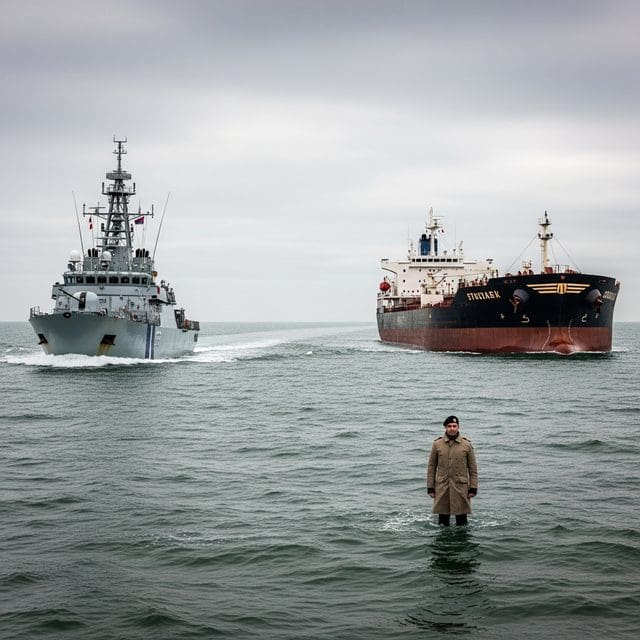
British and French naval forces have seized Russian shadow fleet tankers, prompting Moscow to threaten maritime sabotage as European leaders prepare to challenge the Trump administration’s Ukraine peace framework.
The geopolitical landscape shifted toward the high seas this week as British and French naval forces executed high-stakes interceptions of Russian shadow fleet tankers. In a six-hour operation, UK forces boarded and detained the SMRTOS in the English Channel, marking the first UK-led seizure of its kind. This vessel, part of a sanctioned fleet of over 500 ships, was intercepted to disrupt the clandestine maritime networks Moscow uses to bypass Western energy restrictions. Simultaneously, French authorities intercepted the Tagor 400 nautical miles west of Brittany, accusing the vessel of operating under a false Cameroonian flag. These actions represent a hardening of European resolve to choke off the revenue streams funding the Kremlin’s campaign in Ukraine.
The Kremlin’s response has been swift and volatile. Prominent Russian state-media figures have called for the rigging of oil tankers with remote-detonated explosives, suggesting that vessels should be destroyed rather than allowed to fall into Western hands. This rhetoric introduces a dangerous new variable into maritime security, potentially turning commercial energy transit into a theater of asymmetric warfare. For the United States, these developments complicate the balance of maintaining global energy stability while upholding the integrity of international sanctions. The prospect of “bombed tankers” creates a significant risk premium for global shipping and insurance markets already strained by regional conflicts.
On the diplomatic front, the upcoming G7 summit in France is emerging as a critical inflection point. European diplomats are signaling intent to push back against a U.S.-drafted peace framework for Ukraine. The American proposal, which includes a nationwide referendum and potential territorial concessions, is viewed by some European capitals as overly favorable to Moscow. European intelligence chiefs remain skeptical of any near-term resolution, noting that Russia continues to pursue a dual-track strategy aimed at securing sanctions relief without relinquishing strategic objectives in the Donbas. They argue that any deal locking in Russian gains could undermine the long-term security of the European continent.
In the Middle East, the Trump administration’s pursuit of a pressure-plus-talks strategy with Iran faces a similar impasse. While Tehran has acknowledged a draft deal involving oil sanctions waivers and asset releases, regional officials describe the negotiations as stalled. Iran continues to demand comprehensive sanctions relief and a pause on nuclear oversight, even as its proxies, including Hezbollah, maintain pressure on Israel’s northern border. Recent Israeli airstrikes on Hezbollah headquarters in Beirut underscore the volatility of this secondary front, where de-escalation remains tied to broader regional demands. The International Crisis Group notes that while the U.S. claims Iran has agreed to avoid nuclear weapons, Tehran’s willingness to cap enrichment remains limited.
Further east, the strategic challenge posed by China continues to expand. Reports indicate a rapid growth in China’s nuclear-powered submarine fleet and long-range missile capabilities, now capable of striking targets as far as Australia. This expansion of the People’s Liberation Army’s reach is matched by aggressive economic maneuvers. China’s Supreme People’s Court recently upheld a sales injunction against Infineon Technologies, demonstrating Beijing’s use of its judiciary to pressure Western tech firms. For American policymakers, the convergence of these threats requires a realist recalibration of power projection. The administration must navigate a path that maintains the ‘peace through strength’ doctrine while managing the friction points within its own alliance.

Olivia Kendall serves as the Senior Correspondent for Geopolitics, Defense, and Foreign Policy at Just Right News, where she provides a principled, conservative perspective on the complex forces shaping the global stage. With a career dedicated to deconstructing the intricacies of international relations, Kendall has become a trusted voice for readers who value national sovereignty, a robust military, and a foreign policy that prioritizes American interests above all else.
A native of Washington, D.C., Kendall’s professional journey is deeply rooted in her upbringing within the nation’s capital. Growing up in the epicenter of American political life, she developed an early and profound understanding of how policy is crafted and, more importantly, how it often fails to account for the values of the American heartland. This unique vantage point allowed her to witness firsthand the rise of globalist bureaucracies, fueling her commitment to reporting that champions the constitutional foundations of the United States. Her background as a British White American further informs her worldview, providing her with a keen appreciation for the Western tradition and the enduring importance of the “Special Relationship” in maintaining global stability.
Now based in Arlington, Virginia, Kendall operates from the doorstep of the Pentagon and the heart of the nation’s defense establishment. Her proximity to the decision-makers in the military and intelligence communities allows her to provide boots-on-the-ground reporting that is both timely and deeply informed. For Kendall, Arlington is more than just a base of operations; it is a daily reminder of the sacrifices made by the men and women in uniform. This connection to the defense community drives her rigorous coverage of military readiness and her advocacy for a “peace through strength” approach to diplomacy.
At Just Right News, Kendall is perhaps best known for her acclaimed feature series, “The World’s Shadow on America.” In this ongoing project, she explores the direct correlation between international developments and the daily lives of American citizens. Whether she is analyzing the encroachment of foreign adversaries in domestic supply chains or the impact of international treaties on local economies, Kendall’s work serves as a vital bridge between distant geopolitical shifts and their consequences at home. She rejects the notion that foreign policy is an abstract concern for elites, instead proving that what happens in the corridors of power in Brussels or Beijing has a tangible “shadow” that falls across every American doorstep.
Throughout her tenure, Kendall has remained a steadfast critic of international overreach and a vocal proponent of a clear-eyed, realistic foreign policy. She brings a sharp analytical mind to her beat, often challenging the prevailing narratives of the mainstream media to uncover the underlying truths that affect national security. Her reporting is characterized by a refusal to compromise on the truth and a dedication to the idea that a strong, secure America is the world’s best hope for liberty. As a Senior Correspondent, Olivia Kendall continues to lead the charge in providing the essential context and conservative insight necessary to navigate an increasingly volatile world.