

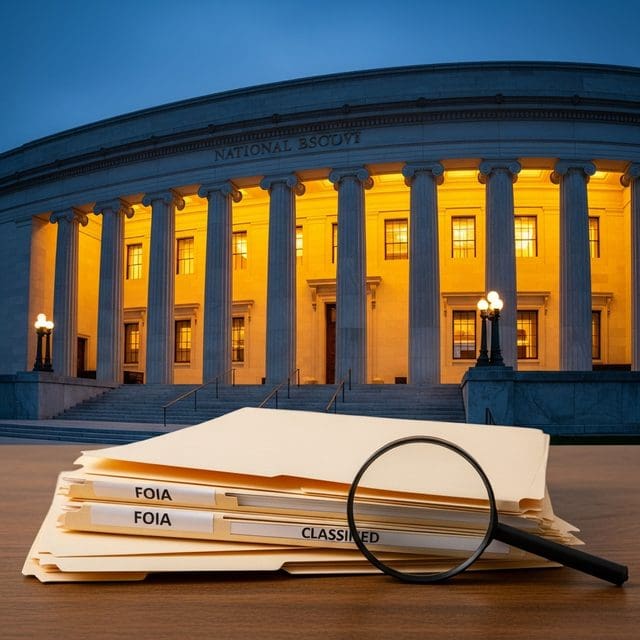
A high-stakes legal battle is emerging as the Justice Department questions the constitutionality of record-keeping laws while watchdogs flood the National Archives with requests.
A fundamental conflict over government transparency is unfolding within the federal bureaucracy as the Trump administration’s first-term records become eligible for public disclosure. Under the Presidential Records Act (PRA), documents from the 2017–2021 term reached the five-year mark for Freedom of Information Act (FOIA) eligibility on January 20, 2026. This milestone has triggered a massive processing effort at the Trump Library and the National Archives and Records Administration (NARA), where archivists are working to release materials that are now presumptively available to the public. However, a recently surfaced Justice Department legal memo is now challenging the very foundation of that transparency framework.
The memo, reported in April 2026, contends that presidents may retain government records after leaving office, asserting that the Presidential Records Act is unconstitutional. This legal position directly clashes with NARA’s established PRA-based FOIA process. While NARA has confirmed it is actively preserving and preparing records—including deleted @realDonaldTrump and @POTUS social media posts for release via the Trump Library website—the Justice Department’s stance sets the stage for a significant separation-of-powers fight. This dispute threatens to stall the release of primary source documents that serve as the bedrock for public oversight and historical accuracy.
Watchdog groups are already moving to compel disclosure through the federal court system. Democracy Forward has filed suit against both the Justice Department and the Treasury Department, alleging that these agencies have produced no substantive records or determinations in response to FOIA requests filed in late 2025. Those requests sought documents regarding an alleged “$230 million payout scheme” and efforts to secure taxpayer funds for investigations into the president’s conduct. Similarly, Public Citizen filed a FOIA request on May 18, 2026, demanding all agreements and communications since May 1 regarding a Trump-related legal settlement, highlighting the intense pressure on the department to disclose arrangements that affect executive accountability.
Internal administrative shifts are further complicating the landscape for federal workers and whistleblowers. The administration has proposed a government-wide non-disclosure agreement for federal employees, a move that free speech and open government groups have protested as an assault on the First Amendment. These critics argue the NDAs are designed to stifle the flow of information to Congress and the public, compounded by significant cuts to oversight budgets. Amidst these restrictions, the Justice Department has simultaneously directed prosecutors to pursue approximately 90 open investigations into immigrant vote fraud, a move that provides a rare glimpse into the scale of the administration’s current enforcement priorities.
Transparency battles are also extending into the private sector and international military history. In the sports world, NBA Commissioner Adam Silver confirmed that an independent probe by the law firm Wachtell, Lipton, Rosen & Katz into the Los Angeles Clippers is nearing completion. The investigation is examining whether a $28 million “no-show” endorsement for Kawhi Leonard was used to circumvent the league’s salary cap. Silver has stressed the urgency to “wrap it up,” as the final report could lead to severe penalties, including fines or the loss of draft picks. Documents from this probe are expected to inform how the league handles future governance and contract enforcement.
Overseas, the Irish Defence Forces Tribunal is utilizing its discovery powers to compel the release of Military Police files regarding the 1991 death of army apprentice Oliver Mullaney at Devoy Barracks. The tribunal is investigating both the death and allegations of systemic bullying, moving to secure historical records that have remained shielded for decades. This international move to secure a verifiable paper trail mirrors the domestic struggle in the United States: without a transparent records process, the public is left to rely on official narratives rather than the documented facts found in primary sources.
Ben Taylor serves as the Senior Correspondent and Investigations Lead for Just Right News, where he anchors the network’s commitment to government transparency and institutional accountability. With a career defined by a relentless pursuit of the facts, Taylor spearheads the acclaimed feature series “The Paper Trail,” a deep-dive investigative column that prioritizes primary source documentation over political rhetoric. Based in the heart of the nation’s capital, he has earned a reputation as one of the most formidable investigative journalists in Washington, D.C., known specifically for his mastery of public records and the Freedom of Information Act.
Taylor’s approach to journalism is deeply rooted in his upbringing in Kansas City, Missouri. Growing up in the “Show Me State,” he developed a healthy skepticism of centralized power and a profound respect for the common-sense values of the American heartland. This Midwestern foundation informs his reporting today, as he bridges the gap between the complex machinations of federal bureaucracy and the everyday concerns of citizens across the country. For Taylor, investigative reporting is not about chasing headlines; it is about ensuring that the government remains answerable to the people it serves.
As an African American man working within the conservative media landscape, Taylor brings a principled perspective to his beat. He views the Constitution and the right to information as the ultimate equalizers in a free society. His work often highlights how bureaucratic overreach and lack of transparency disproportionately affect individual liberties. By focusing on the “paper trail,” Taylor strips away the spin of partisan talking points, instead providing Just Right News readers with the raw data and internal communications that reveal how their tax dollars are spent and how policy decisions are actually made.
In his role as Investigations Lead, Taylor oversees a team dedicated to uncovering the stories that mainstream outlets often overlook. Whether he is auditing federal spending, investigating regulatory overreach, or exposing inefficiencies within the administrative state, his methodology remains consistent: follow the evidence wherever it leads. His presence in Washington, D.C., allows him to maintain a constant watch over the halls of power, yet he remains steadfastly connected to his roots, ensuring his reporting reflects the clarity and directness of his Missouri home.
Throughout his tenure at Just Right News, Taylor has become a vital voice for those who demand integrity in public office. He believes that a well-informed electorate is the strongest defense against government overreach, and he has dedicated his career to providing the public with the tools they need to hold their leaders accountable. Through “The Paper Trail” and his broader investigative work, Ben Taylor continues to set the standard for rigorous, document-driven journalism that champions the values of transparency, individual responsibility, and the rule of law.