

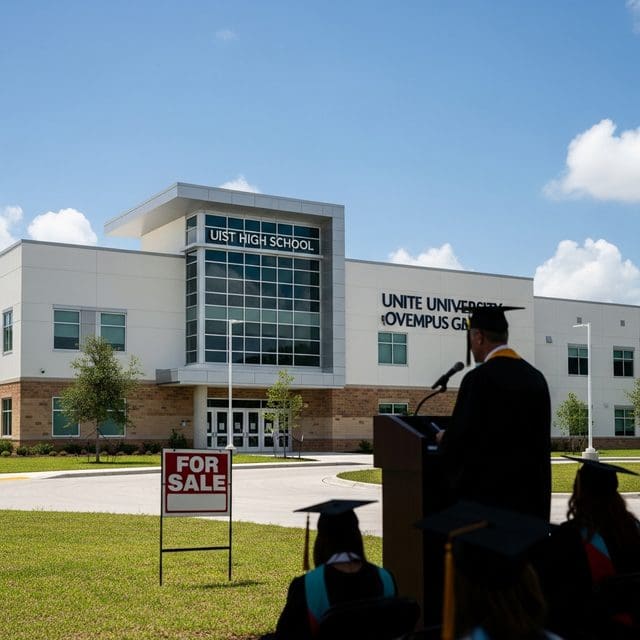
Florida’s proposed property tax elimination and the University of Michigan’s disciplinary fallout highlight a national struggle to balance fiscal reform with institutional stability and campus order.
The landscape of American education is facing a significant stress test as state leaders and university administrators grapple with fiscal reform, labor disputes, and the maintenance of institutional order. In Florida, Governor Ron DeSantis has called a special session to advance a constitutional amendment that would eliminate non-school property taxes on primary residences. While framed as relief for homeowners, the state’s largest teachers union warns of a multi-billion-dollar hole in public funding.
The proposed “Save Our Homes” expansion would force local governments to rely more heavily on sales taxes and fees, potentially shifting the tax burden onto renters and locking school districts into a shrinking share of property wealth. This fiscal tug-of-war coincides with new state laws that went into effect May 1, tightening regulations on teacher unions through higher membership thresholds and limits on political dues collection. Proponents of meritocracy and local control are watching closely to see if these changes streamline bureaucracy or inadvertently starve classrooms of necessary resources.
In higher education, the University of Michigan remains a flashpoint for debates over campus governance. Following a commencement season marked by pro-Palestinian activists and a faculty speech praising demonstrators, the university is navigating donor backlash and political scrutiny. While some faculty advocate for “antiracist” teaching, the administration is under pressure to enforce discipline for disruptive activities. The fallout includes ongoing conduct cases and previous law enforcement interventions, highlighting the difficulty of maintaining a stable, merit-based learning environment when political activism intersects with university policy.
Institutional stability is also being tested by safety concerns in K-12 districts. In Edgecombe County, North Carolina, the Sheriff’s Office has increased its presence following a string of hoax threats and bomb scares that forced schools into remote learning earlier this year. These security measures aim to reassure families, yet the district faces internal challenges as well. Recently, an Edgecombe County teacher was charged after allegedly renting a hotel room for unsupervised juveniles, a reminder that adult accountability remains the bedrock of student safety and public trust.
Even collegiate athletics is signaling a shift toward market-driven expansion. Big 12 football coaches have unanimously endorsed expanding the College Football Playoff to 24 teams. This move reflects a broader trend of university boards seeking to widen postseason access and reshape revenue distribution. As institutions navigate these shifts, the central question remains whether changes serve the student and taxpayer or merely the administrative bureaucracy.
Beyond the classroom, the broader workforce is seeing shifts in labor organization and corporate valuation. Republic Airways technicians recently voted to join the Teamsters, while AI lab Anthropic secured a $65 billion funding round, surpassing OpenAI in valuation. These private-sector developments underscore the importance of a workforce-aligned education system that adapts to rapid technological change. As state governments experiment with tax sovereignty and universities handle internal dissent, the focus must remain on practical, market-aligned solutions that prioritize individual achievement over top-down intervention.
Daniel Owens serves as a Senior Correspondent for Just Right News, where he leads the newsroom’s coverage of Education, Workforce, and Upward Mobility. In an era where the national conversation often overlooks the practical foundations of success, Owens brings a principled perspective to the forefront of the media landscape. His work is defined by a commitment to the idea that a strong society is built on the pillars of quality education, a robust work ethic, and the removal of bureaucratic barriers to individual achievement.
Born and raised in Cleveland, Ohio, Owens’s worldview was shaped by the industrial landscape of the Midwest. Growing up in a city known for its grit and resilience, he witnessed firsthand the transformative power of steady employment and the devastating effects of economic stagnation. This background instilled in him a deep respect for the American worker and a healthy skepticism toward top-down government solutions that often fail to reach the communities they intend to help. As an African American man who has navigated the path to professional success, Owens approaches his beat with a nuanced understanding of how meritocracy and personal responsibility intersect with opportunity. He frequently draws on his roots to highlight the importance of family stability and community-led initiatives in fostering the next generation of leaders.
At Just Right News, Owens is the architect of the acclaimed feature series, “The Learning Curve.” Through this platform, he explores the evolving landscape of American schooling, from the rise of the school choice movement to the revitalization of trade schools and vocational training. He frequently challenges the status quo of higher education, advocating for a return to academic rigor and the practical alignment of degrees with market demands. For Owens, education is not merely about obtaining credentials; it is about equipping young people with the tools necessary to lead self-sufficient, meaningful lives. His reporting on “The Learning Curve” has become essential reading for parents and policymakers who believe that educational competition and parental rights are the keys to a brighter future.
Now based in Raleigh, North Carolina, Owens finds himself at the heart of one of the nation’s most dynamic regions for innovation and growth. Raleigh’s unique blend of traditional values and a fast-paced economy provides the perfect backdrop for his reporting on the modern workforce. From the tech hubs of the Research Triangle to the rural communities of the South, he tracks how shifts in the economy are impacting families and local industries. His reporting often highlights the success stories of entrepreneurs and workers who are thriving by embracing the values of hard work and innovation.
Throughout his career, Daniel Owens has remained a steadfast voice for the student seeking a better path and the worker striving for a better life. His reporting for Just Right News serves as a vital resource for readers who value common-sense solutions to the challenges of the 21st-century economy. By focusing on the intersection of policy and the human spirit, Owens continues to provide a roadmap for how individuals and communities can achieve lasting upward mobility.