

California’s teen unemployment has surged to 23.3% while New Jersey police unions clash with state officials over federal enforcement mandates.
The American labor market is showing signs of a deepening divide as entry-level workers face dwindling opportunities while state-level political maneuvering complicates the landscape for law enforcement. In California, the situation for the youngest cohort of the workforce has reached a critical point. April 2026 data reveals a teen unemployment rate of 23.3%, a figure that signals a structural failure to integrate new entrants into the economy. This is part of a multi-year pattern where the Golden State has consistently ranked among the worst in the nation for 16-to-19-year-olds.
While California’s broader labor market added approximately 28,700 jobs in March, the benefits have not reached the youngest workers. Economists note that the vast majority of national net job growth this year occurred in January alone, leaving subsequent months stagnant for those without established careers. Nationally, labor-force participation has slipped to 61.8%, the lowest level since 2021. Projections from the Bureau of Labor Statistics show participation for 16-to-24-year-olds trending downward through 2034, suggesting a long-term detachment from the dignity of manual and entry-level trades.
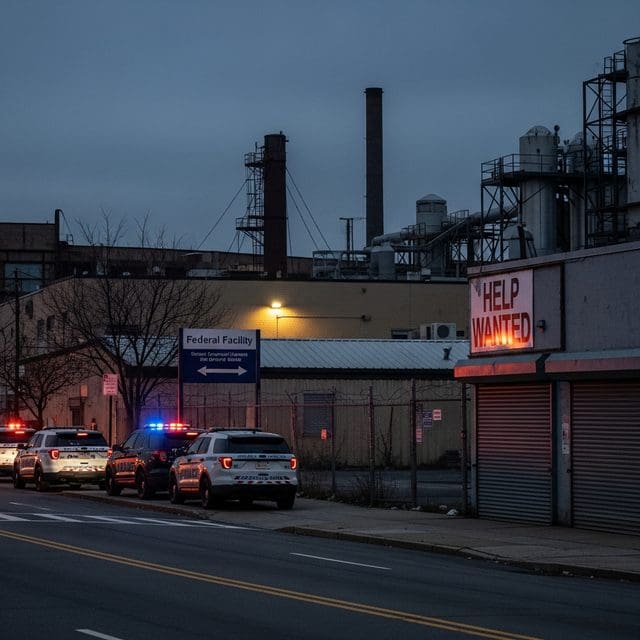
On the East Coast, friction between labor and policy has taken a confrontational form. In Newark, New Jersey, the Fraternal Order of Police has criticized Governor Mikie Sherrill and Mayor Ras Baraka for instructing local officers to stand down during protests at Delaney Hall. James Stewart Jr., president of the Newark FOP, accused the administration of prioritizing politics over the safety of ICE staff and federal contractors. This standoff highlights a growing tension where rank-and-file members find themselves caught between executive mandates and their operational duties to maintain public order.
The situation at Delaney Hall has escalated, with Homeland Security Secretary Markwayne Mullin threatening to deploy federal tactical units if local police continue to stay back. While Governor Sherrill has demanded inspections over alleged inhumane conditions, the Newark police union maintains that the refusal to assist federal agents puts personnel at unnecessary risk. This conflict raises fresh questions about police union contracts and who controls crowd-management decisions in American cities.
These domestic labor tensions unfold against a backdrop of global economic anxiety. While the Trump administration negotiates a 60-day memorandum of understanding with Iran to stabilize shipping in the Strait of Hormuz, the immediate impact on households remains severe. Many families are reportedly depleting emergency savings to cover rising fuel costs. Simultaneously, corporate leaders are questioning the returns on automation. Microsoft recently canceled most Claude Code licenses over high costs, and Uber’s leadership has expressed skepticism regarding productivity gains, suggesting the tech-driven boom has yet to benefit the average worker.
For the American worker, the current environment is one of high stakes and low visibility. Between the collapse of the teen job market in the West and the politicization of law enforcement in the East, the blue-collar workforce is being squeezed by both economic fragility and regulatory overreach. Even as sectors like airline maintenance technicians at Republic Airways move to join the Teamsters, the broader trend shows a workforce struggling to find its footing. Without a shift toward prioritizing local industry and vocational stability, the path to the middle class remains increasingly obstructed for the next generation.

Tom Blake serves as the Senior Correspondent for Labor, Wages, and Automation at Just Right News, where he brings a grounded, principled perspective to the most pressing economic issues facing the American heartland. As the lead voice behind the acclaimed feature series “The Price of Work,” Tom focuses his reporting on the intersection of traditional industry and the rapidly evolving technological landscape, always prioritizing the dignity of the individual worker and the health of the American family.
Tom’s deep understanding of the labor market is not merely academic; it is rooted in his upbringing in Detroit, Michigan. Growing up in the shadow of the automotive industry, he witnessed firsthand the triumphs and tribulations of the American blue-collar workforce. He saw how the stability of a manufacturing job could build a community and, conversely, how the erosion of those industries could tear the social fabric apart. This background instilled in him a lifelong respect for the trades and a healthy skepticism toward economic policies that prioritize globalist interests over the well-being of local communities.
Now based in Pittsburgh, Pennsylvania, Tom continues to report from the front lines of the shifting economy. Pittsburgh, a city that has reinvented itself while maintaining its gritty, industrious spirit, provides the perfect vantage point for his beat. From the steel mills that remain to the high-tech robotics labs reshaping the city’s future, Tom explores how automation is changing the nature of employment. His reporting often highlights the tension between innovation and tradition, arguing that while progress is inevitable, it must not come at the expense of the American worker’s ability to provide for their family through honest, meaningful labor.
In his role at Just Right News, Tom has become a vital voice for those who feel overlooked by mainstream economic coverage. He rejects the notion that the decline of American manufacturing is an unavoidable casualty of the modern era. Instead, his work often examines how regulatory overreach, rising energy costs, and the unchecked rise of automation impact the take-home pay of everyday citizens. Through “The Price of Work,” Tom delves into the true cost of economic shifts, looking beyond the raw data to tell the stories of the people behind the statistics.
Tom’s reporting is characterized by a commitment to the conservative values of self-reliance, fiscal responsibility, and the preservation of the American dream. He believes that a strong nation is built on a foundation of stable jobs and fair wages, and his work seeks to hold both government and corporate entities accountable to that standard. Whether he is interviewing a shop floor manager about the implementation of new AI technology or analyzing the impact of wage inflation on small businesses, Tom provides a clear-eyed analysis that resonates with readers who value hard work and common sense.
Through his dedicated coverage, Tom Blake remains a steadfast advocate for the American workforce, ensuring that the voices of those in the industrial heartland are heard loud and clear in the national conversation. His perspective is essential for anyone seeking to understand the complex realities of labor and automation in the twenty-first century.